
If you look at global trade today, few routes are busier than China to the United States. Every year, hundreds of billions of dollars worth of goods travel across the Pacific — from electronics and furniture to clothing and everyday household products. Thanks to e-commerce platforms like Alibaba, Amazon, and Shopify, importing from China isn’t just for giant corporations anymore. Small businesses, startups, and even solo entrepreneurs are doing it every day.
But let’s be honest—when you first think about Shipping from China to the USA, it can feel a little overwhelming.
Questions start popping up immediately:
- Is shipping going to cost more than my products?
- What if my shipment gets stuck in customs?
- How long will it actually take to arrive?
These concerns are completely normal. International logistics can seem complicated, with unfamiliar terms, paperwork, and shipping options that make your head spin.
The good news? Once you understand how the process works, shipping internationally becomes surprisingly manageable. With the right shipping method, clear documentation, and a reliable freight partner, the entire journey—from factory floor in China to your warehouse or doorstep in the U.S.—can run smoothly.
In this guide, we’ll walk through Shipping from China to the USA step by step. You’ll learn:
- The different shipping methods (air freight, sea freight, and express shipping)
- Typical costs and transit times to expect
- How customs clearance works in the United States
- Practical tips to avoid delays and save money
By the end, you’ll have a clear roadmap for moving goods across the Pacific — without the stress, confusion, or costly mistakes that many first-time importers face. 🌎📦
Table of Contents
🚚 Choosing the Right Shipping Method
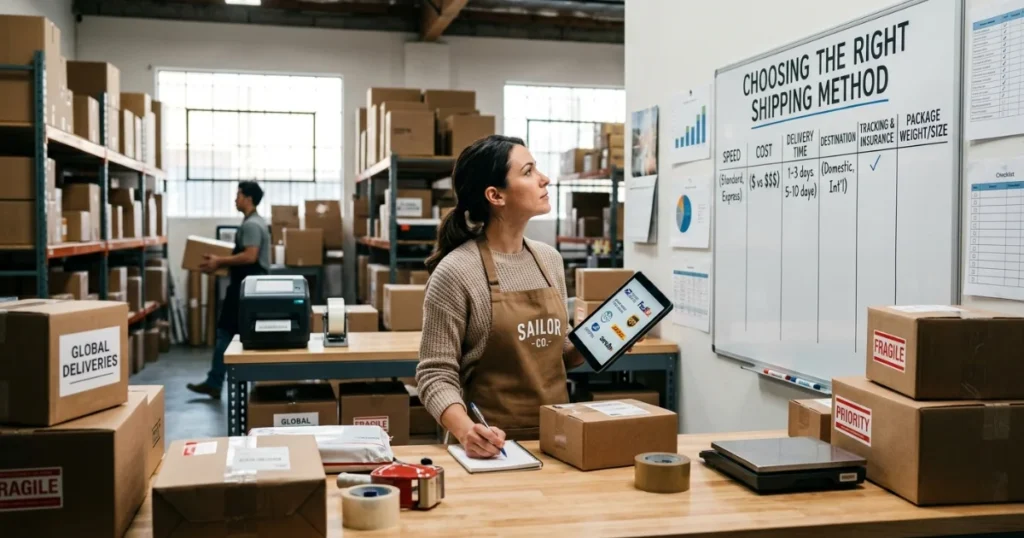
When it comes to Shipping from China to the USA, one of the first (and most important) decisions you’ll make is how your goods will actually travel across the world.
Think of it like choosing transportation for a trip. Do you take a plane for speed, a ship for affordability, or something in between?
In logistics, the right choice usually depends on three key factors:
- Budget – How much you’re willing to spend on freight
- Speed – How quickly you need the goods delivered
- Volume / Weight – How big or heavy your shipment is
Let’s break down the most common shipping options so you can pick the one that fits your business best.
⚡ A. Express Shipping (The Fastest Option)
If speed is your top priority, express shipping is the clear winner. Major carriers like DHL, FedEx, and UPS specialize in ultra-fast international deliveries.
This method is perfect for:
- Product samples
- Urgent documents
- Small parcels
- Dropshipping orders
📦 Transit time: Usually 3–5 days from China to most U.S. cities.
Real-life example:
Imagine you’re launching a new product on Amazon and need a few samples delivered quickly to test quality. Waiting a month for sea freight would be painful. Express shipping gets those samples to your door in just a few days.
Pros:
- Extremely fast delivery
- Door-to-door service
- Simple customs handling
Cons:
- The most expensive option
- Not ideal for heavy or bulk shipments
In short: speed comes at a price.
✈️ B. Air Freight (The Middle Ground)
If express shipping feels too expensive but sea freight feels too slow, air freight hits the sweet spot.
Air cargo is commonly used for:
- High-value goods (electronics, medical devices, fashion items)
- Medium-weight shipments
- Time-sensitive inventory restocks
📦 Transit time: Typically 7–10 days, depending on routes and customs clearance.
One interesting feature of air freight is cargo consolidation, which works a bit like shared shipping space. Freight forwarders combine multiple smaller shipments into one larger cargo load to reduce costs—similar to how LCL works in sea freight.
Example:
Let’s say your online store is running low on inventory before a major sales campaign. Waiting 30 days for ocean freight might mean losing thousands in sales. Air freight lets you restock quickly without paying the premium of express shipping.
Pros:
- Much faster than sea freight
- More affordable than express
- Reliable scheduling
Cons:
- Weight and size limits
- More expensive than ocean shipping
Globally, about 35% of trade value moves by air, even though it represents less than 1% of total cargo volume—showing just how important speed can be for certain products.
🚢 C. Sea Freight (The Economical Choice)
If you’re importing larger quantities, sea freight is usually the most cost-effective way of shipping from China to the USA.
There are two main options:
Full Container Load (FCL)
You rent the entire container for your goods. This is ideal for large shipments and provides better security and lower cost per unit.
Less than Container Load (LCL)
You share container space with other shippers. It’s perfect when your cargo doesn’t fill an entire container.
📦 Transit time: Typically 25–40 days, depending on port routes and congestion.
Real-life example:
A furniture importer shipping 20 cubic meters of goods from Shenzhen to Los Angeles would likely choose FCL or LCL sea freight because the cost savings compared to air freight could be thousands of dollars.
Pros:
- Lowest shipping cost per unit
- Ideal for large shipments
- Widely available routes
Cons:
- Slowest transit time
- Possible delays due to port congestion or customs inspections
But if your business plans inventory properly, sea freight can dramatically improve profit margins.
🚆 D. Rail Freight (The Niche Option)
Rail freight is a lesser-known option in global logistics. It’s faster than sea freight and cheaper than air, making it an interesting middle-ground solution.
However, there are a few limitations:
- Limited routes between China and the U.S.
- Often requires transshipment through Europe or other regions
- Vulnerable to geopolitical disruptions
Because of these constraints, rail freight remains a niche option for most businesses shipping between China and the United States.
Compare Shipping Options from China to the USA
The best shipping method depends on how much you’re sending, how quickly it needs to arrive, and where it needs to go. Here’s what to consider when comparing options:
| Shipping option | Best suited for | Details to provide when requesting a quote |
|---|---|---|
| Air freight | Shipments where delivery speed is a priority | Cargo type, package dimensions, gross weight, cargo-ready date, pickup city in China, and U.S. delivery ZIP code |
| Ocean freight: FCL | Cargo that needs a dedicated container | Container size, cargo-ready date, origin, and destination |
| Ocean freight: LCL | Smaller shipments that can share container space | Number of packages, total volume, gross weight, cargo-ready date, and destination |
| Door-to-door shipping | Shipments that need coordinated transport from pickup through final delivery | Confirm which services are included, such as supplier pickup, export handling, customs coordination, and final delivery |
The right option depends on your cargo, shipment volume, delivery address, and priorities. To compare options, send us your cargo details, origin, destination, and required delivery date.
Explore China–USA freight services and request a quote
💡 Key Takeaway
Choosing the right method for Shipping from China to the USA isn’t about finding a “one-size-fits-all” solution. It’s about balancing speed, cost, and shipment size.
A simple rule of thumb many importers follow:
- Small & urgent → Express shipping
- Medium size & time-sensitive → Air freight
- Large volumes & budget-focused → Sea freight
Once you understand these options, the entire shipping process becomes far less intimidating—and a lot more strategic.
🌏 Why the China → USA Trade Lane Matters
The China–United States trade route is one of the busiest and most important shipping corridors in the world. Every year, hundreds of billions of dollars in goods move across the Pacific Ocean between these two economic powerhouses. For businesses, this trade lane isn’t just a route on the map—it’s a critical supply chain artery that keeps global commerce flowing.
📊 Massive Trade Volume and Economic Importance
China has long been one of the largest trading partners of the United States, supplying everything from everyday consumer products to industrial components. Likewise, American demand fuels a massive export ecosystem across China’s manufacturing hubs.
This steady flow of goods supports millions of businesses—from multinational retailers to small e-commerce sellers importing their first batch of products. In fact, a huge percentage of items sold online in the U.S. originate from Chinese factories.
📦 What Goods Typically Travel This Route?
The China → USA shipping lane carries an enormous variety of products. Some of the most common cargo categories include:
- Consumer electronics – smartphones, accessories, and smart home devices
- Apparel and textiles – clothing, footwear, and fabrics
- Furniture and home goods – tables, chairs, décor, and kitchenware
- Machinery and industrial equipment – tools, components, and manufacturing parts
- Automotive parts – engines, electronics, and replacement components
These goods supply everything from major retail chains to small online businesses selling through platforms like Amazon or Shopify.
🚢 Why Ocean Freight Dominates the Route
While air cargo and express shipping play important roles, ocean freight remains the backbone of shipping from China to the USA. There are two main reasons:
1️⃣ Cost Efficiency
Shipping by sea offers the lowest cost per unit, especially for large shipments. A single container can carry tens of thousands of products, dramatically reducing transportation costs.
2️⃣ Massive Cargo Capacity
Modern container vessels can carry 20,000+ containers in a single voyage. This enormous capacity makes ocean freight the most practical option for moving high volumes of goods across the Pacific.
Because of these advantages, most businesses importing products—from furniture wholesalers to electronics brands—rely on container shipping (FCL or LCL) to keep their logistics costs under control.
💡 Key takeaway: The China–USA trade lane isn’t just busy—it’s essential to global commerce. Understanding how it works helps businesses ship smarter, control costs, and keep products moving efficiently across one of the world’s most important supply chains.
📉 The 2026 Tariff Picture: What’s Changed (And What Hasn’t)
If you shipped from China to the USA even six months ago, the tariff math has moved since then — and it keeps moving.
On February 20, 2026, the U.S. Supreme Court ruled that the President cannot use IEEPA (the law behind the “reciprocal tariff” regime) to impose tariffs — but the de minimis suspension has stayed in place regardless, so that $800 duty-free loophole many importers relied on is still closed for most shipments.
Then in July 2026, USTR added a new 12.5% Section 301 tariff on Chinese goods tied to forced-labor enforcement, effective July 24 — pushing the effective rate on many product categories up by roughly 2.5 percentage points overnight. Days later, China’s Commerce Ministry said Washington had privately committed to capping any further “replacement tariff” increases at 20%, suggesting there’s still room the rate could climb before it’s finished moving.
👉 What this means for you:
The headline duty rate on your product category today may not be the rate you’re quoted next quarter. If your freight forwarder gave you a landed-cost estimate more than a few weeks ago, it’s worth double-checking before you commit to a large order.
The practical takeaway:
- Build a tariff buffer into your pricing — don’t assume this quarter’s rate holds
- Get your HTS code verified now, since Section 301 actions apply differently by product category
- Work with a forwarder who’s actively tracking USTR announcements, not just quoting last month’s numbers
Tariff rates change frequently — always confirm current rates with your freight forwarder or customs broker before shipping.
⚓ Major Origin Ports in China
When planning shipping from China to the USA, choosing the right port of origin can make a big difference in cost, transit time, and logistics efficiency. China has dozens of international ports, but a few major hubs handle the majority of exports to the United States.
Here are some of the most important ones and what they’re best known for:
🌆 Port of Shanghai
The Port of Shanghai is the busiest container port in the world and a major gateway for manufacturers in the Yangtze River Delta, one of China’s most powerful industrial regions.
This port handles a massive volume of goods—from electronics and machinery to consumer products. Because of its advanced infrastructure and high shipping frequency, exporters benefit from regular sailings and efficient logistics connections.
Best for:
- High-volume shipments
- Machinery, electronics, and industrial goods
- Factories located in eastern China (Shanghai, Suzhou, Hangzhou)
⚡ Port of Shenzhen
Located in southern China, the Port of Shenzhen is a key export hub for the Pearl River Delta, one of the world’s largest electronics manufacturing regions.
Major terminals like Yantian and Shekou process huge volumes of consumer electronics, gadgets, and fast-moving consumer goods (FMCG). Because of its proximity to major tech factories, Shenzhen is a favorite origin point for many e-commerce shipments heading to the United States.
Best for:
- Electronics and technology products
- E-commerce and Amazon sellers
- Suppliers in Shenzhen, Dongguan, and nearby manufacturing zones
🚢 Port of Ningbo-Zhoushan
Just south of Shanghai, the Port of Ningbo-Zhoushan has become one of the largest cargo ports in the world. It’s known for handling massive cargo volumes efficiently, making it a popular alternative when Shanghai is congested.
Many exporters use Ningbo for mixed cargo shipments, large container loads, and heavy industrial goods.
Best for:
- Large export volumes
- Bulk and industrial cargo
- Suppliers located in Zhejiang and surrounding provinces
🌐 Other Important Export Ports
While the ports above dominate international trade routes, several other Chinese ports are commonly used depending on the factory location:
- Port of Qingdao – A key northern export hub, ideal for factories in Shandong and northern China. Often used for machinery, tires, and agricultural equipment.
- Port of Guangzhou – A major port in southern China handling consumer goods, textiles, and industrial products from the Guangdong manufacturing region.
- Feeder Ports – Smaller regional ports sometimes connect shipments to larger hubs like Shanghai or Shenzhen. These are useful when factories are located far from major coastal cities.
💡 Pro Tip:
The best port isn’t always the biggest one—it’s the one closest to your supplier and connected to the most efficient shipping route. Choosing the right origin port can reduce trucking costs, avoid port congestion, and shorten your overall transit time when shipping from China to the USA.
🇺🇸 Major Destination Ports in the USA
When planning shipping from China to the USA, the destination port plays a big role in transit time, inland delivery cost, and supply chain efficiency. The United States has several major container ports, but a handful handle most of the cargo arriving from Asia.
Here are the key entry points importers typically use:
🌴 Port of Los Angeles
The Port of Los Angeles is the busiest container port in the United States and the primary West Coast gateway for trade with Asia. Because of its location and massive infrastructure, it handles a huge share of cargo coming from China.
Many retailers and e-commerce companies prefer this port because it provides fast Pacific Ocean transit times and strong connections to rail and trucking networks across the country.
Best for:
- Fastest shipping from China to the U.S. West Coast
- Large-volume container imports
- Distribution to western and central U.S. markets
🚢 Port of Long Beach
Right next door to Los Angeles, the Port of Long Beach forms one of the largest shipping complexes in the world together with the Port of LA. Many vessels arriving from China call at both ports during the same voyage.
Long Beach is known for its advanced cargo terminals and efficient container handling, making it a key hub for major retailers and global supply chains.
Best for:
- High-volume imports from Asia
- Retail and consumer goods shipments
- Logistics networks serving California and the western U.S.
🗽 Port of New York and New Jersey
On the East Coast, the Port of New York and New Jersey is the largest and most important container port. Many shipments from China reach this port via the Panama Canal or Suez Canal routes.
It’s a major entry point for goods destined for the Northeast and Midwest, including large population centers like New York, Philadelphia, and Chicago.
Best for:
- Importers serving the Northeast U.S.
- Distribution to major consumer markets
- Apparel, electronics, and retail products
🌿 Port of Savannah
The Port of Savannah has become one of the fastest-growing container ports in the United States. Thanks to its deep harbor and large container terminals, it handles a rising volume of Asian imports.
Savannah is especially attractive for businesses distributing goods throughout the Southeastern United States.
Best for:
- E-commerce distribution centers
- Retail supply chains in the Southeast
- High container capacity and modern facilities
⚙️ Port of Houston and Gulf Ports
The Port of Houston is the largest container port along the U.S. Gulf Coast. While it handles less Asian cargo than West Coast ports, it’s extremely useful for serving the central United States.
Because of its location and strong rail and trucking connections, Houston is a strategic entry point for goods heading into Texas, the Midwest, and inland distribution hubs.
Best for:
- Industrial cargo and machinery
- Distribution to central U.S. markets
- Businesses with warehouses in Texas or nearby states
💡 Pro Tip:
Choosing the right destination port can significantly impact shipping cost and delivery time. For example:
- West Coast ports (Los Angeles / Long Beach) → faster transit from China.
- East Coast ports (New York / Savannah) → closer to eastern U.S. consumers but slightly longer ocean routes.
Smart importers often choose the port based on where their final customers or warehouses are located, reducing inland trucking costs and speeding up delivery.
🧭 Typical Routes & Transit Times
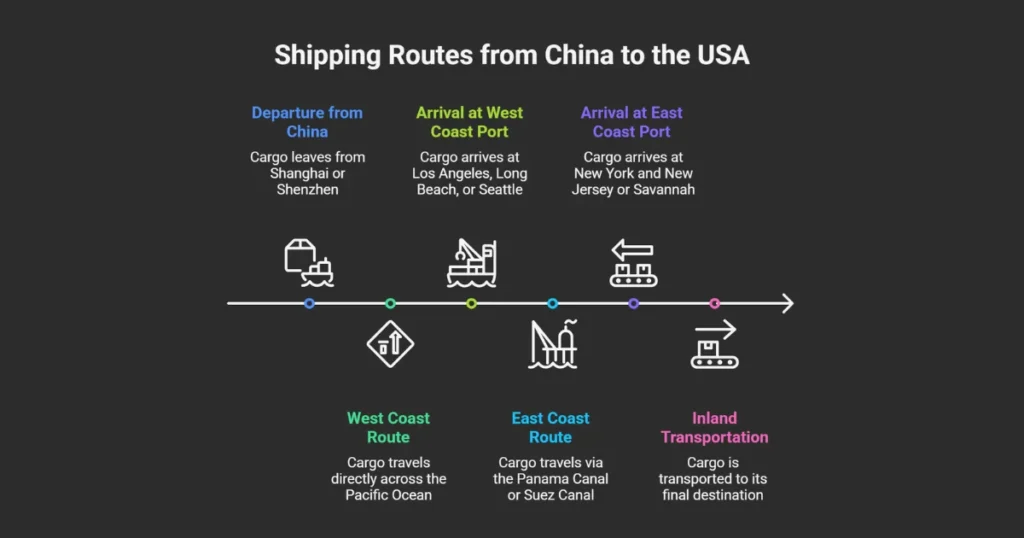
When planning shipping from China to the USA, understanding the typical routes and transit times helps you set realistic expectations for delivery. While shipping schedules can vary, most ocean freight follows two main paths: direct transpacific routes to the West Coast or longer routes to the East Coast via canals or transshipment hubs.
Let’s break it down in practical terms.
🌊 West Coast Routes (Direct Transpacific)
The fastest ocean route between China and the U.S. usually crosses the Pacific Ocean directly.
Typical route:
- Port of Shanghai or Port of Shenzhen
➡️ Port of Los Angeles, Port of Long Beach, or Port of Seattle
📦 Typical transit time:
~11–36 days port-to-port, depending on the carrier, vessel schedule, and whether the route is direct or has intermediate stops.
💡 Why it’s popular:
- Shortest ocean distance between Asia and North America
- High frequency of weekly sailings
- Ideal for importers serving West Coast or central U.S. markets
Example:
An electronics importer shipping goods from Shenzhen to Los Angeles via a direct vessel might see a 14–18 day ocean transit, making it one of the fastest large-scale shipping routes in global trade.
🚢 East Coast Routes (Via Canal or Transshipment)
If your final destination is on the East Coast, the cargo usually travels farther—either through the Panama Canal, the Suez Canal, or via a transshipment hub.
Typical route:
- Port of Shanghai or Port of Shenzhen
➡️ Port of New York and New Jersey or Port of Savannah
📦 Typical transit time:
~30–45+ days door-to-door, depending on port stops, canal transit schedules, and customs processing.
💡 Why companies still choose this route:
Even though the ocean journey is longer, shipping directly to the East Coast can reduce inland trucking or rail costs if your customers are located in the eastern United States.
⚠️ Why Transit Times Can Vary
Even the most carefully planned shipment can experience delays. Transit times often change because of factors such as:
- Carrier service type – direct sailings vs. transshipment routes
- Canal transit delays – especially at the Panama Canal
- Seasonal port congestion – peak shipping seasons can slow operations
- Weather conditions or route changes
- Customs inspections or documentation issues
For example, during peak retail seasons like Q3–Q4 holiday imports, transit times can increase by several days or even weeks due to vessel backlogs at major ports.
💡 Key takeaway:
For speed, West Coast routes are usually the fastest.
For logistics efficiency closer to eastern markets, East Coast routes can still be the smarter choice despite longer ocean transit times.
Smart importers plan shipments 3–4 weeks ahead and work with experienced freight forwarders to choose the best route based on cost, timing, and final delivery location.
📦 Shipping from China to the USA: Step-by-Step Process
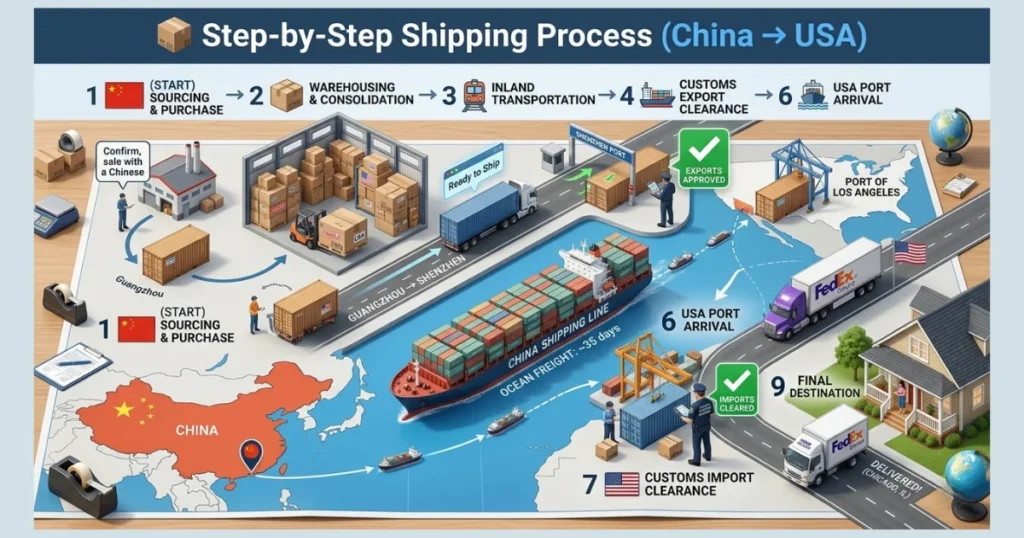
If you’re new to shipping from China to the USA, the whole process can feel like a giant puzzle. Containers, customs forms, freight bookings—where do you even start?
Good news: once you see the process step by step, it’s actually pretty straightforward. Think of it like a relay race where different logistics partners pass the baton until your goods finally reach your warehouse.
Let’s walk through the journey together.
1️⃣ Production & Quality Control
Everything begins at the factory. Your supplier manufactures the goods, packages them, and prepares them for export.
Before shipping, it’s smart to conduct a quality inspection. Many importers hire third-party inspectors to check product quality, packaging, labeling, and quantity.
💡 Why this matters:
Fixing a problem in China is easy. Fixing it after the goods arrive in the U.S. can cost thousands.
Example:
An e-commerce seller ordering 2,000 phone accessories might spend about $200–$300 on a pre-shipment inspection, potentially preventing a costly defective batch from being shipped.
2️⃣ Booking the Freight
Once your goods are ready, the next step is booking transportation.
Most businesses work with a freight forwarder who coordinates the shipping process. They help you choose the best method (air, sea, or express) and reserve space on a carrier.
Your shipment might leave from ports like Port of Shenzhen, Port of Shanghai, or Port of Ningbo-Zhoushan.
Think of the forwarder as the travel agent of international cargo—they handle schedules, paperwork, and coordination so you don’t have to.
3️⃣ Trucking to the Port
Next, the goods need to move from the factory to the export port. This is usually done by local trucking companies.
The cargo is packed into cartons, pallets, or containers and transported to the port terminal.
💡 Tip:
Factories located near major ports can save significant trucking costs. For example, a supplier in Shenzhen can ship to port much cheaper than a factory hundreds of kilometers inland.
4️⃣ Export Customs Clearance (China)
Before leaving China, shipments must pass export customs clearance.
The freight forwarder or exporter submits documents such as:
- Commercial invoice
- Packing list
- Export declaration
Once approved, the cargo is cleared for departure and officially leaves China.
5️⃣ The Voyage
Now the exciting part—the journey across the ocean (or sky).
If you’re using ocean freight, your container boards a massive cargo vessel heading to the United States. Popular destinations include Port of Los Angeles, Port of Long Beach, or Port of New York and New Jersey.
📦 Typical transit times:
- Sea freight to the West Coast: ~15–30 days
- Sea freight to the East Coast: ~30–45 days
- Air freight: ~7–10 days
Fun fact: modern container ships can carry over 20,000 containers at once—basically floating cities of cargo.
6️⃣ U.S. Customs Clearance
Once the shipment arrives in the United States, it must pass inspection by U.S. Customs and Border Protection.
Customs reviews documentation and may check the cargo to ensure it complies with U.S. regulations.
Importers usually work with a customs broker who handles:
- Import declarations
- Duty and tax calculations
- Compliance checks
If everything is correct, the shipment gets the green light.
7️⃣ Destination Handling
After clearing customs, the container is unloaded at the port terminal.
This stage includes:
- Container unloading
- Storage at the terminal
- Preparing the shipment for pickup
At major ports like Los Angeles or New York, thousands of containers move through terminals daily—so efficient handling is crucial to keep cargo flowing.
8️⃣ Final Delivery
Finally, your goods travel to their final destination.
This could involve:
- Truck delivery to your warehouse
- Rail transport for inland destinations
- Delivery to an Amazon FBA fulfillment center
For example, a shipment arriving in Los Angeles might be placed on a freight train heading to Chicago before final truck delivery.
🚀 The Big Picture
While shipping from China to the USA involves several stages, the process follows a predictable path:
Factory → Port → Ocean/Air Transit → U.S. Customs → Local Delivery
Once you understand this journey, importing goods becomes far less intimidating—and much more manageable.
And with the right freight forwarder guiding you through each step, the entire process can run smoothly from start to finish.
📑 Essential Documents & Compliance Notes
When it comes to shipping from China to the USA, paperwork is just as important as the cargo itself. You could have the best products, perfect packaging, and a great freight rate—but if the documents are wrong, your shipment could sit at the port for days (or weeks). And trust me, port storage fees are not cheap.
So let’s break down the essential documents and compliance basics you need to know before your shipment arrives in the U.S.
📜 The Basics: What Is a Customs Bond?
Before importing goods into the United States, most importers need a customs bond.
A customs bond is essentially a financial guarantee to the U.S. government that all duties, taxes, and regulations will be properly paid and followed.
The bond is required by U.S. Customs and Border Protection for most commercial imports.
There are two common types:
- Single Entry Bond – covers one shipment only
- Continuous Bond – covers unlimited shipments for one year
💡 Pro Tip:
If you import regularly, a continuous bond is usually much cheaper in the long run.
📄 The Paperwork You Absolutely Need
Think of shipping documents as the passport for your cargo. Without them, your shipment simply cannot move through customs.
Here are the key ones.
Commercial Invoice (The Most Important Document)
The commercial invoice is the backbone of the entire import process. It tells customs what the shipment is, who is buying it, and how much it’s worth.
It must include:
- Product description
- Quantity
- Unit price and total value
- Country of origin
- Seller and buyer details
💡 Why accuracy matters:
If the value or product description doesn’t match the cargo, customs may flag the shipment for inspection.
Packing List
A packing list provides the physical breakdown of the shipment.
It includes:
- Number of cartons
- Dimensions and weight
- Packaging details
- Item distribution per box
This document helps customs officers, warehouse staff, and logistics teams locate and verify cargo quickly.
Bill of Lading (BOL) or Air Waybill (AWB)
The Bill of Lading (BOL) is issued for ocean freight, while the Air Waybill (AWB) is used for air shipments.
These documents act as:
- A receipt for the cargo
- A contract of carriage
- A document of title
In simple terms, it’s the official record that proves the carrier has received and is transporting your goods.
💰 Duties and Taxes: How They’re Calculated
Import duties aren’t random—they’re determined by a classification system called the Harmonized Tariff Schedule.
Every product receives an HTS code, which defines:
- Duty rate
- Import restrictions
- Regulatory requirements
For example:
- Some electronics may have low or zero duty.
- Certain textiles or footwear can carry higher tariffs.
💡 Important:
Choosing the wrong HTS code can result in penalties or delayed shipments.
U.S. Import Duties and Customs
U.S. import duties and entry requirements depend on factors such as the product, its customs value, country of origin, and applicable trade measures. The former de minimis duty-free treatment for shipments valued at $800 or less has been suspended for most imports, although exceptions may apply.
Do not split shipments to avoid duties. Before booking, ask a licensed U.S. customs broker to confirm the applicable duties, documents, and entry requirements for your goods. The importer remains responsible for the accuracy of the customs entry and applicable charges, even when working with a broker.
Check current CBP guidance or consult a licensed customs broker for shipment-specific advice.
🚫 Restricted & Prohibited Items
Not everything can be imported freely into the United States. Some items are restricted or require special permits.
Examples include:
- Certain pharmaceuticals and medical devices
- Agricultural products
- Weapons or defense-related equipment
- Counterfeit goods
- Hazardous materials
Many regulated products must be approved by agencies such as U.S. Food and Drug Administration or other federal authorities before entering the country.
If you’re unsure about your product category, it’s always best to check with a customs broker or freight forwarder first.
✅ The Key Takeaway
Successful shipping from China to the USA isn’t just about moving cargo—it’s about getting the documentation right.
The winning formula is simple:
✔ Accurate invoices
✔ Correct HTS classification
✔ Proper shipping documents
✔ Compliance with U.S. import regulations
When all these pieces are in place, your shipment moves through customs faster, avoids costly delays, and reaches your warehouse exactly when you need it.
💸 Understanding the True Cost of Shipping
If you’re shipping from China to the USA, the freight quote you get is only the start. The “sticker price” covers the basic transport — but the true landed cost includes a stack of other charges and rules that can quickly add up. Let’s break it down so you stop getting surprised by invoices.
1) The Basic Freight Cost — How Carriers Price It
Carriers price shipments using either actual weight or volumetric (dimensional) weight — whichever is greater. That determines the chargeable weight.
Volumetric weight (air freight) formula (common industry standard):Volumetric weight (kg) = (Length cm × Width cm × Height cm) ÷ 6000
Quick example: a box 50 × 40 × 30 cm = 60,000 cm³ → 60,000 ÷ 6000 = 10 kg volumetric weight.
If the box actually weighs 5 kg, the carrier will charge you for 10 kg because of the space it consumes.
Note: Air freight uses volumetric rules most aggressively. Ocean FCL pricing is per container (flat per 20ft/40ft), while LCL is charged per CBM (cubic meter), so volume matters much more there.
2) Hidden Fees to Watch Out For
Below are the common extras that often turn a “good” quote into a costly one — know them, and you can negotiate or avoid some.
- Fuel Surcharges (BAF / Bunker) — Adjusted with global oil prices; carriers tack this on monthly or quarterly.
- Peak Season Surcharges (PSS) — Extra fees charged during high-demand windows (e.g., pre-holiday spikes like Chinese New Year, Q4).
- Origin Handling Charges — Terminal handling, documentation, and local trucking costs at the Chinese origin port/airport.
- Destination Handling Charges — Terminal handling, port fees, documentation, and local delivery costs in the U.S.
- Terminal Handling Charge (THC) — Port/terminal fee for moving containers on/off the vessel.
- Security & Filing Fees (AMS / ISF / e.g., importer filings) — Mandatory pre-arrival filings and administration fees for U.S. Customs.
- Customs Duties & Taxes — Based on HTS classification and declared value; don’t forget VAT/GST where applicable for other countries.
- Demurrage & Detention — Penalties if you don’t pick up a container on time (demurrage) or return the empty container late (detention). These escalate daily.
- Documentation Fees & Broker Fees — Customs broker, release, and paperwork handling charges.
- Currency / CAF — Adjustments for exchange rate fluctuations.
Tip: Always ask for an all-in, landed-cost quote (or a clear line-item quote) so you can compare apples to apples.
3) Incoterms — Who Pays For What?
Your chosen Incoterm decides where costs and risks transfer between buyer and seller. Here are three crucial ones:
- EXW (Ex Works)
- Seller’s responsibility: Make goods available at their premises.
- Buyer’s responsibility: Everything else — export, freight, import, duties.
- When to use: You want full control of the shipment (and the headache of arranging everything).
- FOB (Free On Board)
- Seller’s responsibility: Deliver goods, cleared for export, onto the vessel at the agreed Chinese port.
- Buyer’s responsibility: Main carriage (ocean/air), insurance, and import.
- When to use: Common, and gives the buyer control of shipping and price negotiation.
- DDP (Delivered Duty Paid)
- Seller’s responsibility: Takes care of everything — transport, duties, taxes, delivery to your door.
- Buyer’s responsibility: Receives the goods.
- When to use: Hands-off approach; convenient but usually the most expensive option.
Rule of thumb: If you want to control freight costs and carrier selection, prefer FOB over CIF/DDP. If you want simplicity and are willing to pay for it, DDP is the hands-off choice.
4) Quick Strategies to Lower the True Cost
- Optimize package dimensions to reduce dimensional weight charges.
- Consolidate shipments to full containers (FCL) where possible — FCL lowers cost per unit.
- Book off-peak or lock in long-term contracts to stabilize rates.
- Negotiate all-inclusive quotes (break down BAF, THC, PSS, documentation fees).
- Choose the right Incoterm for your level of control and risk appetite (FOB for control, DDP for convenience).
- Pre-clear documentation and submit ISF/AMS early to avoid release delays and demurrage.
- Plan container returns and unloading windows to avoid detention/demurrage.
- Work with a trusted forwarder and customs broker who will spot hidden fees and optimize routing.
A low headline freight rate can be a false economy. The smartest importers look at chargeable weight, hidden surcharges, Incoterm responsibilities, and the full landed cost — then make logistics decisions that reduce total landed cost, not just the headline number.
⚠️ Common Pitfalls in Shipping — and How to Avoid Them
Let’s be honest—shipping from China to the USA isn’t just about booking a container and waiting for it to arrive. Even experienced importers run into costly mistakes that lead to delays, damaged goods, or surprise charges.
The good news? Most of these problems are completely avoidable if you know what to watch out for.
Here are some of the most common pitfalls—and how smart importers avoid them.
🚢 Pitfall 1: Confusing a Customs Broker with a Freight Forwarder
Many first-time importers assume a customs broker and a freight forwarder are the same thing. They’re not.
A freight forwarder manages the transportation side of your shipment.
A customs broker handles the legal import process and customs clearance.
For example:
- Your freight forwarder arranges the vessel booking, trucking, and cargo handling.
- Your customs broker ensures your shipment clears U.S. Customs and Border Protection without issues.
💡 Best strategy:
Work with a logistics partner who can coordinate both services. This keeps communication smooth and avoids paperwork mistakes.
📦 Pitfall 2: Underinsuring Your Cargo
Many importers assume their cargo is fully protected during transport. Unfortunately, that’s not always the case.
Basic carrier liability often covers only a small fraction of the cargo value. Some low-cost insurance policies only pay out if the entire shipment is lost—known as “Total Loss Only” coverage.
That means if your cargo is damaged but not completely destroyed, you might receive nothing.
Better option:
Choose all-risk cargo insurance, which protects against:
- Damage during loading/unloading
- Water exposure during ocean transit
- Theft or handling accidents
Considering that global cargo damage rates can reach 5–10% of shipments, proper insurance is a small investment that can prevent major losses.
⏳ Pitfall 3: Delays at the Port (and Expensive Penalties)
Ports are busy ecosystems, and delays happen—especially during peak shipping seasons.
Two costly penalties importers should know about:
- Demurrage — fees for leaving containers too long at the port terminal
- Detention — fees for holding the carrier’s container outside the terminal
During peak seasons like Chinese New Year or pre-holiday retail surges, congestion can increase dramatically at ports like:
- Port of Los Angeles
- Port of Long Beach
💡 How to avoid this:
- Pre-book delivery trucking before arrival
- Submit customs documents early
- Track vessel arrival times carefully
Even one extra day at the port can add hundreds of dollars in penalties.
🌏 Pitfall 4: The Language Barrier
Let’s face it—communication challenges can easily derail international shipments.
Many Chinese factories operate primarily in Mandarin, while importers communicate in English. Misunderstandings can lead to:
- Incorrect product descriptions on invoices
- Wrong packaging or labeling
- Delays in documentation processing
This is why having a freight forwarder who understands both languages and both business cultures is incredibly valuable.
A good logistics partner acts as a translator, negotiator, and problem-solver, preventing small miscommunications from becoming expensive mistakes.
🚧 Pitfall 5: Port Congestion & Equipment Shortages
Global shipping disruptions sometimes cause shortages of:
- Containers
- Truck chassis
- Port storage space
When that happens, shipments may sit waiting for equipment availability.
Smart importers reduce risk by:
- Booking freight weeks in advance
- Allowing flexible pickup windows
- Choosing alternative ports when necessary
For example, if West Coast ports are congested, some shippers route cargo to East Coast gateways like Port of Savannah.
📑 Pitfall 6: Customs Compliance Issues
Nothing slows down shipping from China to the USA faster than paperwork errors.
Common problems include:
- Incorrect product descriptions
- Wrong tariff classifications
- Inaccurate shipment values
These mistakes can trigger inspections or even customs audits.
Working with an experienced broker helps ensure your documents comply with regulations from agencies like U.S. Customs and Border Protection.
✅ The Bottom Line
International logistics can seem complicated, but most problems come down to planning and communication.
Successful importers focus on three key things:
✔ Work with experienced freight forwarders and customs brokers
✔ Insure cargo properly
✔ Prepare documents early and plan for peak-season delays
Follow these principles, and shipping from China to the USA becomes far smoother, faster, and far less stressful.
⚡ Cost-Saving & Speed-Up Playbook (Practical Tips)
If you want to cut shipping costs and get goods to market faster when China → United States, treat logistics like a series of small, smart decisions stacked together. Below are battle-tested, practical moves you can start using today.
1. Consolidate Purchases to Maximize Container Utilization
- Why: A fuller container = lower cost per unit. Half-empty boxes waste money.
- How: Pool multiple POs into one FCL (or use a consolidation service near the supplier).
- Impact: Smart consolidation commonly cuts freight cost per unit 10–25% vs. frequent small shipments.
2. Pick the Right Port of Origin (match supplier → port)
- South China (fast electronics/FMCG) — e.g., Port of Shenzhen — best when suppliers are in the Pearl River Delta.
- East China (Yangtze Delta manufacturing) — e.g., Port of Shanghai — high frequency, slightly higher handling fees.
- North China (heavy industry, bulk goods) — e.g., Port of Qingdao — cost-effective for northern factories.
- Tip: Choose the closest major port to your supplier to reduce inland trucking (drayage) costs and pickup delays.
3. Book Early & Negotiate Longer Contracts
- When: Book 3–4 weeks ahead in normal times; earlier before peak seasons.
- How: Negotiate annual or quarterly service contracts with carriers/forwarders to lock better rates and priority space.
- Why it helps: Locks out last-minute premiums (Peak Season Surcharges) and secures capacity during crunches.
4. Compare Multiple Forwarders — Don’t Chase Only the Lowest Base Rate
- What to compare: All-in landed cost, not just base ocean/air rate — include THC, documentation, fuel surcharges, and local delivery.
- Ask for: Line-item quotes and estimated demurrage/detention terms so you can compare apples to apples.
- Pro tip: Use at least 3 forwarder quotes and ask each how they handle delays or equipment shortages.
5. Use Pre-Clearance & Express Lanes Where Available
- How: File import filings (ISF/AMS equivalents) early and use ports or terminals that offer express release.
- Benefit: Faster release from the terminal reduces demurrage risk and speeds final delivery.
- Note: Requirements vary by port and carrier — your broker/forwarder should handle the filings.
6. Optimize Packaging & Palletization (Cube = Cash)
- Redesign cartons to reduce empty space; standardize pallet sizes to avoid gaps.
- Stack smart: Pack to container height when safe, use stretch wrap and dunnage to prevent movement.
- Result: Higher CBM utilization → fewer containers over time → big savings.
7. Consider Intermodal Options for Cost/Time Tradeoffs
- Example: Sea → West Coast port → rail to inland hubs (cheaper than coast-to-coast truck; faster than coast-to-coast sea).
- When it works: For shipments headed to the U.S. interior (Chicago, Dallas, Atlanta), intermodal often lowers total landed cost with modest time savings.
- Caveat: Check rail schedules and potential congestion for seasonal peaks.
8. Avoid Penalties: Pre-plan for Demurrage & Detention
- Negotiate extended free days on the booking if possible.
- Pre-arrange pickup trucks and warehouse space so empties return promptly.
- Monitor ETAs and have contingency plans for port congestion.
9. Smart Insurance & Risk Management
- Insure to value (all-risk) for high-value shipments; for repetitive small parcels, compare bundled policies.
- Document photos at stuffing/hand-over help speed claims and reduce disputes.
Mini Checklist (Before You Confirm Booking)
- Consolidate POs where possible ✅
- Confirm nearest cost-effective origin port ✅
- Get 3+ all-in quotes from forwarders ✅
- Book 3–4 weeks ahead (more in peak) ✅
- File required pre-clearance docs early ✅
- Plan inland pickup & empty return windows ✅
🛡️ Insurance, Claims & Cargo Security
When it comes to international logistics, one truth stands out: things don’t always go as planned. Containers get damaged in rough seas, boxes fall during loading, and sometimes shipments simply go missing.
That’s why smart importers treat insurance and cargo security as essential parts of shipping from China to the USA, not optional extras.
Let’s break down how to protect your cargo—and what to do if something goes wrong.
🚢 Why Marine Cargo Insurance Matters
Many importers assume the carrier automatically covers their goods during transport. Unfortunately, carrier liability is extremely limited.
In ocean freight, compensation may be calculated based on weight rather than cargo value. This means a container of expensive electronics could receive only a fraction of its real value if damaged.
Marine cargo insurance fills that gap.
There are two main types of coverage:
All-Risk Insurance (Recommended)
All-risk insurance provides the broadest protection and covers most unexpected events during transit, such as:
- Handling damage during loading or unloading
- Water damage from leaks or storms
- Theft or cargo misplacement
- Accidents during trucking or port handling
This is the most popular choice for companies regularly shipping from China to the USA, especially when dealing with high-value products.
Named Perils Insurance
Named perils insurance covers only specific events listed in the policy, such as:
- Ship sinking
- Fire
- Vessel collision
If the cause of damage isn’t listed, the claim may be rejected.
💡 Bottom line:
Named-perils policies are cheaper but far riskier. Most experienced importers choose all-risk coverage for peace of mind.
📸 How to File a Cargo Damage or Loss Claim
If your cargo arrives damaged or missing, documentation is everything. Insurance providers will require evidence before approving a claim.
Here’s the typical process.
Step 1: Inspect Cargo Immediately
As soon as the shipment arrives, inspect the goods before signing the delivery receipt.
Look for:
- Damaged cartons or pallets
- Wet packaging
- Broken seals or tampering
If you notice damage, note it on the delivery receipt immediately.
Step 2: Document Everything
Take clear photos of:
- The damaged packaging
- Individual damaged products
- Container numbers and seal numbers
Also collect supporting documents such as:
- Weight certificates
- Packing lists
- Bills of lading
These records help verify the claim.
Step 3: Notify the Carrier and Insurance Provider
Report the issue as soon as possible to:
- The freight forwarder
- The carrier
- The insurance company
Most insurance policies require claims to be filed within a specific time window after delivery.
Step 4: Submit Claim Documentation
Your claim usually includes:
- Commercial invoice
- Packing list
- Bill of lading
- Photos of damage
- Inspection report
Once submitted, the insurer reviews the claim and determines compensation.
🔐 Cargo Security Best Practices
Beyond insurance, prevention is the best protection. Many cargo losses occur because of poor security practices.
Here are simple but powerful steps to keep shipments safe.
Use High-Security Container Seals
Containers should always be sealed with tamper-proof security seals before leaving the origin warehouse.
If the seal number doesn’t match the shipping documents when the container arrives, it’s a red flag.
Add Tamper Indicators
Extra measures like tamper-evident tape or labels help detect unauthorized access during transit.
This is particularly useful for high-value cargo such as electronics or branded goods.
Work with Trusted Warehouses
Cargo should be stored and handled at reputable warehouses and terminals.
Major logistics hubs like:
- Port of Shanghai
- Port of Los Angeles
use advanced security monitoring, but smaller facilities may vary in safety standards.
Working with reliable logistics partners significantly reduces the risk of theft or mishandling.
✅ The Key Takeaway
Successful shipping from China to the USA isn’t just about speed or cost—it’s also about protecting your cargo.
The smartest importers follow three rules:
✔ Always insure valuable shipments
✔ Document everything during transit and delivery
✔ Use strong security measures to prevent loss or tampering
With these protections in place, your cargo journey becomes far safer—and far less stressful.
Frequently Asked Questions (FAQ)
How long does shipping take from China to the USA?
Sea freight to the West Coast takes about 15–30 days; to the East Coast, 30–45 days. Air freight typically takes 7–10 days, and express shipping (DHL/FedEx/UPS) takes 3–5 days.
What is the cheapest way to ship from China to the USA?
Sea freight (FCL or LCL) is the most cost-effective option, especially for large or heavy shipments. LCL is cheaper if you’re not filling a full container.
Do you provide door-to-door shipping from China to the USA?
Yes — we handle everything from factory pickup in China through customs clearance to final delivery at your U.S. warehouse or Amazon FBA fulfillment center.
What documents do I need to import from China to the USA?
At minimum: a commercial invoice, packing list, and bill of lading or air waybill, plus a correct HTS code for customs. Our team reviews your documents before shipment to catch errors early.
What logistics services do you need for shipping from China to the USA?
A complete China-to-USA shipment typically involves freight (ocean or air), customs clearance, and last-mile delivery. Depending on your business, you may also need warehousing, Amazon FBA prep, or LC support for supplier payments. FR Logistics handles the full chain, so you can see our full range of China-to-USA logistics services → rather than coordinating separate vendors.
How long does China to USA logistics take door-to-door?
Ocean freight typically takes 25–40 days door-to-door, depending on the origin port and destination. Air freight is much faster, usually 5–10 days door-to-door. The right choice depends on your budget and how urgently you need the goods.
Do you handle customs clearance and tariffs?
Yes. Every US-bound shipment requires ISF 10+2 filing at least 24 hours before the cargo is loaded, along with standard CBP compliance documentation. Tariff exposure — including Section 301 duties on certain Chinese-origin goods — depends on your product’s HTS code, so it’s worth checking this before you ship, not after.
How much does shipping from China to the USA cost?
Cost depends on shipping mode (ocean vs air), cargo weight/volume, and origin port. Ocean freight is more economical for large or heavy shipments, while air freight costs more per kg but saves weeks of transit time. Because rates fluctuate with fuel surcharges and seasonal demand, request a quote for an accurate number based on your shipment.
What’s the difference between ocean freight and air freight from China to the USA?
Ocean freight is the standard choice for bulk and non-urgent cargo — lower cost per unit, longer transit time. Air freight costs more but cuts transit time from weeks to days, making it better for time-sensitive, high-value, or smaller shipments. Most importers use ocean for regular restocking and air for urgent gaps.
Can you ship directly to Amazon FBA warehouses?
Yes. FR Logistics prepares and ships cargo directly to Amazon FBA warehouses, handling labeling, packaging requirements, and delivery scheduling so your inventory is FBA-compliant on arrival. See our Amazon FBA and logistics services → for details.
Can I get a fast shipping quote?
Yes — contact us by phone or WhatsApp, and we’ll get you a detailed quote within 10 minutes.
🚀 Conclusion & Next Steps
Shipping internationally may seem complicated at first, but once you understand the key pieces, the process becomes much easier to manage. When planning shipping from China to the USA, the real success comes down to three things: choosing the right ports, planning the timing carefully, and working with reliable logistics partners.
Start by selecting the most efficient origin and destination ports for your supply chain. Major gateways like Port of Shanghai or Port of Shenzhen in China and Port of Los Angeles or Port of New York and New Jersey in the U.S. handle enormous cargo volumes and offer frequent shipping schedules. Choosing the right route can reduce both transit time and costs.
Equally important is planning your documentation and customs compliance early. Accurate paperwork, correct product classifications, and early customs preparation can prevent delays, extra fees, or unexpected inspections.
In short, successful importing isn’t just about moving cargo—it’s about smart planning, reliable partners, and proactive logistics management.
📦 Ready to Ship?
Need help with shipping from China to the USA?
Contact Fangrun Logistics for tailored freight quotes, expert routing advice, and reliable door-to-door logistics solutions designed for your business.