
“From electronics to garments, a huge portion of Bangladesh’s imports comes from China.”
No surprise there—if you’re running a business, sourcing from China is often the smartest (and sometimes the only) option.
But here’s the catch… shipping from China to Bangladesh isn’t always smooth sailing.
You’ve probably heard the horror stories (or lived them yourself):
- Containers stuck at Port of Chittagong for days (or weeks 😬)
- Confusing customs rules that feel like decoding a secret language
- Monsoon season delays that test your patience and your cash flow
- Unexpected penalties just because of a tiny documentation mistake
Yeah… it can get frustrating fast.
The good news? It doesn’t have to be this way.
Once you understand the system—and more importantly, how to work with it instead of against it—everything becomes much easier. Choosing the right shipping method, planning ahead, and staying compliant with regulations from authorities like the National Board of Revenue (NBR) can literally save you thousands of dollars and weeks of delay.
Think of this guide as your shortcut.
By the end, you’ll clearly understand:
- How to choose the best shipping method for your cargo (air, sea, FCL, LCL)
- How to calculate the real cost (not just the quote you see upfront)
- How to prepare error-free documents that pass customs smoothly
- And how to avoid the most common (and expensive) mistakes importers make
So whether you’re importing for the first time or trying to optimize your logistics like a pro, this guide will help you ship smarter, faster, and with way less stress.
Shipping from China to Bangladesh?
✔ Door-to-Door Delivery (DDP Available)
✔ Fast Customs Clearance
✔ Best Rates for Importers⏱ Get Exact Shipping Cost in 10 Minutes
Weekly Shipments Available – Limited Slots – Contact Now
Trusted by Bangladesh importers for reliable China sourcing & shipping
Table of Contents
🚚 Choosing the Right Shipping Method (China → Bangladesh)
Alright, let’s make this simple—because this is where most importers either save big money… or accidentally burn it.
When it comes to shipping from China to Bangladesh, your choice of method really comes down to three things:
👉 Budget (how much you’re willing to spend)
👉 Urgency (how fast you need it)
👉 Cargo Type (bulk goods vs. small, high-value items)
Think of it like ordering food—sometimes you need fast delivery, sometimes you’re okay waiting if it’s cheaper. Same logic applies here.
✈️ A. International Courier / Air Express (The Fastest Option)
If speed is everything, this is your go-to.
Best for:
- Documents
- Product samples
- E-commerce parcels
- Urgent small shipments
Most express shipments go straight to Hazrat Shahjalal International Airport.
Transit Time: 3–7 days
Cost: High (calculated using volumetric weight)
Real-life scenario:
Let’s say you’re testing a new product and need samples ASAP. Waiting 20 days isn’t an option—you need them this week. Air express saves the day.
Pros:
✔ Lightning-fast delivery
✔ Door-to-door convenience
✔ Minimal paperwork headaches
Cons:
❌ Expensive per kg
❌ Not suitable for bulk cargo
💡 Bottom line: Perfect for speed, terrible for heavy shipments (your wallet will cry).
✈️ B. Air Freight (The Smart Middle Ground)
Now we’re talking balance—faster than sea, cheaper than express.
Best for:
- Medium-volume shipments
- High-value goods
- Time-sensitive restocking
Transit Time: 3–7 days
Typical routes: Direct flights from Guangzhou or Kunming to Dhaka
Example:
You’re running low on inventory during peak sales season. Sea freight is too slow, but express is too expensive. Air freight gives you the sweet spot.
Pros:
✔ Faster delivery than sea
✔ More affordable than express
✔ Reliable schedules
Cons:
❌ Still costly for heavy cargo
❌ Weight/size limitations apply
💡 Pro tip: Air freight works best when your goods have high value per kg.
👉 Choose Air Freight if your shipment is under 200kg and needs urgent delivery
🚢 C. Sea Freight (The Most Economical Choice)
Sea freight is the backbone of global trade—and for good reason.
Full Container Load (FCL)
Best for:
- Large shipments
- Bulk materials (textiles, steel, machinery)
Typical cost: Starts around $1,200 for a 20ft container from Shanghai/Ningbo to Port of Chittagong
Transit Time:
- Direct: 18–25 days
- Via transshipment (e.g., Colombo / Singapore): 25–30 days
💡 If you’re importing regularly, FCL is where the real savings happen.
Less than Container Load (LCL)
Best for:
- Small to medium shipments
- New importers testing the market
You only pay for the space you use (charged per CBM).
But here’s the catch…
At destination, you may face CFS (Container Freight Station) charges, which can surprise new importers.
Example:
Importing 5 CBM of goods? LCL makes sense. But once you cross ~15 CBM, FCL often becomes cheaper.
Pros of Sea Freight:
✔ Lowest cost per unit
✔ Ideal for bulk cargo
✔ Flexible for different shipment sizes
Cons:
❌ Slowest option
❌ Port congestion (especially at Chittagong)
❌ Requires better planning
🚛 D. Multimodal Transport (The Hidden Gem)
This is where things get interesting—and a bit strategic.
Instead of relying on just one mode, multimodal combines sea + land (rail/truck).
Why it’s powerful:
- Can be 10–12 days faster than traditional sea routes
- Often 25–28% cheaper than air freight
Special advantage:
Using inland transport like the Chittagong–Dhaka ICD rail route, your cargo can reach Dhaka in just 40–48 hours, bypassing traffic chaos 🚛💨
When to use it:
- When you want faster delivery than sea
- But don’t want to pay air freight prices
🎯 So… Which One Should You Choose?
Here’s the simple cheat sheet:
- Urgent & small? → Air Express
- Moderate volume & time-sensitive? → Air Freight
- Large & cost-focused? → Sea Freight (FCL)
- Flexible & optimized? → Multimodal
Choosing the wrong shipping method is one of the most expensive mistakes in international trade.
But once you align your budget, urgency, and cargo type, shipping from China to Bangladesh becomes predictable, cost-efficient, and way less stressful.
And honestly? That peace of mind is worth just as much as the savings.
Understanding the True Cost of Shipping from China to Bangladesh
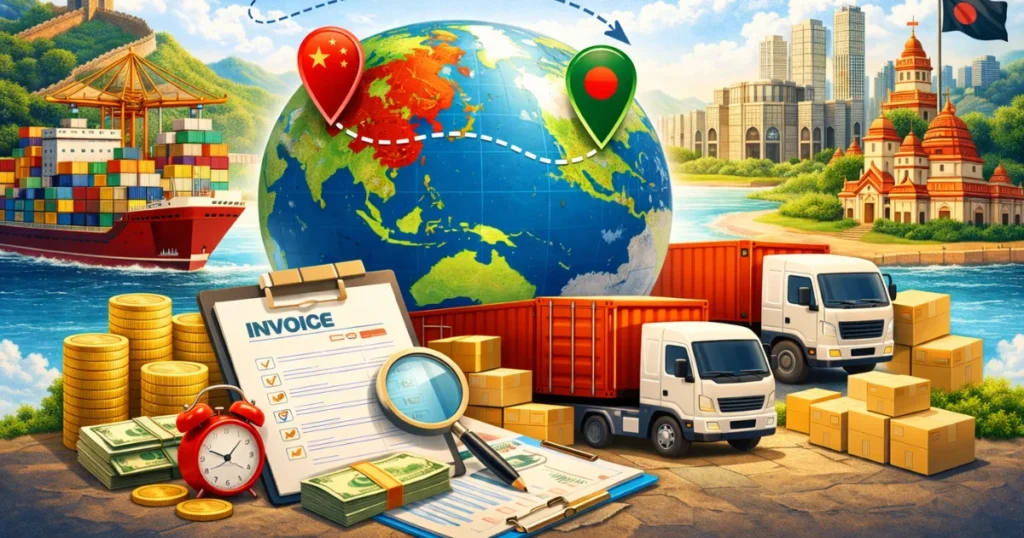
Let’s be real for a second. When you first look at shipping your goods from China to Bangladesh, that initial freight quote looks pretty reasonable. You get excited. You do a little mental math on your profit margins. Maybe you even celebrate a little.
Then the final bill arrives.
Suddenly there’s a “port congestion surcharge” you’ve never heard of. A “terminal handling fee” that makes your eyes water. And don’t even get me started on the government taxes that seem to materialize out of thin air.
I’ve been there. It hurts. But here’s the good news: once you understand how shipping costs really work on this route, those ugly surprises become predictable—and predictable is manageable.
Let me walk you through what shipping from China to Bangladesh actually costs, not the marketing version.
The Baseline: What You’re Probably Expecting to Pay
First, let’s establish some rough benchmarks so you know what “normal” looks like:
Sea Freight (LCL): About $0.80–$2.00 per kg, depending on volume and season . For a cubic meter? Figure $185–250 from Guangzhou or Shenzhen to Chittagong .
Air Freight: Faster, obviously, but your wallet will feel it—roughly $4–$12 per kg depending on weight, route and urgency.
Full Container (FCL): A 20-footer from Shanghai to Chittagong? Around $1,200. A 40-footer? About $1,800 .
But here’s the thing—these numbers are just the appetizer. The main course? That’s where things get interesting.
The Main Cost Components: What You’re Actually Paying For
Ocean or Air Freight Charges
This is the headline number—the one freight forwarders put in big bold text on their quotes. It covers moving your goods from China to Bangladesh. Simple enough.
Terminal Handling Charges (THC)
This is what ports charge for the “privilege” of handling your containers. Both ends. China loads it up, Bangladesh offloads it. And they both want their cut.
Customs Duties & VAT
Bangladesh customs duties typically range from 3% to 25%, depending on what you’re importing . Then there’s the standard 15% VAT on top of that . Some products attract Regulatory Duty too—LED modules, for example, can hit you with up to 25% extra .
Real talk: If you’re importing textile accessories, expect 15% VAT plus potentially 5% supplementary duty. Plastic zippers fall into this category . Know your HS code before you ship. Not knowing is expensive.
Documentation Fees
Paperwork isn’t free. Bills of lading, certificates of origin, commercial invoices—every document someone has to process means another $30–50 on your bill .
Inland Transport (Chittagong → Dhaka)
Here’s something first-time importers often miss: Chittagong Port is not your final destination. If your warehouse is in Dhaka, those goods need to travel about 200 kilometers inland. That’ll run you $45–65, depending on fuel prices and road conditions . And in Bangladesh, fuel prices and road conditions are… let’s call them “dynamic.”
Optional But Highly Recommended: Insurance
Look, I know you’re watching every dollar. But here’s a question: if that container falls off a ship or gets damaged in port, can you absorb the loss? Most standard freight contracts limit carrier liability to almost nothing. Insurance is usually 0.1–0.3% of the cargo value. Skip it at your own risk.
Bangladesh-Specific Surcharges: The Ones Nobody Warns You About
This is where things get spicy.
Port Congestion Surcharge
Chittagong Port handles over 90% of Bangladesh’s external trade . That’s a lot of containers moving through a single facility. When it gets backed up—which is often—carriers slap on congestion surcharges.
Real example: In February 2026, Chittagong faced a four-day strike that crippled operations . Vessel owners were paying $10,000–15,000 PER DAY in demurrage during disruptions . Guess who that cost eventually gets passed to?
Destination Charges
These are the fees that appear after your goods arrive:
- CFS charges: For breaking down container loads (LCL shipments)
- Terminal handling fees: Moving containers around the port
- Delivery order fees: About $30–50 just for the paperwork to release your goods
Government Taxes You Need to Know About
Advance Income Tax (AIT): Generally 5% of the assessable value, collected at import. It is a prepayment you can usually adjust against your income tax later, but you pay it at clearance.
Advance Tax (AT): A separate VAT-related charge collected at import. The rate varies by product and importer type (commonly about 5%, up to 7.5% for some commercial imports). Rates as of October 2026. Confirm with the NBR duty calculator or your clearing agent.
Regulatory Duty: This is the nasty one. On certain products—especially those competing with local industries—the government adds Regulatory Duty. LED modules? Up to 25% .
The “Hidden Cost” Reality: Port-to-port quotes often exclude 22–38% of final costs once you add customs brokerage, inland haulage, and VAT advance payments . That $420 quote? It might become $580 by the time goods reach your Dhaka warehouse.
Let’s Make This Real: Sample Cost Breakdown
Here’s what a typical LCL shipment from Guangzhou to Dhaka actually looks like on paper:
| Cost Item | Estimated Cost (USD) | What’s Included |
|---|---|---|
| Sea Freight (LCL) | $185–250 | Guangzhou/Shenzhen to Chittagong port |
| China Origin Charges | $65–95 | Customs clearance, terminal handling, docs, warehouse fees |
| Bangladesh Destination Charges | $110–160 | Port handling, delivery order, CFS fees |
| Customs Duty & VAT | Variable | Textiles: ~15% VAT; Electronics: potential 25% RD |
| Inland Haulage (Chittagong→Dhaka) | $45–65 | About 200km of Bangladeshi road |
Total range: Approximately $405–570, plus duties.
Now here’s the kicker—these numbers fluctuate. Constantly. Fuel prices spike, and suddenly that inland haulage jumps. The taka weakens against the dollar, and your landed cost shifts. Chittagong gets congested, and surcharges appear.
Pro tip: Always ask for a line-item breakdown signed and stamped by your provider . If a quote says “all-inclusive” without details, run. Fast.
💰 Our Shipping Cost from China to Bangladesh
Shipping costs depend on cargo size, weight, and delivery method. Here’s a quick estimate:
✈️ Air Freight (Fastest Option)
- Cost: $4 – $12 per kg
- Delivery Time: 3–7 days
- Best for: Urgent, lightweight, high-value goods
👉 Choose air freight if speed is your priority
🚢 Sea Freight – FCL (Full Container Load)
- Cost: $800 – $2,500 per container
- Delivery Time: 18–30 days
- Best for: Large shipments (15+ CBM)
👉 Best option for lowest cost per unit
📦 Sea Freight – LCL (Less than Container Load)
- Cost: $80 – $300 per CBM
- Delivery Time: 20–35 days
- Best for: Small to medium shipments
👉 Ideal for importers who don’t need a full container
⚠️ Prices may vary depending on cargo type, season, and shipping line availability.
⏱ Shipping Time from China to Bangladesh
| Shipping Method | Estimated Time |
|---|---|
| Air Freight | 3–7 Days |
| Sea Freight FCL | 18–30 Days |
| Sea Freight LCL | 20–35 Days |
📦 Want the exact cost and time for your shipment?
📞 Call now to get the exact cost and time based on your cargo
💬 WhatsApp us for a quick quote (within 10 minutes)
💡 Most importers choose sea freight (LCL or FCL) to reduce shipping costs significantly.
Incoterms: The Secret Code That Determines Who Pays for What
Incoterms are international trade terms that define who pays for what and when risk transfers. Get these wrong, and you’ll pay for things you never expected.
FOB (Free on Board)
This is the sweet spot for many Bangladeshi importers .
How it works: Your supplier gets the goods to the Chinese port and loads them on the ship. From that moment, everything is on you—freight, insurance, clearance, inland transport .
Best for: Importers with their own customs clearing agent in Bangladesh who want control over shipping costs .
Risk transfer moment: When goods cross the ship’s rail in China . Not when they arrive in Bangladesh. Important distinction.
CIF (Cost, Insurance, and Freight)
This one’s common because it feels convenient—the supplier arranges everything to get goods to Chittagong.
How it works: Your supplier pays for freight and minimum insurance to the destination port .
The catch: Risk still transfers when goods are loaded in China, not when they arrive in Bangladesh . So if something happens mid-ocean, technically it’s your problem, even though the supplier arranged the shipping.
Watch out: CIF insurance is typically minimum coverage. You might want to supplement it.
DDP (Delivered Duty Paid)
This is the “I-don’t-want-to-think-about-it” option.
How it works: Your supplier handles everything—freight, clearance, duties, taxes, delivery to your door .
The reality: This is the most expensive option, but it’s also the most hands-off . Good for small buyers without import rights or experience.
The risk: Only use DDP if your supplier can legally manage import clearance in Bangladesh . Some can’t, and that causes problems.
Remarks
Shipping from China to Bangladesh isn’t cheap, but it’s predictable once you know what to look for. The freight quote is just the beginning. Terminal charges, government taxes, inland transport, and the ever-present risk of congestion surcharges all add up.
Your action plan:
- Get detailed breakdowns from at least three freight forwarders
- Know your HS code and research applicable duties BEFORE shipping
- Build in buffer for delays—Chittagong congestion is a feature, not a bug
- Choose your Incoterm carefully based on your risk tolerance and experience level
- Consider a small test shipment before committing to large volumes
The importers who succeed on this route aren’t the ones who find the cheapest freight quote. They’re the ones who understand the full cost picture and plan accordingly.
Now go forth and ship. Just don’t say I didn’t warn you about those destination charges.
🌏 Major Shipping Routes (China → Bangladesh)
Let’s talk routes—because this is where your shipment’s time, cost, and reliability are quietly decided.
When it comes to shipping from China to Bangladesh, most cargo doesn’t travel on a single direct vessel. Instead, it usually goes through transshipment hubs—basically a “connecting flight,” but for containers 🚢
🔄 Southern China Route (Most Common for Fast Turnaround)
Route:
Port of Shenzhen / Port of Guangzhou →
via Singapore or Colombo →
Port of Chittagong
Why it’s popular:
- Ideal for electronics, garments, and fast-moving goods
- Shorter inland distance from factories in South China
- Generally faster than northern routes
💡 Real-world example:
If your supplier is in Shenzhen producing electronics, this route is usually the fastest and most cost-efficient.
🔄 Eastern China Route (Best for Bulk & Industrial Goods)
Route:
Port of Shanghai / Port of Ningbo-Zhoushan →
via Port Klang or Colombo →
Port of Chittagong
Why choose this route:
- Strong for bulk cargo and large-volume shipments
- Better vessel availability for industrial goods
- Competitive freight rates for FCL shipments
⚠️ Important Note: Transshipment Is the Norm
Unlike major global trade lanes, direct shipping routes to Bangladesh are limited.
That means:
- Most shipments are transshipped (reloaded at another port)
- This adds a few extra days but helps optimize global shipping networks
📍 Common transshipment hubs:
- Singapore
- Colombo
- Port Klang
💡 Think of it like this: your cargo takes a short “layover” before reaching Bangladesh.
🚢 Main Ports in China and Bangladesh
Knowing the right ports helps you choose better routes, reduce inland costs, and avoid delays.
🇨🇳 Key Chinese Ports
- Port of Shanghai
The world’s busiest port—massive capacity, high frequency, slightly higher costs. - Port of Shenzhen (Yantian / Shekou)
Electronics powerhouse and export hub for South China. - Port of Ningbo-Zhoushan
Excellent for bulk shipments and large-scale exports. - Port of Guangzhou
Strong regional gateway with good connectivity. - Port of Qingdao
Ideal for northern China manufacturing and industrial goods.
🇧🇩 Bangladesh Ports
- Port of Chittagong
Handles ~90% of the country’s container traffic—the main gateway for imports. - Mongla Port
A useful alternative for certain cargo types and less congestion. - Payra Port
A developing port with future potential as Bangladesh expands its logistics network.
Why Routes Matter to You
Okay, geography lesson over. Here’s why you actually care about this:
- Transit time estimates depend on which route your cargo takes. A Shenzhen-to-Chittagong shipment via Singapore is different from a Ningbo-to-Chittagong via Port Klang.
- Congestion patterns vary. If Singapore is backed up, your cargo waits. If Colombo is strike-bound, your cargo waits. Knowing the hubs helps you understand why your shipment is delayed.
- Cost structures differ slightly by route. Some carriers have stronger networks through certain hubs, which can affect pricing.
- Risk assessment matters. When geopolitical tensions affect the Strait of Malacca (rare but possible), routes through Colombo become relatively more attractive.
Remarks
Choosing the right route isn’t just about geography—it’s about strategy.
Pick the wrong route, and you might face:
❌ Longer transit times
❌ Higher inland costs
❌ Unexpected delays
Pick the right one, and you’ll enjoy:
✔ Faster delivery
✔ Lower total cost
✔ Smoother logistics
And in the world of shipping from China to Bangladesh, that difference can make or break your entire supply chain.
Transit Time: How Long Does Shipping from China to Bangladesh Really Take?
Let’s address the question everyone asks first: “How long until my stuff gets here?”
It’s the natural question. You’ve paid for your goods, they’re sitting in a warehouse in Guangzhou or Shanghai, and you need them in Dhaka or Chittagong yesterday. The clock is ticking.
Here’s the thing about transit times on the China-Bangladesh route—they’re a bit like Bangladeshi traffic. The theoretical time and the actual time can be two very different numbers.
Let me give you the straight talk on what to expect.
The Short Answer
Ocean Freight: Approximately 18–30 days from port to port, depending on your specific route and how smoothly the transshipment goes.
Air Freight: Approximately 3–7 days from airport to airport, assuming no major hiccups.
But here’s where it gets interesting—those numbers are just the sailing or flying time. They don’t include the waiting. The queuing. The “your shipment is currently being transferred to the feeder vessel” purgatory.
Let’s break down what really happens.
Ocean Freight: The Patient Importer’s Choice
When you choose sea freight, you’re making a trade. You’re trading time for money. And most of the time, that’s the right call.
The optimistic scenario: Your container loads in China, makes its connection in Singapore or Colombo smoothly, and arrives at Chittagong outer anchorage in about 18–20 days. The stars align. The shipping gods smile upon you.
The realistic scenario: You’re looking at 18–22 days. Maybe longer if you’re shipping during peak season (September to December) when everyone and their grandmother is moving goods for the holidays.
The “I should have planned better” scenario: 25–30 days. This happens when you hit the perfect storm of delays—congestion at the transshipment port, a missed connection, and then waiting outside Chittagong because there’s no berth available.
Air Freight: The Speed Demon
If you need it yesterday, you fly it.
Dhaka-bound air cargo typically leaves from Guangzhou, Hong Kong, or Shanghai and arrives at Hazrat Shahjalal International Airport in 3–5 days for express options, or 5–7 days for standard air freight.
The beautiful thing about air freight? Fewer variables. The plane takes off, it lands, your goods clear customs (hopefully quickly), and they’re on a truck to your warehouse.
The painful thing about air freight? The price tag. You’re paying for that speed.
The Four Horsemen of Shipping Delays
Here’s what actually determines whether your shipment arrives in 12 days or 30 days.
1. Port Congestion: The Usual Suspect
Chittagong Port handles over 90% of Bangladesh’s container traffic. That’s roughly 3 million TEUs annually, moving through facilities that weren’t designed for that volume.
What this looks like in practice: Your ship arrives at the outer anchorage and… waits. There’s no available berth. Maybe there are 15 vessels ahead of you. Maybe 20. During peak times, container ships can wait 5–10 days just to get a spot at the dock.
Real talk: In early 2026, Chittagong faced serious congestion issues. A four-day strike in February brought operations to a crawl, and it took weeks to clear the backlog. Vessel owners were paying $10,000–15,000 per day in demurrage during disruptions. That cost eventually finds its way into someone’s freight rates.
The fix: Work with forwarders who have good relationships at the port. Ask about current congestion levels before you ship. Build buffer time into your planning—especially if you’re shipping between September and December.
2. Transshipment Delays: The Missed Connection
Remember how most China-to-Bangladesh shipments go through Singapore, Colombo, or Port Klang? That transfer is a potential delay point.
The problem: Your main vessel arrives in Singapore on Tuesday. The feeder vessel to Chittagong leaves on Wednesday. Perfect timing, right? Except your container needs to be unloaded, sorted, and loaded onto that feeder. If there’s a backlog at the transshipment hub, your container misses the Wednesday boat and waits for the next one—maybe Saturday, maybe next Tuesday.
The math: A missed connection at transshipment adds 3–7 days to your transit time. Just like that.
The reality: Singapore handles over 20 million TEUs annually. It’s efficient, but it’s also massively busy. Sometimes things slip through the cracks.
3. Weather Conditions: The Uncontrollable Variable
Bangladesh has three seasons: hot, hotter, and monsoon. That last one affects shipping.
June to October is cyclone season in the Bay of Bengal. Vessels delay departures, alter routes, or seek shelter when storms approach. Your 18-day transit suddenly becomes 22 days because the captain decided not to sail through a tropical cyclone. Smart captain.
Monsoon rains (June to September) don’t stop ships, but they can slow port operations. Heavy rain affects visibility and safety. Cargo handling slows down. Everything takes longer.
The fog factor: During winter months (December to February), dense fog can affect navigation in the Karnaphuli River channel leading to Chittagong. Pilots won’t move ships in zero visibility. Another delay.
4. Customs Clearance Speed: The Gateway to Your Warehouse
Your ship docks. Your container is unloaded. Now you need to get it out of the port and on its way to your warehouse.
This is where the Bangladesh Customs House and the National Board of Revenue (NBR) enter the picture.
The fast scenario: Your documentation is perfect. Your HS codes are accurate. Your valuation is reasonable. Your clearing agent knows what they’re doing. Clearance takes 2–3 days.
The slow scenario: There’s a discrepancy between your invoice and your packing list. Your HS code doesn’t quite match the product. The customs officer decides to do a physical inspection. Suddenly you’re looking at 7–10 days, plus storage charges at the port.
The nightmare scenario: Your documents are missing something crucial—maybe your BIN number isn’t on the bill of lading, or you don’t have the right import permit. Your goods sit in customs limbo while you scramble to fix paperwork. Weeks can pass.
Pro tip: The single biggest factor in customs clearance speed is documentation quality. Get it right before the ship leaves China. Triple-check everything. Have an experienced clearing agent review your documents before arrival. This one step can save you days—and thousands in demurrage.
Putting It All Together: Realistic Planning
So what does this mean for your planning?
If you’re shipping by sea: Tell your stakeholders 25–30 days from factory gate to Dhaka warehouse. If it arrives in 20 days, you’re a hero. If it takes 35 days, you built in buffer.
If you’re shipping by air: Plan for 7–10 days total. Air freight is more predictable, but customs clearance on the Dhaka end can still introduce delays.
Peak season reality: From September through December, add at least one week to every estimate. Everyone is shipping. Ports are crowded. Vessels are full. Delays multiply.
Important Note
Transit time from China to Bangladesh isn’t just a number—it’s a range with a story behind it. Understanding that story helps you plan better, stress less, and explain delays to your boss or customers without sounding like you’re making excuses.
Your action items:
- Ask your forwarder about current conditions before shipping. “How’s congestion at Chittagong right now? Any issues at Singapore or Colombo?”
- Build buffer into your delivery promises. Under-promise and over-deliver is a cliché for a reason.
- Track your shipment actively. Most forwarders offer tracking. Use it. If your container misses a connection in Singapore, you want to know immediately, not two weeks later.
- Fix your documentation. Seriously. Most customs delays are paperwork problems. Solve them before your ship leaves China.
The China-Bangladesh shipping route is well-established and reliable—but it’s not instant. Respect the journey, plan accordingly, and your goods will arrive. Eventually.
And when they do? That feeling when the truck pulls up to your warehouse? Worth every day of waiting.
FCL vs. LCL Shipping: Which One Should You Choose?
You’ve got your goods ready. The factory in China is packed and waiting for your shipping instructions. Now comes a decision that’ll impact your costs, your timeline, and your blood pressure over the next few weeks:
Should you ship FCL or LCL?
If those acronyms sound like alphabet soup, don’t worry. FCL means “Full Container Load” — you rent the whole container. LCL means “Less than Container Load” — your goods share space with other people’s cargo.
It’s like the difference between renting an entire apartment versus sharing a dorm room. Both get you a place to stay, but the experience is… different.
Let me walk you through the trade-offs so you can make the right call for your business.
The Quick Comparison
| Factor | FCL (Full Container) | LCL (Shared Container) |
|---|---|---|
| Volume | Large shipments (basically, a lot of stuff) | Small shipments (you don’t fill a whole container) |
| Cost | Cheaper per unit for bulk | You pay per cubic meter (CBM) |
| Speed | Faster — direct loading, less handling | Slower — consolidation and deconsolidation take time |
| Risk | Lower — your stuff, your container | Slightly higher — more handling, more chances for issues |
| Best For | Regular importers, big orders | Small businesses, testing new products |
The Volume Question: How Much Stuff Are You Really Shipping?
This is where it all starts. How many cubic meters (CBM) are we talking about?
If you’re shipping less than 10–12 CBM: LCL is probably your friend. You’re paying for exactly the space you use, nothing more. A 20-foot container holds about 28–30 CBM. If you’re only using half of that, why pay for the empty half?
If you’re shipping 15 CBM or more: Listen carefully — this is where the math starts shifting. At around 12–15 CBM, FCL often becomes more cost-effective than LCL. You might pay slightly more for the container, but the per-unit cost drops, and you avoid a bunch of LCL-specific headaches.
If you’re shipping a full 20-foot container’s worth (28–30 CBM): Stop reading this section and book FCL. Seriously. It’s not even a debate.
Real example: Let’s say you’re importing ceramic tableware from Guangzhou. An LCL shipment of 12 CBM might cost you $400–500 in freight plus all the destination charges. A full 20-foot container might run $1,200–1,400 for the freight. That’s only 2–3 times the cost for 2.5 times the volume. Plus, you get the benefits we’re about to discuss.
The Cost Breakdown: It’s Not Just About the Freight
Here’s where LCL can trick you.
With LCL, you see that per-cubic-meter rate and think, “Perfect, I’m only paying for my space.” And you are — for the ocean freight part.
But LCL comes with extra hands in the cookie jar:
Origin consolidation fees: Someone has to take your boxes, combine them with other people’s boxes, and stuff them into a container. That costs money.
Destination CFS charges: At the other end, your container goes to a Container Freight Station, where it’s de-stuffed. Your boxes are separated from everyone else’s. More handling, more charges.
The per-CBM math: Those destination charges are often billed per cubic meter. So if you’re at 12 CBM, you’re paying 12 times that fee. At a certain point, paying a flat container rate starts looking pretty good.
FCL simplicity: With FCL, your container is loaded at origin, sealed, and not opened until it reaches your warehouse or your nominated depot. One price. One set of handling charges. No sharing.
The Speed Factor: Time Is Money
FCL is faster. Not dramatically faster, but noticeably.
Why? Because FCL containers are “roll-on, roll-off.” They go from the factory truck onto the vessel, sail, and then get trucked to your door with minimal intermediate handling.
LCL has extra steps:
- Your goods arrive at the consolidation warehouse in China
- They wait for enough cargo to fill a container (this can take days)
- The container is stuffed and loaded
- At destination, it’s de-stuffed
- Your goods wait for customs clearance with everyone else’s
- Finally, they’re loaded onto a truck for delivery
The real-world difference: An FCL shipment from Shanghai to Chittagong might take 22–25 days total. An LCL shipment on the same vessel could take 24–28 days because of the consolidation/deconsolidation time.
If you’re restocking popular items or shipping to Amazon FBA (yes, people do that from China to Bangladesh for resale), those extra days matter.
The Risk Reality: Less Handling = Less Headache
Let’s be honest — your stuff is precious to you. To a longshoreman moving 50 boxes an hour, it’s just another box.
FCL risk: Your container is sealed at the factory or warehouse and doesn’t open until it reaches your destination. The only people touching your goods are the ones loading them at origin. That’s it.
LCL risk: Your boxes get loaded onto a truck, unloaded at a consolidation warehouse, stacked with other people’s cargo, loaded into a container, unloaded at destination, sorted, and reloaded onto your truck. That’s 5–6 touch points instead of 2–3.
The math of risk: More handling means more chances for:
- Damaged boxes
- Lost items
- Theft (rare, but it happens)
- Someone else’s leaking product ruining your goods
The insurance angle: If you’re shipping fragile items, high-value goods, or products that don’t play well with others (like food items that could absorb odors), FCL is worth the extra cost just for the separation.
The Break-Even Point: The Golden Number
Here’s the golden rule that experienced importers live by:
Around 12–15 cubic meters, start getting FCL quotes.
Below that, LCL usually wins on price. Above that, FCL starts making sense — not just for cost, but for speed, safety, and sanity.
But here’s the thing — that number isn’t fixed. It moves with:
- Fuel prices (affects both, but differently)
- Port congestion (LCL gets hit harder by delays)
- Your specific cargo (fragile items justify FCL earlier)
- Time of year (peak season LCL can get badly delayed)
Pro tip: Always ask your forwarder for both quotes once you’re above 10 CBM. The math might surprise you. I’ve seen 14 CBM shipments where FCL was actually cheaper than LCL once you added all the destination handling fees.
Who Should Choose What?
FCL is for you if:
- You’re shipping more than 15 CBM regularly
- Your goods are fragile, valuable, or sensitive
- You need faster, more predictable transit
- You’re a regular importer with steady volume
- You hate surprises (who doesn’t?)
LCL is for you if:
- You’re just starting out or testing a new product
- Your shipments are under 10 CBM
- You don’t mind waiting a few extra days
- You want to minimize upfront cash tied up in inventory
- You’re shipping robust goods that won’t mind the extra handling
The Strategic Angle: Think Beyond This Shipment
Here’s something importers don’t always consider — your shipping choice now affects your future options.
Start with LCL while you’re testing products and building demand. Keep inventory lean. Don’t commit to volume until you know what sells.
Switch to FCL once you have consistent orders. The per-unit savings let you either increase margin or drop prices to beat competitors. Plus, having a container arriving means you can stock deeper and avoid stockouts.
The hybrid approach: Some savvy importers combine FCL for their core products with LCL for new test products. Best of both worlds.
Important Note
Choosing between FCL and LCL isn’t rocket science, but it’s not random either. Match your shipping method to your volume, your risk tolerance, and your business stage.
Under 10 CBM? LCL is your friend. Keep costs low, stay flexible.
Over 15 CBM? Get those FCL quotes. The math probably works in your favor.
In between? Do the detailed comparison. Ask your forwarder for both options with all fees itemized. Sometimes the answer surprises you.
👉 Choose FCL if your shipment is over 15 CBM and you want the lowest cost per unit
👉 Choose LCL if you’re importing small quantities
And remember — the goal isn’t to find the absolute cheapest option. It’s to find the option that gives you the best balance of cost, speed, and safety for YOUR specific situation.
Now go forth and ship wisely. Your goods (and your bank account) will thank you.
Required Documents for Shipping from China to Bangladesh: Your Paperwork Survival Guide
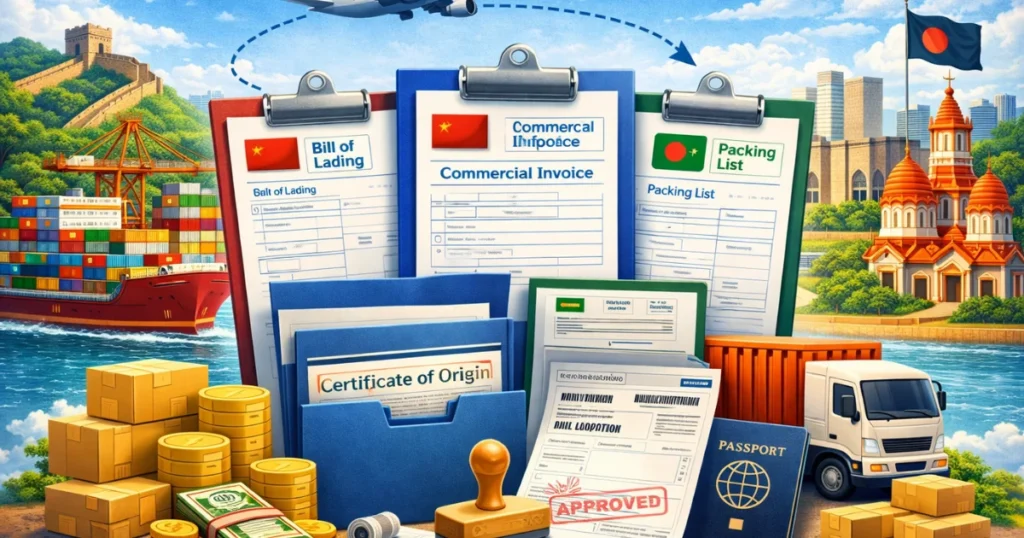
Let me tell you a story about a friend of mine. We’ll call him Rafiq.
Rafiq had been importing textiles from China for about six months. Everything was going smoothly—good products, decent margins, happy customers. Then one shipment arrived at Chittagong port, and… nothing. It sat there. For days. Then weeks.
The problem? His commercial invoice didn’t match his packing list. Just a small discrepancy—a few boxes counted differently. But to Bangladesh Customs, that small discrepancy looked like a red flag. They held his container for inspection. They charged him storage fees. They delayed his delivery by three weeks.
Rafiq learned the hard way: In shipping, paper is as important as product.
Your goods can be perfect. Your supplier can be amazing. Your freight forwarder can be the best in the business. But if your documentation is wrong, everything stops.
Let me walk you through exactly what documents you need, why they matter, and how to get them right the first time.
The Document Lineup: Your Shipping Dream Team
Think of these documents as your cargo’s identity papers. Without them, your goods are stateless, suspicious, and stuck.
1. Bill of Lading (B/L) — The Title Deed
This is the big one. The boss document. The paper that proves ownership of your goods.
What it is: A contract between you and the shipping line. It says: “We received this cargo in good condition, and we’ll deliver it to this person at this port.”
Why it matters: The Bill of Lading is a document of title. Whoever holds the original B/L owns the goods. Lose it? You can’t take delivery. End of story.
The Bangladesh-specific detail: Your B/L must show the consignee’s BIN Number (Business Identification Number) . Miss this, and your goods will be held at customs until you fix it. No exceptions.
What to check:
- Is your name spelled correctly?
- Is the BIN number there?
- Does the cargo description match your other documents?
- Is it “Clean” (meaning no damage noted)?
Pro tip: For Bangladesh shipments, insist on a “Surrendered” or “Telex Release” B/L if possible. It means the original stays with the carrier electronically, and you can’t lose it in transit.
2. Commercial Invoice — The Price Tag
This is your sales document. It tells Bangladesh Customs what your goods are worth.
What it must include:
- Exporter and importer details (full names, addresses)
- Description of goods (be specific—”garments” is bad, “men’s cotton t-shirts” is good)
- Unit price and total value
- Currency (USD, usually)
- Payment terms (L/C, T/T, etc.)
- HS Codes (more on these in a minute)
- Shipping terms (FOB, CIF, etc.)
The Bangladesh twist: Your commercial invoice should ideally be attested by a bank or chamber of commerce. This isn’t always mandatory, but it reduces your inspection risk significantly. Customs trusts bank-verified documents more than supplier-printed ones.
Real talk: Don’t even think about under-invoicing to save on duty. Bangladesh Customs has sophisticated valuation databases. They know what your products should cost. Get caught under-declaring, and you’ll face penalties, delays, and a permanent spot on the “inspect everything” list.
3. Packing List — The Inventory
If the commercial invoice is the “what it’s worth” document, the packing list is the “what’s actually here” document.
What it shows:
- Number of packages (cartons, pallets, etc.)
- Contents of each package
- Net weight and gross weight
- Measurements (for LCL shipments, this determines your cubic meters)
Why it matters: Customs officers at Chittagong will sometimes open containers for random inspection. They’ll count packages and check against your packing list. If the numbers don’t match, they’ll assume something’s hidden. Delays follow.
The critical detail: Your packing list must match your commercial invoice exactly. Same description of goods. Same quantities. If Invoice says 100 cartons and Packing List says 98, you have a problem.
4. APTA Certificate of Origin — The Discount Card
This is your money-saving document.
What it is: Bangladesh and China are both members of the Asia-Pacific Trade Agreement (APTA).
Why it matters: An APTA Certificate of Origin can qualify eligible goods for a reduced duty rate. Preferences apply only to listed tariff lines, so check your HS code first.
How to get it: Your supplier applies through the issuing authority in China (the chamber of commerce or customs). Apply before shipment, because retroactive issuance is limited.
What to check:
- Does it cover ALL your products?
- APTA Certificate of Origin (if eligible) issued before shipment?
- Are the dates correct?
- Is it signed and stamped?
Pro tip: An APTA certificate can matter on tight-margin imports, but only if your product is covered. Have your clearing agent confirm eligibility before you order.
5. Import License & HS Code Declaration — The Permission Slips
This is where Bangladesh-specific requirements really kick in.
Import Registration Certificate (IRC): You cannot clear goods through Bangladesh Customs without an IRC. Period. If you’re a new importer, apply for this through the Office of the Chief Controller of Imports and Exports before you order anything.
HS Code Declaration: Every product has a Harmonized System (HS) code. Bangladesh uses an 8-digit code for imports. You must declare this on your documentation.
Why HS codes matter:
- They determine your duty rate
- They flag restricted products
- They tell customs what inspections are needed
The risk: Wrong HS code = wrong duty = customs considers it misdeclaration = penalties and delays.
Special permits: Some products need extra approvals:
- Food items need clearance from the BSTI (Bangladesh Standards and Testing Institution)
- Pharmaceuticals need DGDA approval
- Chemicals need Department of Environment clearance
- Electronics need BTRC certification
Check your product’s requirements before you ship. Getting these permits after arrival is painful and slow.
6. Insurance Certificate — The Safety Net
This one’s optional. But “optional” in the same way that a life jacket on a boat is optional.
What it is: Proof that your cargo is insured against loss, damage, or theft during transit.
Why you need it: Standard carrier liability is shockingly low. If your container falls overboard in a storm, the shipping line will pay you maybe $500 per package. If your container holds $50,000 worth of electronics, that’s a disaster.
Coverage options:
- “All Risks” covers most things (damage, theft, non-delivery)
- “Total Loss” only pays if the whole shipment is destroyed (cheaper, but riskier)
- “With Average” covers partial damage
The cost: Usually 0.1–0.3% of your cargo value. On a $20,000 shipment, that’s $20–60. Worth every penny for peace of mind.
The claim reality: If something happens, you’ll need your insurance certificate, B/L, and invoice to file a claim. Keep copies of everything.
The Document Checklist: Your Pre-Shipment Review
Before your goods leave the factory in China, run through this checklist:
| Document | Status | Notes |
|---|---|---|
| Bill of Lading draft | ✓ | BIN number included? |
| Commercial Invoice | ✓ | Bank attested? HS codes correct? |
| Packing List | ✓ | Matches invoice exactly? |
| Certificate of Origin (Form E) | ✓ | Issued before shipment? |
| Import License (IRC) | ✓ | Valid and current? |
| Special Permits (if needed) | ✓ | BSTI? DGDA? BTRC? |
| Insurance Certificate | ✓ | Coverage adequate? |
Common Document Mistakes That Kill Shipments
Mistake #1: Mismatched information
Your B/L says “100 cartons.” Your Packing List says “100 cartons.” Your Invoice says “98 cartons.” Customs sees this and thinks: “Someone is hiding something.” Delay.
Fix: Triple-check that every number matches across every document.
Mistake #2: Missing BIN number
Bangladesh Customs requires the importer’s BIN on the B/L. Forget it, and your goods sit at the port while you scramble to amend documents.
Fix: Put your BIN number on every document. On the B/L, make sure it’s in the consignee field.
Mistake #3: Wrong HS code
You declare your textile trims under the wrong HS code. Customs figures out the correct code, and suddenly you owe back-duties plus penalties.
Fix: Have an experienced clearing agent verify your HS codes before shipment. Pay for a professional classification if needed.
Mistake #4: No APTA certificate
Your product qualified, but you skipped it, so you pay the full duty rate at clearance.
Fix: Check eligibility early and ask your supplier when you book.
💡 To ensure a smooth import from China, our team will guide you through every document to avoid delays, extra charges, or customs issues.
Important Note
Documentation isn’t the exciting part of importing. You can’t touch it, feel it, or sell it. But get it wrong, and nothing else matters.
Your action plan:
- Start early. Don’t wait until the ship is loading to think about documents.
- Verify everything. Check and double-check every number, date, and description.
- Get professional help. A good clearing agent in Bangladesh is worth their weight in gold. Use them to review your docs before shipment.
- Keep copies. Store digital copies of everything. You’ll need them for future shipments, insurance claims, and tax purposes.
Shipping from China to Bangladesh is a journey of thousands of miles. But it starts with a single piece of paper. Make sure yours is perfect.
Customs Clearance in Bangladesh: The Gate You Must Get Through
Let me introduce you to Jahangir.
Jahangir is a clearing agent at Chittagong port. He’s been doing this job for seventeen years. He knows which customs officers are sticklers for detail and which ones just want to get through the day. He knows that shipments of textiles get inspected more often than machinery, and that Wednesday morning is the best time to submit documents because the officers are still in a good mood from Tuesday’s chai break.
Jahangir is worth his weight in gold.
Here’s the truth about shipping from China to Bangladesh: Your shipment isn’t truly yours until it clears customs. Everything before that—the factory in China, the ocean voyage, the arrival at Chittagong—is just transportation. Customs clearance is where shipments go to live or die.
Let me walk you through how this works, what can go wrong, and why Jahangir is the most important person you haven’t met yet.
The Gatekeepers: C&F Agents
In Bangladesh, you don’t clear customs alone. You can’t. The system isn’t designed for individual importers to navigate. This is where Clearing & Forwarding (C&F) agents come in.
What they do: Think of a C&F agent as part lawyer, part fixer, part paperwork ninja. They:
- Submit your documents to customs through the Bangladesh Single Window system
- Pay duties and taxes on your behalf
- Coordinate with port authorities for inspections
- Physically attend container examinations when required
- Arrange delivery orders and trucking out of the port
- Handle the inevitable “unexpected issues” that arise
Why you need one: Because customs clearance in Bangladesh involves multiple agencies with overlapping authority. Customs (NBR). Port authority. BSTI for standards. Plant quarantine for agricultural goods. The list goes on. A good C&F agent knows every desk, every officer, and every form.
How to find one: Your freight forwarder will usually have a preferred C&F partner, or they may offer clearance as part of their service. Ask for referrals. Check their track record. A bad C&F agent can cost you days and dollars.
The cost: C&F fees typically run 5,000–15,000 BDT per shipment ($45–135), depending on complexity. Worth every taka.
What You Actually Pay: Duties, VAT, and the Tax Man Cometh
When your goods arrive in Bangladesh, the National Board of Revenue (NBR) wants its share. Here’s how that breaks down.
Assessable Value: This is the starting point. Customs calculates this based on your CIF value (Cost, Insurance, Freight). They have their own valuation database, and if your declared value seems low, they’ll adjust it upward.
Customs Duty: Typically ranges from 3% to 25% , depending on your HS code. Raw materials often get lower rates. Finished goods pay more. Products that compete with local industries? Sometimes 25% or higher.
Regulatory Duty (RD): This is the wildcard. On certain products—especially those the government wants to discourage or protect local industry from—Regulatory Duty can hit 20–50% . LED lights, for example, have faced RD up to 25%. Check your HS code carefully.
Supplementary Duty (SD): Applied to “luxury” or non-essential goods. Can range from 20% to 350% (yes, three hundred fifty percent) for items like alcohol or high-end electronics.
Value Added Tax (VAT): A straight 15% on most imports, calculated on the value after customs duty. Yes, you pay VAT on the duty amount too. That’s how VAT works.
Advance Income Tax (AIT): 0.25% of the CIF value, collected at import stage. Think of it as a prepayment on your income tax.
The total picture: A shipment with 10% customs duty might end up paying 25–30% total after VAT, AIT, and other charges. Know your numbers before you ship.
Regulatory Checks: When Other Agencies Get Involved
Sometimes customs isn’t the only agency that wants a look at your goods.
BSTI (Bangladesh Standards and Testing Institution): If you’re importing food products, cosmetics, electronics, or children’s toys, BSTI may want samples tested. This means your container gets held until test results come back—typically 7–14 days.
Plant Quarantine: Agricultural products, wooden furniture, or anything that could carry pests needs clearance from Plant Quarantine. They’ll inspect, possibly take samples, and issue a release.
Drug Administration (DGDA): Pharmaceuticals, medical devices, and health supplements go through DGDA. This is a whole separate clearance process with its own documentation requirements.
Department of Environment: Certain chemicals, batteries, and industrial materials need environmental clearance. If your product falls in this category, start the approval process before shipping. Seriously. Before.
The reality: Each additional agency means more time, more fees, and more opportunities for delay. Factor this into your timeline.
The Three Nightmares: Common Customs Issues
I’ve seen these destroy shipments. Don’t let them destroy yours.
Nightmare #1: Incorrect HS Code
The setup: You declare your product under HS code 6203.42 (men’s cotton trousers). Customs decides it should be 6203.43 (synthetic trousers). The duty rate is different. The valuation is different. The whole declaration is wrong.
The fallout: Your shipment is held for “misdeclaration.” You pay a penalty. You pay storage fees while it sits. You pay your C&F agent to fix the paperwork. You explain to your customers why their order is late.
Why it happens: HS codes can be ambiguous. A “cotton blend” could be classified multiple ways. Different countries interpret codes slightly differently. And sometimes customs officers just have a different opinion.
The fix: Have an experienced C&F agent review your HS codes before shipment. Pay for a professional classification if you’re unsure. And always, always include the full 8-digit code on your documents.
Nightmare #2: Missing Documents
The setup: Your shipment arrives. Your C&F agent starts the clearance process. “Where’s the Certificate of Origin?” Um… you forgot to ask your supplier for the APTA certificate. Without it, you pay the standard rate instead of the preferential one.
The fallout: Without Form E, you pay full duty—maybe 15% more than you expected. Or worse, if the product needs a special permit you didn’t know about, the shipment sits indefinitely while you scramble.
Why it happens: Different products need different documents. First-time importers don’t know what they don’t know. Suppliers sometimes forget to mention special requirements.
The fix: Create a document checklist for every shipment. Verify every item before the ship sails. Ask your C&F agent to review the list. Assume nothing.
Nightmare #3: Undervaluation Disputes
The setup: You declared your ceramic tiles at $2.50 per square meter. Customs’ database says they’re worth $3.20. They reject your valuation and demand you pay duty on the higher amount.
The fallout: You now have two choices: accept their valuation (and higher duty) or fight it. Fighting means submitting additional documentation—factory invoices, bank statements, third-party valuations. This takes weeks. Your container sits. Storage fees accumulate.
Why it happens: Bangladesh Customs maintains a “reference value” database for thousands of products. If your declared value is significantly below reference, red flags go up. Sometimes the reference values are outdated. Sometimes they’re just wrong. But they’re what customs uses.
The fix: Know the reference values for your products. Your C&F agent can check this. If your actual price is genuinely lower, prepare documentation to prove it. And never, ever deliberately under-invoice. Customs has seen every trick. They know what you’re doing.
The Golden Rule: Work With Experienced Customs Brokers
Here’s the simplest advice in this entire guide:
Don’t try to clear customs yourself. Don’t use the cheapest broker you can find. Work with someone experienced.
Why?
Experience means relationships. A good C&F agent knows the officers. They know who’s strict and who’s reasonable. They know which inspection bays move fastest. They know how to phrase things to avoid triggering reviews.
Experience means knowledge. Customs rules change. Valuation methods evolve. New products get reclassified. An experienced agent stays current. They know what documentation works and what gets rejected.
Experience means problem-solving. When something goes wrong—and something always goes wrong eventually—an experienced agent knows how to fix it. They know which forms to file, which desks to visit, which arguments work.
The cost difference: A great C&F agent might cost 10,000 BDT. A mediocre one might cost 6,000. That 4,000 BDT difference ($35) is nothing compared to the cost of a week of port storage (easily $200+) or a customs penalty (potentially thousands).
How to choose:
- Ask for referrals from other importers
- Check how long they’ve been in business
- Ask about their experience with your specific product type
- Communicate before you ship—do they respond promptly? Do they ask good questions?
- Get references and actually call them
Your Customs Clearance Checklist
Before your shipment arrives, run through this:
| Task | Status | Notes |
|---|---|---|
| C&F agent confirmed | ✓ | Contact info shared with forwarder |
| HS codes verified | ✓ | Checked with agent, confirmed in database |
| Form E obtained | ✓ | Issued before shipment, matches dates |
| Special permits applied | ✓ | BSTI? DGDA? Started early |
| Documents sent to agent | ✓ | At least 5 days before arrival |
| Duty payment arranged | ✓ | Funds available in BDT account |
| Insurance confirmed | ✓ | Coverage in place |
Red Flags: When to Worry
Your C&F agent says:
- “Don’t worry about it” (without explaining)
- “Just send the documents after arrival” (no, send them before)
- “The HS code doesn’t matter much” (yes it does)
- “We can adjust the value to save duty” (run, don’t walk)
Your shipment gets:
- Selected for “red channel” inspection (physical exam)
- Flagged for valuation review
- Held for “mismatched documents”
Important Note
Customs clearance in Bangladesh isn’t complicated—it’s intricate. The difference between those two words is everything. Complicated things are hard to understand. Intricate things have many moving parts that need to work together.
A good C&F agent makes the intricate simple. They handle the moving parts so you don’t have to.
Your action plan:
- Find your agent before you need them. Don’t wait until the ship is approaching Chittagong.
- Share documents early. Give your agent at least 5–7 days to review before arrival.
- Ask questions. If you don’t understand something, ask until you do.
- Build buffer. Clearance takes 3–5 days in good conditions, 7–10 in bad. Plan for the bad.
- Stay involved. Your agent does the work, but it’s your shipment. Check in. Follow up. Stay informed.
Shipping from China to Bangladesh is a journey of thousands of miles and dozens of steps. Customs clearance is the step where everything can go right—or terribly wrong.
Choose your agent wisely. Give them what they need. And when Jahangir tells you that Wednesday morning is the best time to submit documents, trust him. He’s been doing this for seventeen years.
Quick C&F Agent Checklist (Printable)
☐ Full company name and license number
☐ Contact person with 24/7 availability
☐ Fee structure (all-in or per item?)
☐ Experience with your product type
☐ References from other importers
☐ Document review process
☐ Communication style (responsive? clear?)
☐ Backup plan for emergencies
🚚 Our Step-by-Step Shipping Process
We follow a simple and reliable process to ensure safe delivery from China to Bangladesh:
1️⃣ Share Your Shipment Details: Tell us your cargo type, weight, and destination
2️⃣ Get the Best Shipping Plan: We recommend the most cost-effective and fastest option
3️⃣ Cargo Pickup & Warehouse Handling: Your goods are collected, inspected, and prepared for shipment
4️⃣ Customs Clearance: Our experts handle export and import procedures smoothly
5️⃣ Final Delivery: Your shipment arrives safely at your destination in Bangladesh
📦 From pickup in China to delivery in Bangladesh—we handle everything for you.
🚀 Most shipments are processed within 24–48 hours after booking confirmation.
✅ Why Importers Trust Us
✔ Experienced in China to Bangladesh shipping
✔ Fast and hassle-free customs clearance
✔ Competitive pricing for businesses
✔ Door-to-door delivery (DDP available)
📞 Call now to get the exact cost and time based on your cargo
💬 WhatsApp us for a quick quote (within 10 minutes)
Common Risks in Shipping from China to Bangladesh (And How to Avoid Them)
Let me tell you about Imran’s first container.
Imran had done everything right. He found a good supplier in Guangzhou. Negotiated a fair price. Ordered a full container of electronics. Paid via wire transfer because the supplier seemed trustworthy and offered a “discount” for avoiding Alibaba’s fees.
The container sailed. Imran tracked it across the ocean, through Singapore, toward Chittagong. He calculated his arrival date, promised his customers, started planning the launch party.
The container arrived. And then… nothing.
The supplier had disappeared. The “company” was fake. The goods? Also fake—cheap counterfeits worth about 10% of what Imran paid. His money was gone. His customers were angry. His business took a hit it never fully recovered from.
Imran learned the hard way that shipping from China to Bangladesh isn’t just about logistics—it’s about risk management.
Let me walk you through the four biggest risks importers face on this route, and exactly how to avoid them.
Pitfall 1: Port Congestion & Demurrage — The Waiting Game
Chittagong Port handles over 90% of Bangladesh’s container traffic. That’s roughly 3 million TEUs annually, moving through facilities that were designed for maybe half that volume.
What this looks like in real life: Your ship arrives at the outer anchorage and… waits. There’s no available berth. Maybe there are 12 vessels ahead of you. Maybe 20. During peak season (September to December), container ships can wait 5–10 days just to get a spot at the dock.
The cost of waiting: Every day your container sits at the port beyond the “free time” (usually 4–7 days), you pay demurrage. These charges escalate quickly—$50–100 per container per day, sometimes more. A week of congestion can cost you $500–700 in unexpected fees.
The damage risk: While you’re waiting, your goods are sitting in a container exposed to Bangladesh’s heat and humidity. Electronics can suffer condensation damage. Food products can spoil. Textiles can develop mold.
Real example: In February 2026, a four-day strike at Chittagong paralyzed operations. Vessels couldn’t berth. Containers couldn’t move. Importers watched their demurrage clocks tick while absolutely nothing happened. Some paid thousands in extra charges through no fault of their own.
How to Protect Yourself
Build in buffer time. Never promise customers delivery dates based on the theoretical 18-day transit. Tell them 25–30 days. If it arrives in 22, you’re a hero. If it takes 28, you’re still on time.
Choose shipping lines wisely. Some carriers have priority berthing agreements at Chittagong. MAERSK, MSC, and COSCO often get faster service than smaller lines. Ask your forwarder which carriers have the best track record for minimizing delays.
Work with a proactive C&F agent. Your Clearing & Forwarding agent should be monitoring your shipment before it arrives. They should know about congestion issues. They should have relationships at the port that can sometimes (not always) help move things along. A passive agent waits for problems. A proactive agent prevents them.
Insurance for delay? Standard marine insurance doesn’t cover demurrage from congestion. But some policies offer “delay in startup” coverage for lost business income. If timing is critical to your business, ask your insurer about this.
Packaging matters. Since you can’t control how long your container sits, control what’s inside it. Use moisture-absorbing desiccants. Vacuum-seal sensitive items. Consider vapor barrier bags for electronics. The extra few taka per item is nothing compared to a container of ruined goods.
Pitfall 2: Document Discrepancies — The Paperwork Trap
Remember Rafiq from our customs section? His container sat for three weeks because his commercial invoice showed 100 cartons and his packing list showed 98.
That’s it. Two cartons. A rounding error in the grand scheme of things. But to Bangladesh Customs, it was a red flag the size of a shipping container.
Why customs cares: Discrepancies suggest someone might be hiding something. Maybe smuggling. Maybe under-declaring value. Maybe misclassifying goods. Customs officers aren’t paid to assume good faith—they’re paid to protect revenue and enforce regulations.
The cascade of problems:
- Your shipment is flagged for inspection
- Your container is moved to the examination bay (more fees)
- Customs officers physically count every carton
- If the count matches your packing list but not your invoice, they question the invoice
- If anything seems off, they dig deeper
- Meanwhile, your demurrage clock is ticking
The cost: A “simple” document discrepancy can easily cost you:
- 5–10 days of delay
- 10,000–30,000 BDT in inspection and handling fees
- Potential penalties for misdeclaration
- Lost sales and angry customers
How to Protect Yourself
Create a verification ritual. Before your goods leave the factory, sit down with all three documents: B/L draft, Commercial Invoice, Packing List. Compare every single field:
- Total cartons match across all three?
- Gross weight matches?
- Description of goods identical?
- HS codes identical?
- Shipper and consignee details identical?
- Marks and numbers identical?
Use the “three-way match” principle. Think of these documents as three witnesses to the same event. If their stories don’t align perfectly, someone’s lying—even if it’s just a typo.
Get your C&F agent involved early. Send your documents to your clearing agent at least 5–7 days before the ship arrives. Ask them to review for Bangladesh-specific requirements. They might spot issues you missed.
Fix problems before arrival. If you find a discrepancy, correct it while the ship is still at sea. Amending documents after arrival is harder, slower, and more expensive.
Automate where possible. Some forwarders offer digital documentation platforms that automatically check for consistency. Use them if available.
Pitfall 3: Lowball Freight Quotes — The “Too Good to Be True” Trap
Here’s how this plays out:
You email five freight forwarders for quotes. Four come back with similar numbers—around $1,200 for a 20-foot container. The fifth quotes $850. “What a deal!” you think. “These guys must be more efficient!”
You book with the cheap quote. Your container sails. Then the invoices start arriving.
The $850 quote was for “ocean freight only.” Now you’re getting bills for:
- Origin THC: $150
- Documentation fee: $75
- Destination THC: $200
- CFS charge: $180
- Delivery order fee: $50
- AIT (Advance Income Tax): 0.25% of CIF
- Port congestion surcharge: $100
- Something called “Carrier security charge”: $25
Add it all up, and your “$850” shipment actually costs $1,630. More than the “expensive” quotes you rejected.
Why this happens: Some forwarders quote the absolute minimum—just the ocean freight—to get your business. They know you’ll compare headline numbers. They’re betting you won’t ask for details until it’s too late.
The hidden charges to watch for:
| Charge | Typical Amount | What It Is |
|---|---|---|
| Origin THC | $100–200 | Terminal handling at Chinese port |
| Documentation fee | $30–80 | Paperwork processing |
| Destination THC | $150–250 | Terminal handling at Chittagong |
| CFS charge | $100–200 | Container Freight Station handling (LCL) |
| Delivery order fee | $30–60 | Fee to release cargo from shipping line |
| AIT (Advance Income Tax) | 0.25% of CIF | Government tax, collected at port |
| AT (Advance Tax) | ~5–7.5% (varies) | VAT-related, collected at port |
| Port congestion surcharge | $50–200 | Applied when Chittagong is backed up |
| Carrier security fee | $15–30 | ISPS code compliance |
| Seal fee | $5–15 | The little plastic thing on your container |
The total picture: These “extra” charges typically add 25–30% to your base freight cost. Sometimes more.
How to Protect Yourself
Ask for “All-Inclusive” quotes. When requesting quotes, say: “Please provide a fully itemized, all-inclusive quote with no hidden charges. I need to see ALL costs from factory door to my warehouse.”
Get it in writing. A verbal quote is worthless. Demand a written quotation that lists every single charge line by line.
Compare the total, not the headline. Put all quotes side by side with every charge itemized. The cheapest headline number is often the most expensive total.
Ask about excluded items. “Does this quote include AIT? Destination THC? Documentation fees? What about port congestion surcharges if they apply?” Make them tell you what’s NOT included.
Build relationships. A forwarder who knows you’ll be shipping regularly has less incentive to play games. They want your repeat business. One-time quote shoppers are easier targets.
The red flags:
- “All-inclusive” without a breakdown (it’s not really all-inclusive)
- “Don’t worry about the details” (worry)
- “We’ll sort it out after shipment” (no, sort it now)
- Vague descriptions like “miscellaneous charges”
Pitfall 4: Supplier Fraud — The Trust But Verify Trap
This is the big one. The nightmare. The one that keeps importers awake at night.
The fraud landscape: According to Alibaba’s own data, trade assurance claims have increased significantly in recent years. Common schemes include:
- Fake companies that disappear after payment
- Suppliers who ship inferior quality goods
- “Bait and switch” where samples are great but bulk orders are trash
- Suppliers who take payment and delay endlessly hoping you’ll give up
- Identity theft where fraudsters pose as legitimate suppliers
The Imran story: Remember Imran from the beginning? He paid $28,000 via wire transfer to a “verified” supplier he found on Alibaba. The supplier wasn’t verified—they’d hacked a legitimate company’s account and changed the bank details. By the time Imran realized, the money was gone, scattered through mule accounts across Southeast Asia.
Why this happens: There’s money to be made, and bad actors follow the money. Bangladesh’s growing import market has attracted both legitimate businesses and criminals.
How to Protect Yourself
Use Alibaba Trade Assurance. This isn’t just a fancy badge—it’s real protection. Trade Assurance covers you up to the amount shown on the supplier’s page (usually up to $100,000). If goods don’t ship on time or quality fails inspection, you get compensated.
How it works: You pay Alibaba, Alibaba holds the funds, releases them to the supplier when shipment is confirmed. Simple. Effective.
But wait—suppliers offering “discounts” for skipping Trade Assurance? Run. That “discount” is them buying your trust for pennies on the dollar. The $500 you save isn’t worth the $28,000 you could lose.
Use Letters of Credit (L/C) for large sums. For shipments over $50,000, consider a Letter of Credit. Your bank guarantees payment when documents are presented. The supplier gets paid only when they provide proof of shipment that matches your terms.
L/C downsides: More expensive (bank fees), more paperwork, and suppliers often dislike them because they tie up their cash flow. But for large amounts, the protection is worth it.
Verify before you wire. If you must do wire transfers (T/T):
- Video call the supplier at their factory
- Ask to see their business license
- Check their company registration online
- Verify bank details match the company name exactly
- Start with small test orders ($500–1,000) before committing large sums
Use third-party inspections. Never skip inspection on your first few orders. Hire SGS, Bureau Veritas, or QIMA to inspect goods before shipment. Their report confirms:
- Quantity matches your order
- Quality meets specifications
- Packaging is adequate
- Loading is supervised
Cost of inspection: $300–500 for a typical order. Worth every penny when it catches problems before your money sails away.
Check supplier history:
- How long have they been on Alibaba? (5+ years is better)
- Do they have Gold Supplier status?
- Read reviews carefully—look for detailed feedback, not just stars
- Search for their company name + “scam” or “review” on Google
- Ask for references from other Bangladeshi importers
Red flags:
- “We don’t accept Trade Assurance” (why not?)
- “Pay by Western Union” (never)
- Pressure to decide quickly (“special price ends today”)
- Too-good-to-be-true prices (30% below market)
- Reluctance to video call or show factory
- Bank accounts in different countries than the supplier
The Bottom Line: Risk Management as Competitive Advantage
Here’s the thing about risks in shipping from China to Bangladesh: They’re predictable.
Port congestion happens. Document discrepancies happen. Lowball quotes happen. Fraud happens. None of this is surprising to experienced importers.
The difference between successful importers and cautionary tales isn’t luck—it’s preparation.
Your risk management checklist:
| Risk | Prevention | Cost of Prevention | Cost of Failure |
|---|---|---|---|
| Port congestion | Buffer time, good carrier | Free (just planning) | $500–2,000+ |
| Document issues | Triple-check, early review | 1 hour of time | $1,000–5,000+ |
| Hidden charges | Detailed quotes, compare totals | 30 minutes of time | 22–38% of freight cost |
| Supplier fraud | Trade Assurance, inspections | 3-5% of order value | 100% of order value |
The math is clear: Prevention is cheap. Failure is expensive.
One More Story — This One Has a Happy Ending
Nasir started importing electronics three years ago. His first shipment? Five cartons LCL, $2,000 worth of smartphone accessories. He used Trade Assurance. He got a detailed quote from three forwarders. He had his documents reviewed by a C&F agent before shipment. He built in buffer time.
The shipment arrived in 23 days. Cleared customs in 4. No surprises. No stress.
Today, Nasir imports full containers monthly. He still uses Trade Assurance. He still gets detailed quotes. He still triple-checks his documents. He’s built a successful business not by taking risks, but by managing them.
You can be Nasir. Or you can be Imran. The choice is yours.
Quick Reference: Questions to Ask Before You Ship
To your forwarder:
- “Can you provide a fully itemized, all-inclusive quote?”
- “What’s NOT included in this price?”
- “Which carriers do you use, and what’s their track record at Chittagong?”
- “How do you handle port congestion delays?”
To your supplier:
- “Do you accept Alibaba Trade Assurance?”
- “Can we do a video call at your factory?”
- “Can I see your business license and registration?”
- “Who have you worked with in Bangladesh before?”
To yourself:
- “Have I triple-checked every document?”
- “Have I built in buffer time?”
- “Do I understand every line item in my freight quote?”
- “Is this price too good to be true?”
If any answer makes you uncomfortable, pause. Investigate. Fix it before you ship.
Shipping from China to Bangladesh is a journey. Make sure you arrive safely.
Tips to Reduce Shipping Costs: Keep More Money in Your Pocket
Let’s be honest—shipping from China to Bangladesh isn’t cheap. Between freight, duties, port charges, and inland transport, those costs add up fast. And if you’re not careful, you can end up paying hundreds or even thousands more than you need to.
But here’s the good news: Most shipping costs are negotiable. Not in a haggling-at-the-market way, but in a “smart planning and strategic choices” way.
I’ve watched importers save 20–30% on their shipping costs just by being smarter about how they ship. Not by cutting corners or using risky cheap options, but by optimizing the things that actually matter.
Let me walk you through five proven strategies to reduce your shipping costs without sacrificing reliability or speed.
Tip 1: Consolidate Shipments to Maximize Container Usage
Here’s a question: Are you shipping small orders frequently, or waiting until you have enough to fill space efficiently?
The math of waste: Remember our FCL vs. LCL breakdown? LCL costs more per cubic meter than FCL—typically 30–50% more. Plus, you pay those destination CFS charges per CBM, which add up fast.
The consolidation strategy: Instead of shipping 8 CBM this month and another 7 CBM next month (two LCL shipments), combine them into one 15 CBM shipment. At that volume, you’re in FCL territory. Your per-unit shipping cost drops significantly.
Real numbers:
- Two LCL shipments of 8 CBM each: ~$450 per shipment = $900 total
- One FCL 20-foot container (28 CBM): ~$1,200 total
- Same volume, $300 saved
The psychology: I know waiting is hard. You want your goods NOW. Your customers want their goods NOW. But if you can plan ahead and consolidate, the savings are real.
For small importers: Consider partnering with other importers to share a container. Find someone bringing in non-competing products and split the space. You pay less, they pay less, everyone wins.
The inventory angle: Consolidation means holding more inventory. That ties up cash. But if your products sell steadily, the shipping savings often outweigh the inventory cost. Run the numbers for your specific situation.
Tip 2: Choose the Right Port in China Based on Supplier Location
This sounds obvious, but you’d be surprised how many importers get it wrong.
The principle: The closer your supplier is to the departure port, the lower your inland trucking costs in China. Those trucking costs get passed directly to you.
The mistake: A supplier in Beijing quotes you a great price, so you book with them. Then you realize shipping from Beijing means trucking your goods 150 kilometers to Tianjin port. That trucking costs money. Meanwhile, a slightly more expensive supplier in Shenzhen might ship through Yantian port with minimal trucking.
The math:
- Inland trucking in China: ~$100–300 depending on distance
- A “cheaper” supplier 500km from port + trucking = possibly more expensive than a “dearer” supplier 50km from port
The port-supplier map:
- Shanghai/Ningbo: Best for suppliers in Jiangsu, Zhejiang, Anhui, and surrounding areas
- Shenzhen/Guangzhou: Best for suppliers in Guangdong, Fujian, and the Pearl River Delta
- Qingdao: Best for suppliers in Shandong, Hebei, Beijing, Tianjin
- Xiamen: Best for suppliers in Fujian
- Hong Kong: Good for high-value goods or if your supplier is nearby, but generally more expensive
The question to ask: “Where is your factory located, and what port do you normally use?” Then get trucking quotes for that port versus alternatives. Sometimes paying slightly more for freight from a closer port saves you significantly on trucking.
The consolidation angle: If you have multiple suppliers in different regions, consider consolidating goods at a central warehouse near a major port. Pay trucking from each supplier to that warehouse, then one LCL or FCL shipment. This can be cheaper than shipping separately from multiple ports.
Tip 3: Avoid Peak Seasons (Before Chinese New Year Is a Killer)
Timing isn’t everything—but it’s a lot.
The peak season reality: Shipping rates aren’t fixed. They fluctuate based on demand. And demand spikes at predictable times.
The biggest spike: The 4–6 weeks before Chinese New Year (usually January–February). Factories are rushing to complete orders before shutting down for holidays. Exporters are scrambling to move goods. Freight space becomes scarce. Rates go through the roof.
The numbers: During peak season, ocean freight rates can increase 20–50%. Air freight? Double or triple. Plus, you get delays because everyone’s fighting for limited space.
Other peak periods:
- September–December: Pre-holiday rush (Christmas, New Year)
- July–August: Some European and American buyers stock up
- Right after Chinese New Year: Everyone ships at once when factories reopen
The strategy: If possible, schedule your shipments for April–June. Demand is lower. Rates are better. Space is available.
The planning angle: This means ordering earlier. Instead of rushing in December for January delivery, order in July or early August to ship before the September–December rush. Your goods arrive later, but you save significantly.
The exception: If you need goods for a specific selling season (like Ramadan or Eid), you don’t have a choice. You ship when you must. But for regular replenishment, avoid peaks.
Tip 4: Book Shipments 2–3 Weeks in Advance
Last-minute bookings cost more. Always.
Why it matters: Freight forwarders love predictability. When you book early, they can plan space, consolidate efficiently, and give you better rates. When you book last minute, they have to scramble—and that scramble costs you.
The discount: Forwarders often offer “early bird” rates for bookings made 2–3 weeks before sailing. These can be 5–15% lower than spot rates.
The space guarantee: During peak season, last-minute bookings might not get space at all. You’ll be rolled to the next vessel, delayed, and still pay higher rates.
The reality: Your supplier might not give you final weights and dimensions until the last minute. That’s normal. But you can still book “provisionally” with estimates, then confirm details later. Most forwarders allow this.
The timeline:
- 4 weeks before: Start getting quotes
- 3 weeks before: Book provisionally
- 2 weeks before: Confirm details, arrange pickup
- 1 week before: Goods at port, documentation in progress
The question to ask: “What’s your rate if I book today for sailing in three weeks?” Then compare to “What’s your rate for sailing next week?” The difference tells you something.
Tip 5: Partner with Reliable Freight Forwarders
This is the big one. The meta-tip that makes all other tips work.
The relationship advantage: When you have a regular forwarder who knows your business, magic happens:
- They give you better rates because you’re a repeat customer
- They warn you about upcoming rate increases
- They suggest consolidation opportunities
- They flag potential problems before they happen
- They advocate for you when things go wrong
The “shopping around” trap: New importers often get quotes from 10 different forwarders for every shipment, trying to save $20. This backfires because:
- Forwarders recognize “quote shoppers” and don’t invest time in them
- You get generic service, not customized solutions
- No one knows your business well enough to optimize
- When problems arise, you have no relationship to fall back on
The better approach: Choose 2–3 forwarders who specialize in the China-Bangladesh route. Build relationships with them. Give them consistent business. In return, they’ll give you:
- Better rates (loyalty discounts are real)
- Priority during peak seasons
- Faster responses
- Proactive problem-solving
- Honest advice (not just sales pitches)
How to choose:
- Look for forwarders with offices in both China and Bangladesh
- Check their experience with your product type
- Ask for references from other Bangladeshi importers
- Test them with a small shipment before committing large volumes
- Pay attention to communication—are they responsive? Clear? Honest?
The red flags:
- Salespeople who promise everything but deliver nothing
- Quotes that are dramatically lower than everyone else (see Pitfall 3)
- Unwillingness to provide detailed breakdowns
- Poor communication or slow responses
The long game: A good forwarder relationship lasts years. They become part of your supply chain team. They celebrate your wins and help you through problems. That relationship is worth far more than the $50 you might save by switching to an unknown provider for one shipment.
Bonus Tip: Optimize Your Packaging
This isn’t on your list, but it deserves mention.
The principle: You pay for volume, not weight (on LCL and air freight). The bigger your boxes, the more you pay.
The opportunity: Can your supplier pack goods more efficiently? Can they remove excess air? Can they use vacuum packing for textiles? Can they disassemble items to reduce volume?
The savings: Reducing your shipment volume by 10% saves you 10% on freight. That’s pure profit.
The conversation: Talk to your supplier about packaging optimization. Explain that smaller boxes mean lower shipping costs, which means you can order more. Most suppliers will help if they understand the goal.
Putting It All Together: A Cost-Saving Checklist
Before your next shipment, run through this:
| Strategy | Status | Potential Saving |
|---|---|---|
| Consolidate small shipments into FCL | ☐ | 20–40% on freight |
| Choose port closest to supplier | ☐ | $100–300 on trucking |
| Avoid pre-Chinese New Year peak | ☐ | 20–50% on rates |
| Book 2–3 weeks in advance | ☐ | 5–15% on rates |
| Build forwarder relationships | ☐ | Ongoing savings |
| Optimize packaging | ☐ | 5–15% on volume |
The Bottom Line: Shipping Costs Are Manageable
Here’s what I want you to take away:
Shipping from China to Bangladesh doesn’t have to be expensive. Yes, there are costs. Yes, some are unavoidable. But a huge portion of what you pay is within your control.
Consolidate wisely. Choose ports strategically. Time your shipments. Book ahead. Build relationships.
Do these five things consistently, and you’ll save thousands over a year of importing. Not by cutting corners, but by being smart. And in the competitive world of import business, smart is how you win.
💡 Our clients typically reduce shipping costs by 20–40% using optimized shipping strategies.
Quick Reference: Questions to Ask Yourself Before Shipping
☐ Can I wait another 2–3 weeks to consolidate with other orders?
☐ Is this supplier located near the port I’m shipping from?
☐ Am I shipping during a peak season I could avoid?
☐ Have I booked early enough to get better rates?
☐ Do I have a forwarder relationship, or am I starting from zero each time?
☐ Could my packaging be more efficient?
Answer these honestly, and you’ll already be ahead of most importers.
Why Choose a Freight Forwarder Like Fangrun Logistics for Your China-Bangladesh Shipping
You’ve made it through this entire guide. That means you now know more about shipping from China to Bangladesh than most importers learn in years of trial and error.
You know about the routes, the ports, the documents, the customs traps, and the hidden costs. You know what can go wrong—and how to avoid it.
But here’s the thing: Knowing what to do and actually doing it are two different things.
You could handle all of this yourself. You could coordinate with multiple suppliers, negotiate with shipping lines, manage documentation, clear customs, and arrange inland transport. You could spend hours on every shipment, stress over every detail, and learn through expensive mistakes.
Or you could work with someone who does this every single day.
💳 LC Opening & Payment Support for Importers
Importing from China can be challenging due to payment and supplier trust issues. We simplify the process with complete support:
✔ LC (Letter of Credit) opening assistance
✔ Supplier verification & sourcing support
✔ Secure payment handling
✔ Coordination with banks and exporters
💡 Perfect for new importers and businesses facing payment challenges.
📦 Need help with LC or supplier sourcing? 📞 Call now to speak with our expert. 💬 WhatsApp us for instant assistance
Why Partner with a Freight Forwarder?
Think of a freight forwarder as your logistics department—without the overhead of hiring staff, renting office space, or learning the hard way.
We handle the complexity so you can focus on your business.
End-to-End Shipping Solutions (China → Bangladesh)
From the moment your goods leave your supplier’s factory in China to the moment they arrive at your warehouse in Bangladesh, we’re there.
Origin services:
- Factory pickup and inland trucking to the port
- Export customs clearance in China
- Container stuffing and consolidation
- Booking with reliable shipping lines
- Documentation preparation
Ocean or air transport:
- Competitive freight rates
- Choice of carriers with proven track records
- Regular sailing schedules
- Real-time shipment tracking
Destination services:
- Bangladesh customs clearance
- Duty and tax payment coordination
- Port handling and CFS services
- Inland transport to Dhaka or anywhere in Bangladesh
- Delivery to your door
One point of contact. One phone call. One company responsible for the entire journey.
Competitive FCL & LCL Rates
Remember our discussion about FCL vs. LCL, peak seasons, and hidden charges? Volume matters. Relationships matter.
Because we ship consistently on the China-Bangladesh route, we get better rates from carriers than you could on your own. We pass those savings to you.
What this means for you:
- LCL shipments at competitive per-CBM rates
- FCL containers priced below spot market
- No last-minute rate shocks
- Transparent pricing with no hidden surprises
- Honest advice on whether FCL or LCL makes sense for your volume
The comparison: You could approach a shipping line directly. They’ll give you their “published rates”—the highest prices they offer. Or you could work with us and get the rates we’ve negotiated through years of partnership and consistent volume.
Customs and Documentation Support
If there’s one section of this guide you should take seriously, it’s the one about customs clearance. Document errors are the #1 cause of delays, penalties, and frustration.
Our customs support includes:
- Document review before your ship leaves China
- HS code verification and classification assistance
- APTA Certificate of Origin eligibility and guidance
- Ensuring your B/L includes the required BIN number
- Liaison with Bangladesh Customs and NBR
- Coordination with C&F agents at Chittagong
- Handling of inspections if they occur
The benefit: Instead of wondering if your documents are correct, you’ll have experts reviewing them. Instead of stressing about customs delays, you’ll have someone on the ground advocating for your shipment.
For new importers: If you don’t have an Import Registration Certificate (IRC) yet, we can guide you through the process. If you’re unsure about HS codes, we can help you classify correctly. If you need special permits (BSTI, DGDA, etc.), we’ll tell you what’s required before you ship—not after.
Who We Help
First-time importers: You’re nervous. You’ve heard horror stories. You want to get it right the first time. We’ll hold your hand through every step, explain what’s happening, and make sure you don’t make expensive mistakes.
Growing businesses: You’re shipping regularly now. You need consistent service, competitive rates, and someone who understands your business. We become your logistics partner—not just a vendor.
Established importers: You know the drill. You just want it done right, on time, at a fair price. We deliver reliability so you can focus on selling, not shipping.
The Bottom Line
Shipping from China to Bangladesh doesn’t have to be stressful. It doesn’t have to be complicated. It doesn’t have to be expensive.
You can do it alone, learn through mistakes, and hope for the best.
Or you can work with experts who’ve done it thousands of times, who know the pitfalls, who have relationships at every stage, and who are committed to your success.
Looking for smooth and cost-effective shipping from China to Bangladesh?
Fangrun Logistics is here to help.
We offer end-to-end shipping solutions tailored to your needs. Whether you’re shipping a small LCL shipment or multiple FCL containers, we’ll handle the logistics so you can focus on your business.
Contact us. Let’s talk about your next shipment. No obligation. Just honest advice and a clear quote.
Your goods are ready in China. We’ll take it from there.
Conclusion: Plan Smart, Ship Smarter
Remember when shipping from China to Bangladesh felt overwhelming? All those acronyms—FCL, LCL, FOB, CIF, B/L, IRC, AIT—swimming in your head like alphabet soup. The horror stories about containers stuck at Chittagong for weeks. The fear of hidden costs blowing up your budget. The worry about choosing the wrong partner and paying for it dearly.
Here’s the truth: Shipping from China to Bangladesh isn’t rocket science. It’s a system. And like any system, once you understand how it works, you can work it to your advantage.
Let’s take a moment to bring everything together.
The Key Takeaways: What You’ve Learned
Choose Your Method Wisely
- Sea freight for bulk shipments and regular inventory—slower but economical
- Air freight for urgent items, samples, or high-value goods—faster but expensive
- FCL when you’re shipping more than 12–15 CBM—cheaper per unit, faster, safer
- LCL for smaller shipments—pay for exactly what you need, but account for extra handling
Understand the True Cost
- The freight quote is just the beginning
- Factor in origin charges, destination fees, customs duties, VAT, AIT, and inland transport
- Get detailed, itemized quotes—never settle for “all-inclusive” without a breakdown
- Remember that 22–38% of your final cost might not appear in the initial quote
Master the Process
- Choose the right Chinese port based on your supplier’s location
- Plan for 18–30 days transit by sea, plus clearance and delivery
- Prepare documents meticulously—one discrepancy can cost you weeks
- Work with a proactive C&F agent who knows Bangladesh Customs
- Build buffer time into every schedule—Chittagong congestion is a feature, not a bug
Manage the Risks
- Port congestion happens—plan for it
- Document errors are the #1 cause of delays—triple-check everything
- Lowball quotes hide charges—demand transparency
- Supplier fraud is real—use Trade Assurance, inspections, and verified payments
Cut Costs Strategically
- Consolidate shipments to maximize container usage
- Time your shipments to avoid peak seasons
- Book 2–3 weeks in advance for better rates
- Optimize packaging to reduce volume
- Build relationships with reliable partners
The Most Important Decision You’ll Make
Here’s what every successful importer eventually realizes: You can’t do this alone.
Not because you’re not capable. You absolutely are. But because your time is better spent building your business—finding customers, improving your products, growing your brand—than wrestling with shipping lines, customs forms, and port congestion.
The importers who thrive on the China-Bangladesh route aren’t the ones who handle everything themselves. They’re the ones who find great partners and let those partners handle the logistics while they focus on what they do best.
Your shipping partner is the difference between stress and success.
A good freight forwarder:
- Gets you better rates through volume and relationships
- Reviews your documents before problems arise
- Navigates customs complexities with local expertise
- Keeps you informed with real-time tracking
- Solves problems when they happen (and they sometimes will)
- Advocates for your shipment at every stage
A bad one? Well, you’ve read this guide. You know what can go wrong.
The Final Tip
Always work with a freight forwarder who specializes in the Bangladesh route and can navigate the complexities of Chittagong port.
This isn’t a one-size-fits-all business. The China-Bangladesh route has its own quirks, its own challenges, its own opportunities. A forwarder who mainly does China-US or China-Europe won’t know that your B/L needs a BIN number. They won’t have relationships with C&F agents at Chittagong. They won’t understand the seasonal congestion patterns or the specific documentation requirements.
You need a specialist. Someone who lives and breathes this route. Someone who knows when an APTA certificate can lower your duties. Someone who has a C&F partner they’ve worked with for years. Someone who picks up the phone when Chittagong port has a problem and says, “I’ll handle it.”
Your Next Step
You now know more about shipping from China to Bangladesh than most importers learn in years of trial and error. You understand the methods, the costs, the documents, the risks, and the strategies.
But knowledge without action is just entertainment.
The question is: What will you do with what you’ve learned?
Will you go it alone, hoping you remember everything, learning through expensive mistakes, and stressing over every shipment?
Or will you partner with experts who do this every day, who’ve handled thousands of shipments, who know the route better than anyone, and who are committed to your success?
Looking for smooth and cost-effective shipping from China to Bangladesh?
Fangrun Logistics is here to help.
We specialize in the China-Bangladesh route. We have offices in Shenzhen, Guangzhou, Shanghai, Dhaka, and Chittagong. We’ve helped hundreds of importers—from first-timers shipping their first carton to established businesses moving full containers every month.
When you work with us, you get:
- End-to-end shipping solutions tailored to your needs
- Competitive FCL and LCL rates with transparent pricing
- Customs and documentation support from experts who know the requirements
- Real-time tracking and proactive communication
- A partner who cares about your success as much as you do
Don’t leave your shipments to chance. Leave them to us.
Let’s talk about your next shipment. No obligation. Just honest advice and a clear, detailed quote.
Your goods are ready in China. We’ll take it from there.
Frequently Asked Questions (FAQ)
How much does shipping from China to Bangladesh cost?
Shipping costs typically range from $4–$12 per kg for air freight, $80–$300 per CBM for LCL, and $800–$2,500 for full container (FCL), depending on cargo type and season.
How long does shipping take from China to Bangladesh?
Air freight takes around 3–7 days, while sea freight takes 18–35 days depending on the shipment type.
What is the cheapest way to ship from China?
Sea freight (LCL or FCL) is the most cost-effective option for bulk shipments.
Do you provide door-to-door delivery?
Yes, we offer complete door-to-door (DDP) shipping services from China to Bangladesh, including pickup, customs clearance, and final delivery.
What documents are required for importing from China?
Common documents include commercial invoice, packing list, and bill of lading or air waybill. Our team will assist you with the full process.
Can I get a quick shipping quote?
Yes! Contact us via phone or WhatsApp and get a detailed quote within 10 minutes.