
“From ready-made garments to leather goods, Bangladesh exports billions of dollars’ worth of products to the U.S. every year.” And honestly, that number keeps climbing—because the USA isn’t just another market, it’s the market for many Bangladeshi exporters.
If you’ve ever tried to figure out Shipping from Bangladesh to USA, you already know it can feel a bit like solving a puzzle with missing pieces. One minute you’re comparing freight rates, the next you’re drowning in paperwork, wondering what on earth a “Bill of Lading” even means. Add fluctuating costs, confusing routes, and unpredictable transit times—and yeah, it’s enough to make anyone want to take a long nap instead.
But here’s the thing: getting your shipping strategy right isn’t just important—it can make or break your business. Faster delivery means happier buyers. Smarter cost decisions mean better profits. And understanding the logistics? That’s your secret weapon to staying ahead of competitors who are still guessing.
Think of this guide as your friendly shortcut through all the chaos. We’re going to walk through everything you actually need to know—without the boring jargon overload. From choosing the right shipping method (air vs. sea, the eternal debate) to understanding key routes, breaking down costs, estimating transit times, and decoding essential documentation—we’ve got you covered.
By the end, Shipping from Bangladesh to USA won’t feel like a headache anymore. It’ll feel like something you actually have control over. And trust me, that confidence? It’s a game-changer.
📦 Fangrun Bangladesh to USA Shipping Service
✔ Door-to-Door Delivery (Air & Sea)
✔ Fast Customs Clearance
✔ Affordable Rates for Personal & Business Shipping⏱ Get Exact Shipping Cost in 10 Minutes
👉 Limited Slots for Weekly Shipments – Contact Now
Trusted by importers & businesses shipping from Bangladesh to USA every week
Table of Contents
The 2026 “Made in Bangladesh” Boom
Let’s be real for a second—if you’re in the export game right now, you’ve probably felt the shift. It’s not just talk. It’s not hype. It’s a full-on “Made in Bangladesh” boom, and it’s changing how global trade works—especially when it comes to Shipping from Bangladesh to USA.
The Sourcing Shift: Why Buyers Are Leaving China (and Knocking on Bangladesh’s Door)
Here’s what’s happening behind the scenes: over the past few years, U.S. importers have been hit with high tariffs on Chinese goods—sometimes up to 25% or more depending on the product category. That’s not pocket change. That’s profit-killing, margin-crushing pain.
So what did smart buyers do? They diversified. Fast.
Bangladesh quickly became one of the biggest winners of this shift. In fact, the country’s exports to the U.S. have crossed $10+ billion annually in recent years, with steady growth even during global slowdowns. Why? Because Bangladesh offers what buyers desperately need right now: cost efficiency + large-scale production + improving quality.
Picture this:
A U.S. apparel brand that used to source 80% from China now splits orders across Vietnam, India, and Bangladesh. But guess who gets the bulk of their high-volume orders? Yep—Bangladesh. Because when it comes to producing at scale without breaking the bank, it’s hard to compete.
For you as an exporter, this is massive. More buyers are looking your way—but they’re also expecting you to handle Shipping from Bangladesh to USA like a pro. No delays, no confusion, no “oops, we missed a document.”
Beyond Fast Fashion: Bangladesh Is Leveling Up (Big Time)
Now here’s where things get even more interesting.
Bangladesh is no longer just the “basic t-shirt factory” of the world. That era? It’s fading fast.
Today, exporters are moving into high-value segments:
- Woven garments (think dress shirts, trousers, jackets)
- Footwear (leather and non-leather)
- Travel goods (luggage, backpacks, accessories)
And this shift isn’t small—it’s strategic.
Why does this matter? Because higher-value products mean:
- Better margins for you
- More demanding buyers
- And yes… more complex logistics
Let’s say you’re exporting premium leather bags to a retailer in New York. This isn’t a bulk t-shirt shipment anymore. The buyer cares about:
- Packaging quality
- Delivery timelines
- Product condition on arrival
Suddenly, Shipping from Bangladesh to USA isn’t just about “getting it there.” It’s about getting it there perfectly.
And here’s the kicker: global buyers are willing to pay more—but only if you can match their expectations. That’s where smart logistics becomes your competitive edge.
The 2026 Reality: Cheap Labor vs. Slow Ships (The Trade-Off Nobody Talks About)
Alright, let’s talk about the elephant in the room.
Yes—Bangladesh has a huge labor cost advantage. Manufacturing costs can be 30–50% lower than China depending on the product. That’s why buyers keep coming back.
But… (you knew there was a “but,” right?)
Shipping takes time. Ocean freight from Bangladesh to the U.S. typically takes:
- 25–40 days, depending on the port and route
- Longer if there’s congestion, transshipment delays, or peak season chaos
Compare that to faster supply chains from Mexico or even some Southeast Asian routes—and suddenly, time becomes your biggest enemy.
Here’s a real-life scenario:
You secure a big order from a U.S. buyer. Production goes smoothly. Everything looks perfect.
But your shipment gets delayed by 10 days due to port congestion.
What happens next?
- Your buyer misses their retail season
- You get hit with penalties (or worse, lose future orders)
- All that hard work… down the drain
Brutal, right?
This is the balancing act of 2026:
- Low production cost = huge opportunity
- Long transit time = serious risk
And the only way to win? You guessed it—mastering Shipping from Bangladesh to USA.
Smart exporters are already adapting:
- Using a mix of sea + air freight for urgent orders
- Planning production schedules around shipping timelines
- Partnering with reliable freight forwarders to avoid nasty surprises
Because in today’s market, it’s not enough to produce cheaply.
You have to deliver smartly.
If you’re feeling a bit overwhelmed, don’t worry—that’s normal. The rules of global trade are evolving fast. But here’s the good news: once you understand how these shifts affect your shipping strategy, you’re no longer reacting… you’re leading.
And that’s exactly where you want to be.
Best Shipping Methods from Bangladesh to USA
Alright, let’s get practical—because this is where most exporters either save big money… or accidentally burn through their profits.
Choosing the right method for Shipping from Bangladesh to USA isn’t just about picking the cheapest or fastest option. It’s about finding that sweet spot between cost, speed, and reliability—based on what you’re actually shipping.
Let’s break it down like we’re figuring this out over coffee ☕👇
🚢 Ocean Freight (Most Common for Bulk Exports)
If you’re dealing with large shipments—garments, textiles, leather goods, industrial products—this is your go-to.
Ocean freight handles over 80% of global trade volume, and for good reason: it’s cost-effective at scale.
You’ve got two main options:
- FCL (Full Container Load): You book the entire container. Best for big orders.
- LCL (Less than Container Load): You share container space. Perfect if you’re not shipping enough to fill one.
Why exporters love it:
- Lowest cost per unit
- Ideal for repeat bulk orders
- Reliable for long-term contracts
But here’s the catch:
It’s slow. Like… “hope your buyer isn’t in a rush” slow.
Transit usually takes 28–40 days, depending on routes and port congestion. And if you’re shipping during peak seasons (hello, holiday rush 👀), delays can sneak in.
👉 Real talk: If your buyer says “I need this next week,” ocean freight is not your friend.
✈️ Air Freight (Fastest Option)
Now this is the “VIP lane” of Shipping from Bangladesh to USA.
Air freight is all about speed and urgency. We’re talking 3–7 days delivery in most cases.
Perfect for:
- Urgent restocks
- High-value goods (like premium garments or leather items)
- Samples that need buyer approval ASAP
Why it’s powerful:
- Lightning-fast delivery
- Lower risk of damage (less handling time)
- Keeps your supply chain flexible
But yeah… it’s expensive.
Air freight can cost 4–6x more than ocean freight, depending on weight and volume. So unless time is money (which it often is), you don’t want to rely on this for everything.
👉 Smart exporters use air freight strategically—like when a delayed shipment could cost them a major client.
🚚 Multimodal Transport (The Smart Hybrid)
This is where things get interesting.
Multimodal shipping combines:
- 🚢 Ocean freight (for long-distance cost savings)
- 🚚 Trucking or rail in the U.S. (for final delivery)
Think of it as the “best of both worlds” approach.
For example:
Your goods leave Chattogram port by sea → arrive in Los Angeles → then move by truck or rail to New York or Chicago.
Why this matters:
- Faster final delivery once goods reach the U.S.
- More flexibility in distribution
- Essential for inland destinations
👉 If your buyer isn’t located near a major port, this setup is non-negotiable.
⚡ Express Courier (For Small but Urgent Shipments)
Not always talked about—but incredibly useful.
Courier services (like DHL, FedEx, UPS) are perfect for:
- Documents
- Product samples
- Small e-commerce orders
Delivery time? 3–6 days door-to-door.
Yes, it’s pricey per kg—but when you need reliability and speed for small packages, nothing beats it.
📊 Quick Comparison: Cost vs Speed vs Use Case
| Method | Typical Transit Time | Best For… |
|---|---|---|
| Ocean Freight (FCL/LCL) | 28–40 Days | Bulk apparel, footwear, and large-scale manufacturing orders |
| Air Freight | 4–8 Days | High-value samples, seasonal fashion rushes, and urgent inventory |
| Express Courier | 3–6 Days | Prototypes, official documents, and small e-commerce parcels |
So… Which One Should You Choose?
Here’s the honest answer: it depends on your situation.
- Tight budget + large shipment? → Ocean freight
- Urgent order + high stakes? → Air freight
- Small package + fast delivery? → Courier
- Complex delivery route? → Multimodal
Most successful exporters don’t stick to just one—they mix and match depending on the order.
Because at the end of the day, mastering Shipping from Bangladesh to USA isn’t about memorizing options… it’s about making smart, strategic decisions every single time.
And once you get that right?
You’re not just shipping products—you’re building a reliable, scalable export business.
Major Export Ports in Bangladesh
Before your goods even think about crossing the ocean, they need to pass through Bangladesh’s key export gateways. And trust me—choosing the right port can make your Shipping from Bangladesh to USA smoother, faster, and way less stressful.
Let’s break it down in simple terms 👇
🚢 Chittagong Port – The Powerhouse
This is the heart of Bangladesh’s export economy. If your goods are leaving the country by sea, chances are they’re going through Chittagong Port.
We’re talking about:
- 90%+ of Bangladesh’s seaborne trade
- Massive container handling capacity(and yes, it’s busy… very busy)
- Direct connections to major global shipping routes
Why exporters rely on it:
- Frequent vessel schedules
- Established logistics infrastructure
- Ideal for garments, textiles, and bulk exports
The downside?
Congestion can happen—especially during peak seasons. If you’ve ever had a shipment delayed here, you know the pain 😅
👉 Pro tip: Plan your shipping schedule early and work with experienced freight forwarders to avoid bottlenecks.
🚢 Mongla Port – The Underrated Backup
Think of Mongla Port as the quiet alternative to Chittagong.
It’s not as crowded, which can actually be a huge advantage.
Best for:
- Specific export routes
- Bulk cargo
- Shipments from western or southern Bangladesh
Why it’s gaining attention:
- Less congestion = faster handling (in many cases)
- Government investment is improving capacity
- Growing interest from international logistics players
👉 Real-world example:
Some exporters are now routing shipments through Mongla to avoid Chittagong delays—especially when timing is critical.
✈️ Hazrat Shahjalal International Airport – The Air Cargo Hub
When speed matters, everything moves through Dhaka.
This airport handles the majority of Bangladesh’s air freight, especially for:
- Ready-made garment samples
- High-value fashion items
- Urgent export orders
Why it’s critical for Shipping from Bangladesh to USA:
- Direct air cargo connections to major global hubs
- Fast processing for time-sensitive shipments
- Essential for meeting tight buyer deadlines
The reality check:
Air cargo space can get tight during peak seasons (think fashion cycles and holiday demand). Prices? They can spike fast.
👉 If you’ve ever scrambled to book last-minute air freight—you already know the struggle.
🔄 How Your Cargo Actually Moves (Simple Flow)
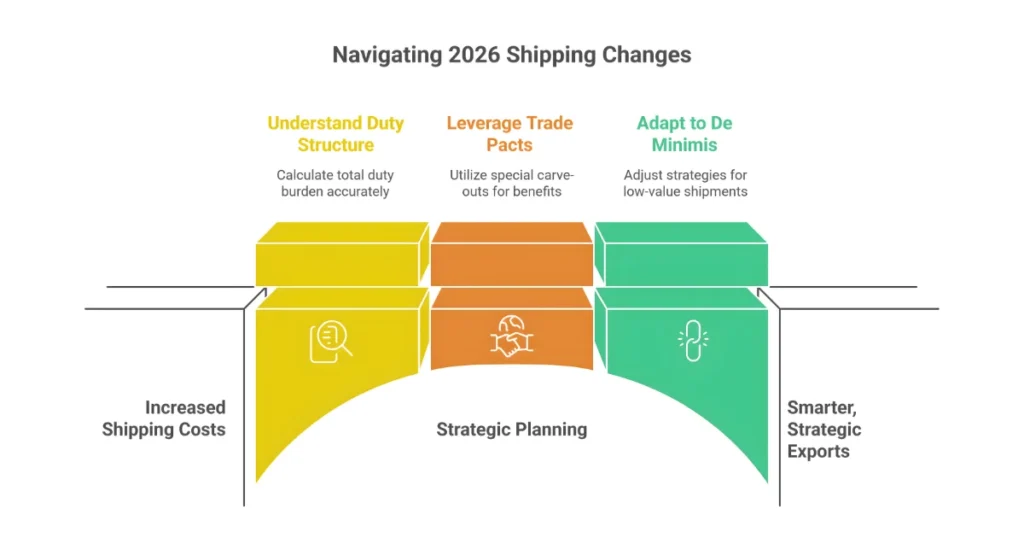
Let’s visualize this in a real-world scenario:
Factory in Dhaka → Inland Transport (Truck) → Port/Airport → USA Destination
- Goods are produced in factories (mostly around Dhaka, Gazipur, Narayanganj)
- Transported by truck to:
- Chittagong Port (most common for sea freight)
- Mongla Port (alternative option)
- Dhaka Airport (for air freight)
- Then shipped to major U.S. ports like Los Angeles, New York, or Houston
👉 Sounds simple, right? But every step has timing, cost, and coordination challenges.
Why This Matters for You
Here’s the honest truth:
You can have the best product, the best price, and a ready buyer…
But if your port strategy is weak?
Your entire Shipping from Bangladesh to USA operation can fall apart.
Smart exporters:
- Choose ports based on cargo type and urgency
- Avoid congestion risks with backup options
- Align factory production with shipping schedules
Because in this business, it’s not just about what you ship—
It’s about how smoothly you get it out of the country.
And that’s where the real game is won.
Tariffs, Trade Pacts, and the End of “De Minimis”
Alright—this is the part nobody wants to deal with… but absolutely has to. Because when it comes to Shipping from Bangladesh to USA, tariffs and customs rules aren’t just background noise—they directly decide how much money you keep (or lose).
Let’s unpack what’s changed in 2026—and why exporters are paying very close attention.
📉 The February 2026 Trade Pact: Small Drop, Big Signal
So here’s the headline:
A new U.S.–Bangladesh trade agreement in February 2026 reduced the reciprocal tariff rate from 20% to 19%.
Now you might be thinking:
“Wait… just 1%? That’s it?”
But hold on—that 1% can be a big deal at scale.
👉 Example:
If you’re exporting $1 million worth of garments annually, that’s $10,000 saved. Not exactly pocket change.
But here’s where it gets interesting:
There are special carve-outs for products made using U.S.-grown cotton.
That means:
- If your supply chain includes American cotton
- You may qualify for additional tariff benefits
👉 This is a strategic play. Some smart manufacturers are already tweaking sourcing strategies to take advantage of this.
What it really signals:
The U.S. is slowly opening the door—but not fully. Bangladesh still doesn’t have full duty-free access like some competitors.
💰 Understanding the Total Duty Burden (This Is Where It Gets Tricky)
Here’s where many exporters get caught off guard.
That 19% tariff?
It’s not always the only duty you’re paying.
You also need to consider MFN (Most Favored Nation) duties—the baseline tariffs applied to imports.
So your total duty burden can look like this:
- MFN duty (varies by product category)
- Reciprocal tariff (19%)
- = Final landed duty cost
👉 Real-world example:
- Apparel MFN duty: ~10–16%
- Add 19% reciprocal tariff
- Total duty impact: can exceed 25–30%+
Now imagine you didn’t factor that into your pricing…
Suddenly:
- Your buyer complains about high landed cost
- Your margins shrink
- Or worse—you lose the deal entirely
😬 Yeah… not fun.
This is why understanding duty structure is critical for Shipping from Bangladesh to USA.
It’s not just logistics—it’s pricing strategy, negotiation power, and long-term survival.
🚫 The Death of the $800 Loophole (a.k.a. “De Minimis”)
Okay, this one? It’s a game-changer.
Previously, the U.S. allowed shipments under $800 to enter duty-free under something called the de minimis exemption.
This was HUGE for:
- Samples
- Small e-commerce shipments
- Trial orders
Exporters loved it. Buyers loved it. Everyone was happy.
But in 2026?
That loophole is gone.
The U.S. has suspended the de minimis rule for many imports, meaning:
👉 Even low-value shipments now require:
- Formal customs entry
- Documentation
- Duties (in many cases)
Let’s make this real:
Before:
- You send a $200 sample → No duty, minimal paperwork, fast clearance
Now:
- Same $200 sample → Full customs process, possible duties, delays
You can already guess what happens next:
- Higher costs
- Slower approvals
- More friction in buyer relationships
And if you’re running an e-commerce export business?
This hits hard.
😓 What This Means for You (Yes, It’s Complicated—but Manageable)
Let’s be honest—2026 isn’t making things easier.
Between layered tariffs and stricter customs rules, Shipping from Bangladesh to USA now requires more planning than ever.
But here’s the upside:
Exporters who understand this system are winning.
They’re:
- Pricing smarter
- Structuring shipments strategically
- Avoiding surprise costs
- Building trust with U.S. buyers
👉 And most importantly—they’re not getting blindsided.
🔑 Bottom Line
- That “small” tariff drop? It matters—especially at scale
- Total duty = more than just one number (always calculate the full picture)
- The de minimis change? A wake-up call for anyone relying on low-value shipping
Yes, it’s more complex now.
But complexity creates opportunity—for those who know how to navigate it.
And once you do?
You’re no longer just exporting… you’re playing the game at a much higher level.
🔥 Hot Cargo: What the US is Sourcing in 2026
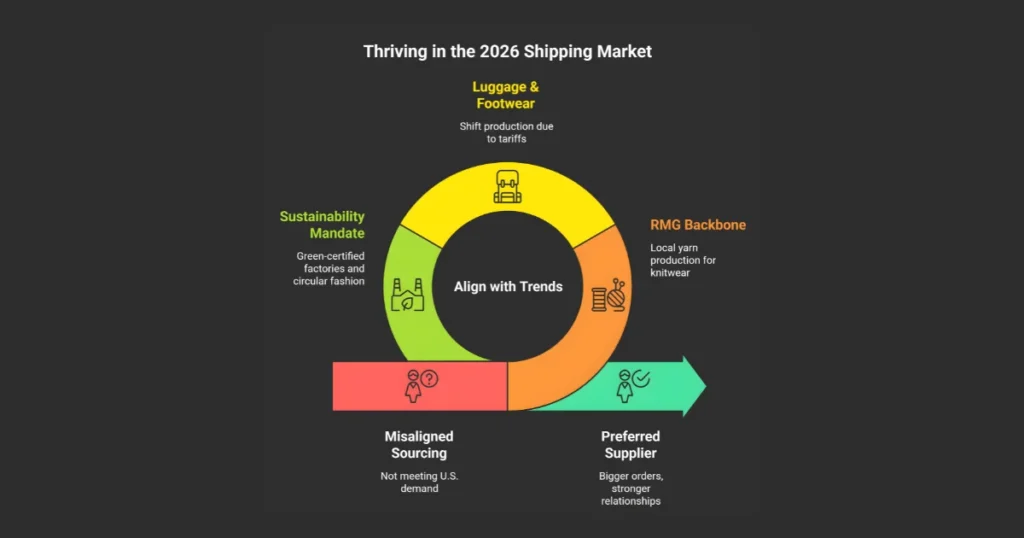
Let’s talk about what’s actually moving right now—because understanding demand is half the battle in Shipping from Bangladesh to USA.
You can master logistics, negotiate great freight rates, and still struggle… if you’re not aligned with what U.S. buyers are actively sourcing.
So here’s the inside scoop 👇
👕 The RMG Backbone: Why Knitwear Still Rules
Bangladesh’s ready-made garment (RMG) sector isn’t just surviving—it’s dominating. And a big reason for that is something called “backward linkage.”
Sounds technical, but here’s the simple version:
👉 Instead of importing yarn and fabric, Bangladesh is increasingly producing them locally.
Why does that matter?
- Faster production cycles
- Lower dependency on foreign suppliers
- Better cost control
- More flexibility for last-minute orders
And in the fast-moving world of fashion? That’s gold.
Knitwear, in particular, is where Bangladesh shines:
- T-shirts
- Polo shirts
- Sweaters
- Activewear
These products benefit massively from local yarn production, making Bangladesh one of the most competitive suppliers globally.
📊 Fun fact: Bangladesh remains one of the top 3 apparel exporters to the U.S., with knitwear leading the charge year after year.
👉 Real-life scenario:
A U.S. retailer needs to restock best-selling t-shirts fast. Suppliers relying on imported fabric take weeks longer. Bangladeshi factories? They move quicker—and win the order.
What this means for you:
If you’re in knitwear, you’re sitting on a massive advantage. Pair that with efficient Shipping from Bangladesh to USA, and you’ve got a winning formula.
🎒 The Luggage & Footwear Surge: The Unexpected Goldmine
Now here’s where things get exciting.
While everyone talks about garments, a quiet revolution is happening in:
- Travel bags
- Backpacks
- Footwear
These categories are seeing 50%+ growth in exports to the U.S. in recent years.
Why the sudden boom?
👉 One word: China tariffs.
U.S. importers are actively shifting away from China in these categories due to high duties. And guess who’s stepping in?
Yep—Bangladesh.
Why Bangladesh is winning here:
- Competitive labor costs
- Growing expertise in leather and synthetic materials
- Expanding manufacturing capacity
👉 Example:
A U.S. travel brand that used to source backpacks from China now splits production—with a significant chunk moving to Bangladesh to cut tariff costs.
But here’s the catch (there’s always one, right?):
These products often have:
- More complex designs
- Higher quality expectations
- Tighter delivery timelines
So now, your logistics game has to level up too.
Because when you’re shipping higher-value goods, mistakes in Shipping from Bangladesh to USA get expensive—fast.
🌱 The Sustainability Mandate: “Green” Is No Longer Optional
This one isn’t a trend. It’s a requirement.
U.S. brands in 2026 are obsessed with:
- Green-certified factories (LEED-certified, eco-compliant)
- Circular fashion (recycling, reuse, waste reduction)
- Water-saving dyeing and finishing processes
And they’re not just asking politely—they’re demanding proof.
👉 Why?
Because consumers in the U.S. are pushing hard for sustainability. Brands that don’t comply risk losing market share—and reputation.
Bangladesh, surprisingly, is stepping up in a big way:
- Home to 100+ LEED-certified green garment factories (one of the highest in the world)
- Investments in energy-efficient production
- Adoption of eco-friendly technologies
👉 Real-world scenario:
A U.S. brand chooses between two suppliers:
- One cheaper but not environmentally certified
- One slightly more expensive but fully compliant
Guess who wins?
The sustainable one. Every time.
😬 What This Means for You
Let’s be honest—this new landscape can feel overwhelming.
You’re not just:
- Producing goods
- And arranging Shipping from Bangladesh to USA
You’re now expected to:
- Optimize supply chains
- Meet sustainability standards
- Deliver faster
- Stay price competitive
Yeah… it’s a lot.
🚀 But Here’s the Opportunity
If you can align with these “hot cargo” trends, you’re not just another exporter—you become a preferred supplier.
That means:
- Bigger orders
- Long-term contracts
- Stronger buyer relationships
And when you combine that with smart, reliable Shipping from Bangladesh to USA?
You’re no longer chasing opportunities…
They start coming to you.
Major Import Ports in the USA
Alright—your shipment has survived production, paperwork, and a long ocean journey. Now comes the make-or-break moment: where it lands in the U.S.
Choosing the right destination port isn’t just a technical detail—it directly impacts cost, delivery time, and your buyer’s happiness. And when you’re dealing with Shipping from Bangladesh to USA, this decision can seriously level up (or mess up) your entire supply chain.
Let’s walk through the key U.S. gateways like we’re mapping out your next big shipment 👇
🚢 Port of Los Angeles & Port of Long Beach – The West Coast Giants
These two ports are basically the front door of Asia to America.
Together, they handle a massive chunk of U.S. imports—especially from Asia, including Bangladesh.
Why exporters love them:
- Faster ocean transit from Asia (compared to East Coast routes)
- High-frequency vessel schedules
- Ideal for West Coast distribution (California, Texas, nearby states)
But here’s the reality check:
- Congestion can be brutal during peak seasons
- Port delays = extra costs + unhappy buyers
👉 Best use case:
If your buyer is on the West Coast or needs faster ocean transit, this is usually your best bet.
🚢 Port of New York and New Jersey – The East Coast Powerhouse
This is the largest import hub on the East Coast—and a favorite for apparel shipments.
Why it matters for Shipping from Bangladesh to USA:
- Direct access to major retail markets (New York, New Jersey, Pennsylvania)
- Strong distribution networks for fashion and e-commerce
- Less inland transport needed for East Coast buyers
The trade-off:
- Longer ocean transit (often via transshipment or Panama Canal routes)
- Potentially higher shipping costs
👉 Real-world example:
If your buyer’s warehouse is in New Jersey, shipping to Los Angeles first makes zero sense—you’ll just add time and trucking costs.
🚢 Port of Savannah – The Rising Star
Savannah has been quietly becoming a logistics superstar.
Why everyone’s talking about it:
- Faster container turnaround times
- Less congestion than older ports
- Strategic location for Southeast U.S. distribution
📊 In recent years, Savannah has ranked among the fastest-growing container ports in the U.S.
👉 Best for:
- Retailers distributing across the Southeast
- Importers looking to avoid congestion in New York
Exporter insight:
Some U.S. buyers are now requesting Savannah specifically to keep their supply chains smooth.
🚢 Port of Houston – The Central Connector
Houston is your gateway to the central U.S. market.
Why it’s important:
- Strong rail and trucking connections across the Midwest
- Ideal for distributing goods inland
- Less coastal congestion compared to LA/NY
👉 Perfect scenario:
If your buyer serves multiple states in the middle of the U.S., Houston can cut down inland transport costs significantly.
🧭 So… Which Port Should You Choose?
Here’s the honest answer: it depends on your buyer’s location and priorities.
- West Coast buyers → Los Angeles / Long Beach
- East Coast retailers → New York / New Jersey
- Southeast distribution → Savannah
- Central U.S. coverage → Houston
👉 The biggest mistake exporters make?
Choosing a port based on habit—not strategy.
💡 Final Thought
You’ve already done the hard work—manufacturing, pricing, negotiating.
Now don’t let a poor port choice slow you down.
Because in Shipping from Bangladesh to USA, the final destination isn’t just where your cargo lands…
It’s where your reputation as a reliable exporter is either built—or broken.
Shipping Routes & Transit Time
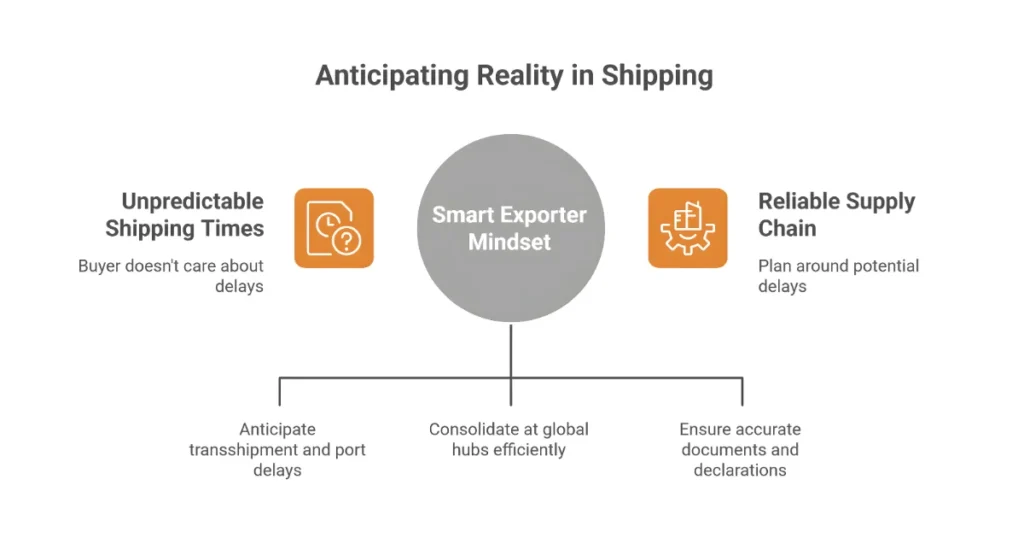
Let’s talk about the journey your cargo actually takes—because when it comes to Shipping from Bangladesh to USA, it’s not just about where your goods start and end… it’s everything that happens in between.
And trust me, that journey? It’s rarely a straight line.
🚢 Ocean Freight Routes: The Long but Cost-Effective Journey
Most shipments from Bangladesh don’t go directly to the U.S. in one shot. Instead, they follow a transshipment route.
Here’s the typical path:
Chittagong → Singapore / Colombo → USA (West or East Coast)
Why the stopover?
Because Bangladesh doesn’t always have direct vessel connections to the U.S., so containers are transferred (“transshipped”) at major global hubs like:
- Singapore (one of the busiest ports in the world)
- Colombo (a key South Asian hub)
⏱️ Transit Time: ~25–45 days
Yeah, it’s a wide range—and here’s why:
- Some routes are faster (West Coast via Pacific)
- Others take longer (East Coast via Panama Canal or additional stops)
👉 Real-life scenario:
You ship a container of garments. It reaches Singapore smoothly—but misses the connecting vessel by 2 days. That small delay? It can turn a 28-day transit into 35+ days.
Welcome to real-world logistics 😅
✈️ Air Freight Routes: Speed with Strategic Stopovers
Air freight is much faster—but still not always direct.
Typical route:
Dhaka → Middle East / European Hub → USA
Common transit hubs include:
- Dubai
- Doha
- Istanbul
- Frankfurt
⏱️ Transit Time: ~3–7 days
Why the stopovers again?
Because:
- Direct cargo flights from Dhaka to the U.S. are limited
- Consolidation at global hubs improves efficiency and availability
👉 Example:
A shipment leaves Dhaka → lands in Doha → connects to New York → delivered within 5 days.
Fast, efficient, and perfect when time is critical.
⚠️ What Actually Affects Transit Time? (This Is Where Things Get Real)
Here’s the part most guides don’t explain well—because transit time isn’t just about distance.
It’s about what can go wrong (or right) along the way.
⛴️ Transshipment Delays
This is the #1 hidden factor in ocean shipping.
- Missed connections at hubs
- Overbooked vessels
- Poor coordination between carriers
👉 Even a 1–2 day delay at a hub can snowball into a week-long delay.
🚧 Port Congestion
Some ports get crazy busy—especially during peak seasons.
- Long waiting times for berthing
- Delays in unloading containers
- Backlogs in processing
👉 If your shipment hits a congested port, your timeline instantly becomes… unpredictable.
🌧️ Weather Conditions
Mother Nature doesn’t care about your delivery deadline.
- Storms in the Indian Ocean or Pacific
- Heavy rains affecting port operations
- Seasonal disruptions
👉 These can slow down vessels or delay port handling.
🛃 Customs Clearance Efficiency
This one’s often underestimated.
Even if your shipment arrives on time:
- Missing documents
- Incorrect declarations
- Inspection delays
👉 Can hold your cargo for days—or even weeks.
😬 Why This Matters More Than You Think
Let’s be honest—your buyer doesn’t care about why your shipment is late.
They care about:
- Stock availability
- Retail deadlines
- Customer demand
And if you can’t deliver on time?
They’ll find someone who can.
💡 The Smart Exporter’s Mindset
Successful exporters don’t just ask:
“How long does shipping take?”
They ask:
“What could delay it—and how do I plan for that?”
That’s the difference.
Because mastering Shipping from Bangladesh to USA isn’t about memorizing transit times…
It’s about anticipating reality and building a supply chain that can handle it.
🚀 Bottom Line
- Ocean freight = cheaper, slower, more variables
- Air freight = faster, costlier, more predictable
- Transit time = not fixed—it’s influenced by multiple moving parts
Once you understand this, you stop reacting to delays…
And start planning around them like a pro.
Shipping Logistics & Port Realities
Let’s get into the part nobody really glamorizes—but every exporter eventually learns the hard way: logistics on the ground.
Because here’s the truth—Shipping from Bangladesh to USA isn’t just about choosing ocean or air. It’s about how well you handle the real-world bottlenecks, paperwork, and timing pressure that come with it.
Let’s walk through it like someone who’s been through a few shipping headaches already 👇
🚢 Navigating Chittagong Port: Where Everything Gets Real
This is Bangladesh’s main export gateway—and honestly, it’s both a blessing and a challenge.
The good stuff:
- Handles the majority of export cargo
- Strong connectivity to global shipping lines
- Essential for large-scale shipments
The reality check:
- Congestion is common
- Container handling can slow down during peak seasons
- Truck queues and port delays can stretch timelines
👉 What this means for you:
You can’t just think, “Production finishes on Monday, ship leaves Tuesday.”
Realistically, you need to:
- Build in buffer time (3–7 extra days)
- Coordinate closely with freight forwarders
- Track vessel schedules like your business depends on it (because it does)
👉 Real-life scenario:
Your goods are ready—but miss the vessel cutoff by a few hours. Result? You wait for the next sailing… and lose a full week.
Yeah. It happens more often than you’d think.
✈️ The Dhaka Air Route via Hazrat Shahjalal International Airport: The Pressure Valve
When ocean freight starts failing—delays, missed deadlines, buyer panic—this is your emergency exit.
Dhaka’s main airport becomes the lifeline for urgent shipments.
Why it’s critical:
- Handles the bulk of Bangladesh’s air cargo
- Keeps supply chains moving during crises
- Saves relationships with demanding buyers
But here’s the twist…
When everyone rushes to air freight at the same time:
- Cargo space gets tight
- Rates shoot up (sometimes 2x or more)
- Booking becomes competitive
👉 Example:
A delayed ocean shipment risks missing a retail season. The buyer demands urgent delivery. You switch to air freight—but now you’re competing with dozens of other exporters doing the same thing.
Lesson?
Air freight isn’t just fast—it’s your backup strategy. Use it wisely.
📄 The Paperwork Checklist (Your Silent Deal-Maker… or Deal-Breaker)
Let’s be honest—documentation isn’t exciting.
But mess this up, and your shipment doesn’t move. Simple as that.
Here are the must-have documents for Shipping from Bangladesh to USA:
- Commercial Invoice → Details of goods, value, buyer/seller info
- Packing List → Breakdown of contents, weight, dimensions
- Certificate of Origin → Confirms goods are made in Bangladesh
- Bill of Lading (B/L) → The most important shipping document (your cargo’s “passport”)
👉 Common mistake:
Small errors—wrong HS code, mismatched quantities, missing details.
Result?
- Customs delays
- Extra inspections
- Unexpected costs
😬 And yes, your buyer will notice.
⏱️ The ISF Filing Rule: The 24-Hour Deadline You Can’t Ignore
Now this one is critical—and often misunderstood.
The U.S. requires something called the Importer Security Filing (ISF), also known as “10+2”.
Rule:
Your U.S. customs broker must submit shipment data at least 24 hours before cargo is loaded onto the vessel.
Not after loading.
Not “close enough.”
Before loading.
👉 Why this matters:
If you miss it:
- Fines can go up to $5,000 per shipment
- Cargo can be delayed or even held
- Your reputation with buyers takes a hit
👉 Real-world scenario:
You finalize documents late. The ISF isn’t filed on time. The container gets flagged.
Now instead of a smooth shipment—you’re dealing with delays, penalties, and an unhappy client.
😓 The Reality of Shipping in 2026
Let’s not sugarcoat it.
Managing Shipping from Bangladesh to USA today means juggling:
- Port congestion
- Tight schedules
- Rising costs
- Strict compliance rules
It’s not easy.
🚀 But Here’s the Advantage
Most exporters struggle because they react.
Smart exporters plan ahead:
- They build buffer time into schedules
- Double-check every document
- Coordinate closely with brokers and forwarders
- Treat logistics as a core strategy—not an afterthought
And that’s the difference between:
- Constant stress…
vs. - Smooth, predictable shipments
💡 Final Thought
You don’t need to control everything in logistics (that’s impossible).
But you do need to control what you can:
- Timing
- Documentation
- Communication
Get those right, and Shipping from Bangladesh to USA stops feeling like chaos…
and starts feeling like a system you can actually rely on.
Step-by-Step Shipping Process (BD → USA)
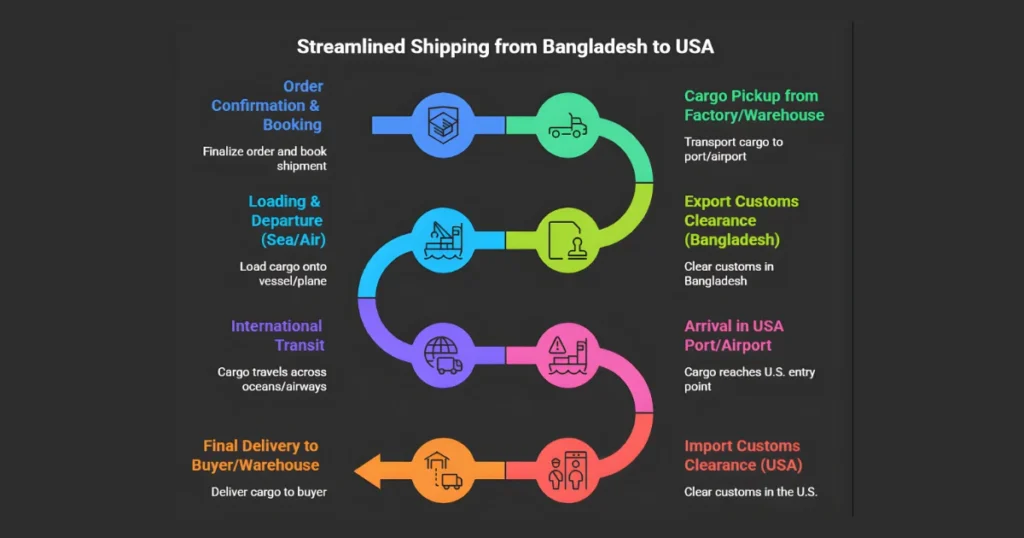
Alright—let’s simplify the whole journey.
Because when people talk about Shipping from Bangladesh to USA, it often sounds complicated, technical, and honestly… a bit overwhelming.
But when you break it down step by step?
It’s actually a clear process—you just need to know what happens when (and where things can go wrong 😅).
Let’s walk through it like you’re handling a real shipment 👇
📝 1. Order Confirmation & Booking
Everything starts here.
- You finalize the order with your U.S. buyer
- Agree on price, Incoterms (FOB, CIF, etc.), and delivery timeline
- Book your shipment with a freight forwarder or carrier
👉 Pro tip:
Don’t wait until production is finished to book space—especially during peak seasons. Ships and planes fill up fast.
🚚 2. Cargo Pickup from Factory/Warehouse
Your goods are ready—great. Now they need to move.
- Cargo is picked up from your factory (Dhaka, Gazipur, Narayanganj, etc.)
- Transported via truck to port or airport
👉 Reality check:
Traffic, road conditions, and timing can all impact this stage. A late pickup can mean missing your vessel cutoff.
🛃 3. Export Customs Clearance (Bangladesh)
Before your shipment leaves the country, it must be cleared by customs.
Handled through:
- National Board of Revenue (NBR)
- Your customs clearing agent (C&F agent)
Documents required:
- Commercial Invoice
- Packing List
- Export Declaration
- Certificates (if applicable)
👉 Common mistake:
Incorrect documentation = delays + extra costs.
🚢✈️ 4. Loading & Departure (Sea/Air)
Now your cargo officially begins its journey.
- Loaded onto a vessel at Chittagong Port
- Or flown out via Hazrat Shahjalal International Airport
👉 Key moment:
This is where the ISF filing deadline (24 hours before loading) becomes critical for U.S. compliance.
Miss it—and you’re in trouble.
🌍 5. International Transit
Your shipment is now on the move.
- Ocean freight → via transshipment hubs (Singapore, Colombo)
- Air freight → via Middle East/European hubs
⏱️ Transit time:
- Sea: ~25–45 days
- Air: ~3–7 days
👉 This is the “waiting game”—but also where delays can happen due to weather, congestion, or missed connections.
🇺🇸 6. Arrival in USA Port/Airport
Your cargo finally reaches the U.S. 🎉
Typical entry points:
- Port of Los Angeles
- Port of New York and New Jersey
- Port of Savannah
👉 But don’t celebrate just yet—your shipment isn’t “delivered” until it clears customs.
🛃 7. Import Customs Clearance (USA)
Now U.S. Customs steps in.
Handled by:
- Your buyer’s customs broker
- U.S. Customs and Border Protection (CBP)
What happens here:
- Document verification
- Duty and tax calculation
- Possible inspection
👉 If everything is correct → smooth clearance
👉 If not → delays, inspections, penalties
This is where your earlier paperwork either saves you… or haunts you.
🚚 8. Final Delivery to Buyer/Warehouse
Last step—almost there!
- Cargo is picked up from the port/airport
- Delivered via truck or rail to the buyer’s warehouse
👉 This is where multimodal logistics comes into play.
And finally…
Your shipment reaches its destination ✅
If you want a trouble-free shipping service. Then sit back and relax, we handle everything from pickup to final delivery.
😬 Where Things Usually Go Wrong
Let’s be honest—problems don’t happen randomly. They usually happen at:
- Booking too late
- Missing vessel cutoffs
- Documentation errors
- ISF filing delays
- Poor coordination between parties
✅ Why Choose Fangrun?
✔ Experienced in Bangladesh to USA shipping
✔ Fast customs clearance support
✔ Competitive pricing for businesses & individuals
✔ Door-to-door delivery available
📞 Call now to speak directly with a shipping expert
💬 WhatsApp us for instant assistance
🚀 Most shipments are processed within 24–48 hours after confirmation.
🚀 The Big Picture
When you understand this flow, Shipping from Bangladesh to USA stops feeling chaotic.
Instead, it becomes:
- A structured process
- With clear checkpoints
- And predictable risks
And once you master that?
You’re not just shipping goods…
You’re running a professional, reliable export operation that buyers trust.
Shipping Costs from Bangladesh to USA: What You’ll Really Pay (And How Not to Get Ripped Off)
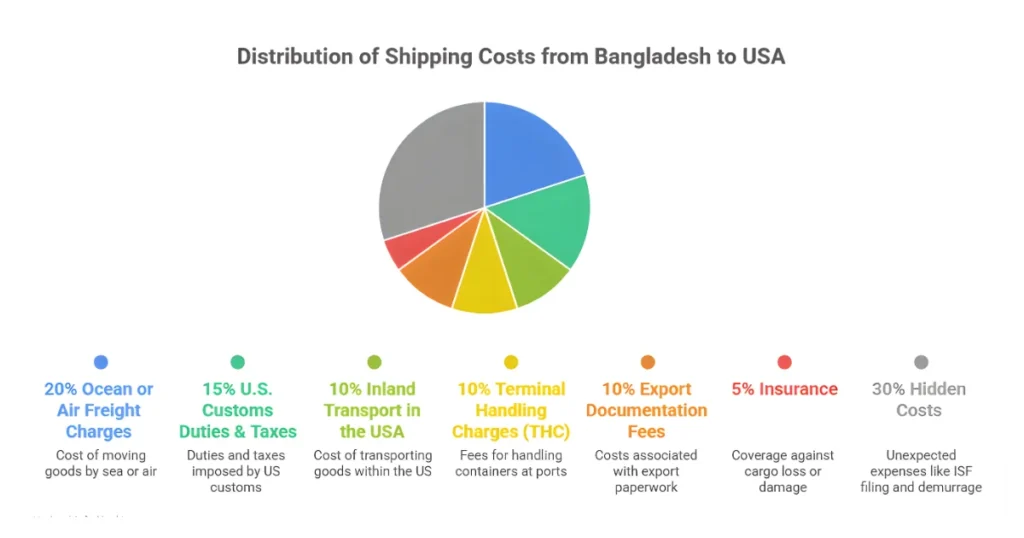
Let me tell you about a conversation I had last week with a garment manufacturer in Dhaka.
“Someone quoted me $1,800 for a 20-foot container to New York,” he said, practically glowing. “Is that real?”
I took a deep breath. “My friend,” I said, “that’s like someone offering you a brand new iPhone for $50. It might exist, but you really don’t want to find out the hard way.”
Here’s the thing about shipping from Bangladesh to USA—the initial quote you get is rarely the final number you pay. It’s like buying a house. The listing price is just the beginning. Then come the closing costs, the inspection fees, the title insurance, and suddenly you’re wondering where all your money went.
But don’t worry. I’m going to walk you through exactly what shipping from Bangladesh to the US actually costs, break down every sneaky fee, and give you the tools to spot a bad quote from a mile away.
The Big Picture: What You’re Actually Paying For
Before we dive into numbers, let me show you all the hands that reach into your wallet during a shipment from Bangladesh to America.
Ocean or Air Freight Charges
This is the headline number—the one freight forwarders put in bold on their quotes. It’s the cost of moving your container from Chittagong or Dhaka to a US port.
Ocean Freight (FCL 20ft): Realistically, you’re looking at $1,500–$3,000 for a standard 20-foot container. But here’s the honest truth—rates in early 2026 have been running closer to $2,500–4,000 to the US East Coast due to ongoing market volatility【7†L3-L4】.
LCL (Less than Container Load): If you’re not filling a whole container, expect $150–$300 per cubic meter (CBM). That’s for ocean freight only. Remember, you’ll pay destination handling fees on top of this.
Air Freight: Need it fast? You’ll pay $4–$8 per kilogram, depending on volume and urgency. A 500kg shipment could run you $2,000–4,000. Ouch. But sometimes you have no choice.
Terminal Handling Charges (THC)
Both Bangladesh and US ports charge for the “privilege” of handling your container. At Chittagong, this might run $150–250. At US ports like New York/New Jersey or Los Angeles, add another $200–400. The ports need their cut.
Export Documentation Fees
Paperwork isn’t free in Bangladesh either. Expect to pay:
- Bill of Lading fee: $30–50
- Certificate of Origin: $20–40 (you’ll need this for duty preferences)
- Export customs clearance: $50–100
- ISF filing (Importer Security Filing): $25–50—this is mandatory for all US-bound ocean shipments and must be filed at least 24 hours before loading
U.S. Customs Duties & Taxes
This is where things get interesting—and potentially expensive.
The US has a de minimis rule: shipments valued under $800 can enter duty-free. That’s right—small shipments can skip customs duties entirely【9†L0-L2】. For larger commercial shipments, duty rates vary wildly by product category:
- Garments (Bangladesh’s biggest export to the US): 11–32% depending on fabric type. A cotton sweater might pay 16%, while synthetic blends could hit 28%. Ouch.
- Leather goods (shoes, bags): 8–15%
- Jute products (Bangladesh is famous for this): 0–8%
- Electronics: 0–5% (one of the few bright spots)
And don’t forget the Merchandise Processing Fee (MPF) —0.3464% of the entered value, with a minimum of $29.66 and a maximum of $575.35. It’s not huge, but it’s there.
Inland Transport in the USA
Your container arrives at a US port—say, New York/New Jersey, Savannah, or Los Angeles. But your warehouse isn’t at the port, is it?
Trucking your container from the port to your final destination can cost:
- Within 100 miles of port: $300–600
- 500 miles inland: $1,000–1,800
- Cross-country (port to West Coast if you arrived at East Coast): $2,500–4,000
Pro tip: If your customers are spread across the US, consider shipping to a port closer to your main market. Bangladesh to US East Coast (New York, Savannah) is typically faster and cheaper than to West Coast ports.
Insurance (Optional But Highly Recommended)
Here’s a scary statistic: cargo theft in the US increased by 57% in 2023, with the average loss valued at $260,000 per incident【5†L6-L8】. Your container isn’t immune.
Marine cargo insurance typically costs 0.1–0.3% of your cargo value. On a $50,000 shipment, that’s $50–150. Worth every penny when you consider what’s at stake.
Real story: A friend of mine shipped $80,000 worth of leather jackets from Dhaka to Los Angeles. He skipped insurance to save $200. The container was dropped during unloading. Jackets everywhere. Damaged. Unsellable. The shipping line offered him $500—the standard liability limit. He lost $79,500. Don’t be my friend.
Let’s Get Real: Example Cost Breakdowns
Scenario 1: Small Business Shipment (LCL)
You’re shipping 8 cubic meters of readymade garments from Dhaka to your boutique in Chicago.
| Cost Component | Estimated Amount |
|---|---|
| LCL ocean freight (8 CBM × $200) | $1,600 |
| Bangladesh export THC | $180 |
| Export documentation | $100 |
| ISF filing | $35 |
| US import THC | $250 |
| US customs duties (15% of $20,000 CIF) | $3,000 |
| Trucking Chicago (port to warehouse) | $800 |
| Insurance ($20,000 cargo × 0.2%) | $40 |
| Total estimated cost | $6,005 |
The freight quote alone was $1,600. The total was $6,005. That’s nearly four times the “headline” number. This is why you need to read the fine print.
Scenario 2: Large Shipment (FCL 20ft)
You’re shipping a full 20-foot container of jute products (20 CBM, 18,000 kg) from Chittagong to Savannah, then trucking to Atlanta.
| Cost Component | Estimated Amount |
|---|---|
| FCL ocean freight | $2,800 |
| Bangladesh export THC | $200 |
| Export documentation + ISF | $150 |
| US import THC | $300 |
| US customs duties (5% of $45,000 CIF) | $2,250 |
| Trucking Savannah to Atlanta | $450 |
| Insurance ($45,000 × 0.15%) | $68 |
| Total estimated cost | $6,218 |
Scenario 3: Emergency Air Freight
Your US customer needs 200 kg of samples yesterday.
| Cost Component | Estimated Amount |
|---|---|
| Air freight (200 kg × $6/kg) | $1,200 |
| Export documentation | $100 |
| US customs clearance | $150 |
| US duties (varies) | $50–500 |
| Total estimated cost | $1,500–2,000 |
The Hidden Costs Nobody Warns You About
ISF Filing: The $35 Fee That Can Cost You $5,000
The Importer Security Filing (ISF) must be filed at least 24 hours before your cargo is loaded on the vessel at Chittagong. Miss this deadline? The fine starts at $5,000. Your forwarder should handle this for $35–50. Don’t skip it.
Demurrage & Detention
Your container arrives at the US port. You have “free time”—usually 4–5 days—to pick it up. After that, demurrage (port storage) and detention (container late fees) kick in. These can run $100–200 per day, per container. A two-week delay could cost you $2,000+ in fees alone.
Peak Season Surcharges
Shipping from Bangladesh to USA is cheaper in February than in August. Why? Retailers stock up for the holidays, and everyone ships at once. During peak season (August–October), expect to pay 20–50% more for ocean freight. Plan accordingly.
Bangladesh to USA: Key Trade Statistics
Let me give you some context so you understand the scale here.
In fiscal year 2024-2025, Bangladesh’s exports to the United States reached approximately $8.5 billion—making the US Bangladesh’s single largest export market【1†L0-L2】.
The readymade garment (RMG) sector alone accounted for over 80% of that total, with the US importing more than $6.8 billion worth of Bangladeshi apparel【3†L8-L9】.
Export growth to the US jumped 14.24% year-over-year in June 2025, signaling strong demand【2†L0-L1】.
What does this mean for you? You’re not alone. Thousands of Bangladeshi exporters ship to the US every single day. The infrastructure exists. The routes are established. The forwarders know what they’re doing. You just need to find the right partner.
Transit Times: How Long Will It Take?
- Ocean freight (Chittagong to US East Coast): 25–35 days, depending on transshipment at Colombo, Singapore, or Port Klang
- Ocean freight (Chittagong to US West Coast): 30–45 days (longer distance, plus potential Panama Canal delays)
- Air freight (Dhaka to US): 3–7 days, depending on connections
Pro tip: If you’re shipping to the US East Coast (New York, Savannah, Charleston), you’ll typically get faster transit and lower costs than West Coast destinations. The Suez Canal route (for East Coast) is generally more efficient than crossing the Pacific to the West Coast.
How to Reduce Your Shipping Costs from Bangladesh to USA
1. Consolidate Shipments
If you’re shipping LCL, wait until you have 10–12 CBM before booking. The per-unit cost drops significantly as volume increases.
2. Choose the Right Incoterm
FOB Chittagong is standard for Bangladesh exports—you control the freight from the port onward. CIF puts more responsibility on your supplier (and often higher costs). EXW gives you maximum control but requires you to arrange pickup from the factory.
3. Plan Around Peak Seasons
Avoid shipping between August and October if possible. Rates are higher, space is tighter, and delays are more common.
4. Get Multiple Quotes
Always get at least 3–5 quotes for every shipment. Rates vary dramatically between forwarders. But remember—the cheapest quote is often hiding the most fees.
5. Build Relationships
The best rates come from repeat business. Find a forwarder you trust, give them consistent volume, and they’ll reward you with better pricing and priority service.
The Bottom Line
Shipping from Bangladesh to the USA isn’t cheap. But it doesn’t have to be a mystery either.
The quote you get is just the beginning. Terminal charges, documentation fees, customs duties, inland transport, and insurance can easily double—or triple—your total cost.
The cheapest option is rarely the best option. That $1,800 quote for a 20ft container? It’s missing about $3,000 in “extras” you’ll discover later.
Planning saves money. Consolidate shipments. Avoid peak seasons. Build relationships. Get everything in writing.
And for the love of your profit margins, buy the insurance.
📦 Not sure which option is best for you?
📞 Call now to get the exact cost based on your cargo
💬 Or message us on WhatsApp for a quick quote (response within 10 minutes)
⚠️ Prices may vary based on cargo type, season, and airline/shipping line availability. Contact us for the most accurate quote.
Required Documents for Export & Import: Your Paperwork Lifeline for Shipping from Bangladesh to the USA
Let me tell you about a nightmare I witnessed firsthand.
A leather goods exporter in Dhaka—let’s call him Mr. Hasan—had a container ready to ship to New York. $120,000 worth of handcrafted bags. A dream order from a major US retailer. Everything was perfect.
The container arrived at Chittagong port. The ship sailed. Twenty-eight days later, it reached New York.
And then… nothing.
The US customs broker called Mr. Hasan. “Sir, where is your ISF filing?”
“My what?”
“You didn’t file the Importer Security Filing. Your container is sitting at the port. The fine is $5,000. Plus storage fees. Plus we can’t release the cargo until you fix this.”
Mr. Hasan spent the next two weeks in a panic. His customer was furious. The storage fees climbed to $2,000. The fine was real. And all because of one missing piece of paper.
Here’s the thing about shipping from Bangladesh to USA: The paperwork isn’t optional. It’s everything.
Your goods can be flawless. Your pricing can be unbeatable. Your customer can be desperate for your product. But if your documents are wrong, incomplete, or missing, your container sits. And sits. And sits.
Let me walk you through every document you need—on the Bangladesh side and the US side—so you don’t become the next Mr. Hasan.
Export Documents (Bangladesh Side): What You Need Before the Ship Leaves
Think of these as your passport. Without them, your goods aren’t going anywhere.
Commercial Invoice
This is your sales document. It tells US Customs what you’re shipping, who’s selling it, who’s buying it, and how much it’s worth.
What must be on it:
- Exporter and importer names and addresses
- Detailed description of goods (not just “garments”—say “men’s cotton woven shirts, 100% cotton, size M-XXL”)
- Quantity, unit price, total value
- Currency (USD is standard)
- Incoterms (FOB Chittagong, CIF New York, etc.)
- HS code (at least 6 digits, preferably 10)
Why it matters: US Customs uses the commercial invoice to assess duties. If your description is vague, they might hold your shipment for inspection. If your value seems too low, they’ll adjust it upward. Be honest. Be detailed.
Pro tip: Include your buyer’s US tax ID (EIN) on the invoice. It speeds up clearance.
Packing List
This is the inventory. It tells customs exactly what’s inside each box, carton, or pallet.
What it shows:
- Number of packages
- Contents of each package
- Net weight and gross weight
- Dimensions (length × width × height)
- Marks and numbers (how your boxes are labeled)
Real-life example: A shipment of 500 cartons of frozen fish. The packing list says “Carton 1-500: Hilsa fish, 10kg each.” Customs randomly opens Carton 347. They weigh it. 10kg. Good. They check the temperature log. Good. Everything matches. Clearance takes 2 days.
Without a packing list? They’d open ten cartons, count everything manually, and your clearance takes 10 days. And your fish thaws. You get the picture.
Export License
Most products don’t need an export license from Bangladesh. But some do.
When you need one:
- Military or dual-use items (things that could be used for weapons)
- Certain chemicals and pharmaceuticals
- Cultural artifacts (antiques, heritage items)
- Products subject to international sanctions
The reality: For 95% of Bangladeshi exports—garments, leather goods, jute products, agricultural items—no export license is required. But check with your forwarder. The 5% that need it can cause major problems if you skip it.
The penalty: Exporting controlled goods without a license is smuggling. That’s not a fine—that’s potentially criminal. Don’t mess with this.
Bill of Lading / Air Waybill
The Bill of Lading (B/L) for ocean freight, or Air Waybill (AWB) for air freight, is the contract of carriage. It’s also a document of title—whoever holds the original B/L owns the goods.
Two types you’ll encounter:
Original Bill of Lading (OBL): A physical paper document. Three originals are typically issued. The consignee needs one to take delivery. This is old-school and slow—mailing the OBL from Bangladesh to the US takes days.
Telex Release / Surrendered B/L: The carrier agrees to release the cargo without physical documents. Much faster. Standard for regular trade relationships. Most US importers prefer this.
What to check:
- Consignee name matches your buyer exactly
- Notify party is correct (usually your buyer’s customs broker)
- Description of goods matches commercial invoice
- No “discrepancies” noted (clean bill)
The nightmare scenario: You issue an Original B/L. You mail it to your US buyer. It gets lost in the mail. Your container arrives. Your buyer has no document. The container sits. You pay storage fees. You pay for a bond. You wait weeks for a replacement. Always, always use telex release if your buyer agrees.
Certificate of Origin
This document proves your goods were made in Bangladesh.
Why you need it: Under the US Generalized System of Preferences (GSP), certain Bangladeshi products can enter the US duty-free or at reduced rates. But you need a Certificate of Origin to claim those benefits.
The US-Bangladesh trade fact: Bangladesh currently benefits from GSP on about 2,000 product categories. However, the GSP program has lapsed periodically. As of early 2026, it’s active, but always check current status. Without GSP, garments from Bangladesh pay 11-32% duty. With GSP, some products pay 0%.
Where to get it: The Bangladesh Export Promotion Bureau (EPB) or the Bangladesh Chamber of Commerce issues these certificates. Your freight forwarder can help.
Pro tip: Get the certificate BEFORE the ship sails. You can’t get it retroactively. And make sure the goods described match exactly what’s in the container.
Import Documents (USA Side): What US Customs Demands
Now let’s talk about the American side of the equation. This is where many Bangladeshi exporters stumble—because they don’t realize how much the US requires.
Importer Security Filing (ISF) — The One Everyone Forgets
Remember Mr. Hasan from the beginning? This was his downfall.
What it is: A security filing that must be submitted to US Customs and Border Protection (CBP) at least 24 hours before your cargo is loaded on the vessel at Chittagong.
What it includes: 10 data elements—importer name, consignee name, seller name, buyer name, ship-to party, manufacturer name, country of origin, HS code, container stuffing location, consolidator name.
Who files it: Your US buyer’s customs broker or your freight forwarder. Someone has to do it. Don’t assume it’s being handled.
The penalty: $5,000 per violation. Yes, five thousand dollars. And your cargo can be held at the port until you file. Some importers have paid $10,000–20,000 for late filings.
The solution: Make ISF filing a mandatory checkbox on your pre-shipment checklist. Confirm with your forwarder 48 hours before loading that the ISF has been filed and accepted.
Customs Entry Documents (CBP Form 3461, 7501)
When your container arrives in the US, your buyer’s customs broker will file an entry with CBP.
CBP Form 3461 (Entry/Immediate Delivery): Requests release of the cargo. Once approved, your container can leave the port.
CBP Form 7501 (Entry Summary): Detailed declaration of goods, value, duties owed. Filed within 10 days of arrival.
What you need to provide your buyer’s broker:
- Commercial invoice (electronic copy)
- Packing list
- Bill of Lading (telex release or copy)
- Arrival notice from the shipping line
The timeline: With good documents, entry takes 2–4 hours. With missing or incorrect information, it can take days. Every day your container sits at the port costs money.
HS Code Classification
The Harmonized System (HS) code determines your duty rate. The US uses a 10-digit code called the HTSUS (Harmonized Tariff Schedule of the United States).
Why it’s critical: A garment classified under 6203.42.0010 (men’s cotton trousers) pays 16.6% duty. The same garment classified under 6203.43.0010 (men’s synthetic trousers) pays 28.2%. Same product, different fabric composition. Get it wrong, and you either overpay duty or get penalized for underpaying.
Who determines the code: The exporter (you) provides the code. US Customs can challenge it. If they disagree, they’ll reassign the code and bill your buyer for the difference plus penalties.
How to get it right:
- Use the US HTSUS search tool online
- Ask your forwarder or customs broker to verify
- Request a binding ruling from CBP if you’re unsure (takes months but gives certainty)
Real example: A Bangladeshi jute rug exporter used HS code 5702.20 (jute carpets). US Customs said it should be 5702.31 (woven carpets of other textile materials). The duty went from 0% to 9%. The exporter had to pay back duties on 12 previous shipments. Ouch.
FDA/USDA Approvals (If Applicable)
If you’re shipping food, beverages, dietary supplements, cosmetics, or medical devices, the US Food and Drug Administration (FDA) gets involved. If you’re shipping plants, seeds, meat, or agricultural products, the US Department of Agriculture (USDA) gets involved.
FDA requirements:
- Prior notice for food shipments (must be filed 24 hours before arrival)
- Facility registration (your factory must be registered with FDA)
- Prior notice confirmation number (needed for customs clearance)
USDA requirements:
- Phytosanitary certificate for plants/seeds
- Import permit for certain agricultural products
- Inspection at port of entry
The timeline: FDA can hold your shipment for 30 days for inspection. If they find issues, they can refuse entry entirely. Then your goods are destroyed or shipped back at your expense.
Real-life scenario: A Bangladeshi frozen food exporter shipped 20 tons of hilsa to New York. They forgot to file prior notice. The FDA held the container for 21 days. By the time it cleared, the fish was thawed and spoiled. The entire shipment was destroyed. $100,000 loss because of one missing filing.
The fix: If your product touches anything that goes in or on the human body, check FDA/USDA requirements BEFORE you ship. Start the registration process months in advance.
To ensure smooth shipping from Bangladesh to the USA, don’t worry, our team will guide you through every document to avoid delays or penalties.
Your Document Checklist: Before the Ship Sails
Print this out. Use it for every shipment.
| Document | Bangladesh Side | USA Side | Status |
|---|---|---|---|
| Commercial Invoice | ✓ | ✓ | ☐ |
| Packing List | ✓ | ✓ | ☐ |
| Export License | ✓ (if needed) | ☐ | |
| Bill of Lading (telex release) | ✓ | ✓ | ☐ |
| Certificate of Origin | ✓ | ✓ | ☐ |
| ISF Filing | ✓ | ☐ | |
| Customs Entry (CBP 3461/7501) | ✓ (buyer’s broker) | ☐ | |
| HS Code Verification | ✓ | ✓ | ☐ |
| FDA Prior Notice | ✓ (if applicable) | ☐ | |
| USDA Permit/Certificate | ✓ (if applicable) | ☐ |
The Golden Rule: Start Early, Verify Everything
Here’s what separates successful exporters from the ones who have containers stuck at port:
Successful exporters create their documents 7–10 days before the ship sails. They send everything to their forwarder and US buyer for review. They confirm ISF filing 48 hours before loading. They have a checklist and they follow it every single time.
Unsuccessful exporters rush documents at the last minute. They assume someone else will handle the filings. They don’t verify HS codes. They learn about FDA requirements after their food shipment arrives. They pay fines and storage fees and wonder why their profit margins disappeared.
Be the first kind.
The Bottom Line
Shipping from Bangladesh to USA involves two governments, two sets of regulations, and about a dozen critical documents. Missing any one of them can delay your shipment for weeks and cost you thousands of dollars.
But here’s the good news: The system is predictable. The requirements don’t change overnight. And once you have a system in place—a checklist, a reliable forwarder, a good relationship with your buyer’s customs broker—it becomes routine.
The exporters who thrive on the Bangladesh-USA route aren’t the ones with the cheapest prices or the fastest production. They’re the ones who never, ever mess up their paperwork.
Be that exporter.
Customs Clearance: Key Things to Know When Shipping from Bangladesh to USA
Picture this: Your container of handwoven jute rugs has traveled 8,000 miles from Chittagong, survived a transshipment in Colombo, and finally arrived at the Port of Savannah. You’re ready to deliver to your eager customer in Atlanta.
Then your phone buzzes. It’s your buyer’s logistics manager.
“Customs has flagged your shipment. Something about an HS code mismatch. They’re holding it for inspection.”
Your heart sinks. You start calculating storage fees. You imagine your customer canceling the order. You wonder how something so small can cause such a big problem.
Welcome to US customs clearance. It’s the final hurdle between your goods and your buyer’s warehouse. And it’s where too many shipments from Bangladesh to USA go sideways.
Let me walk you through exactly what you need to know—so you can be the exporter who sails through customs while others get stuck.
The Two Most Dangerous Words in Customs: “Wrong Code”
Let’s start with the big one.
HS Codes: Get Them Right or Pay the Price
The Harmonized System (HS) code is a 10-digit number in the US (HTSUS) that tells customs exactly what you’re shipping. It determines three critical things:
- The duty rate you’ll pay
- Whether you need special permits (FDA, USDA, etc.)
- Which quotas or restrictions apply
Real-life disaster: A Bangladeshi garment exporter shipped 10,000 men’s cotton shirts under HS code 6205.20 (men’s cotton shirts, 19.7% duty). Customs reclassified them as 6205.30 (men’s shirts of man-made fibers, 28.6% duty) because the shirts had 55% polyester—not the 100% cotton declared on the invoice.
The result? The importer owed an extra $8,900 in duties. Plus a $5,000 penalty for misclassification. Plus the exporter lost a trusted customer.
How to avoid this nightmare:
- Get the full 10-digit HTSUS code from your US buyer’s customs broker
- Verify the fabric composition, materials, and construction
- For garments, know the fiber percentage, weave type, and gender classification
- When in doubt, request a binding ruling from US Customs (takes 3-6 months, but gives legal certainty)
Declared Value: Honesty Is the Only Policy
US Customs uses your declared value to calculate duties. But they also have sophisticated databases showing what similar products from Bangladesh actually sell for.
The temptation: Declare $2.50 per unit when the real price is $3.20. Save 70 cents in duties per unit. What’s the harm?
The reality: Customs has seen this trick a million times. If your declared value is suspiciously low—say, 20% below the average for that product from Bangladesh—red flags go up. They’ll hold your shipment, request supporting documents (bank statements, contracts, payment records), and potentially issue a penalty.
The math of getting caught:
- Duties owed on correct value: $3,200
- Duties you paid on low value: $2,500
- Underpayment: $700
- Penalty (usually 2-5x underpayment): $1,400–3,500
- Storage fees during investigation: $500–1,000
- Total cost of “saving” $700: $2,600–5,200
Does that sound like a good deal to you?
Pro tip: Always declare the transaction value—what you actually paid. If your product is genuinely cheaper because of lower quality or bulk discount, have documentation ready. But never, ever deliberately undervalue.
The US Customs Broker: Your Best Friend at the Border
Here’s something many Bangladeshi exporters don’t realize: You cannot clear US customs yourself unless you’re physically present in the US with a customs bond. Almost everyone uses a licensed customs broker.
What a Customs Broker Does
Think of them as your legal representative inside US Customs. They:
- File the CBP Form 3461 (entry/immediate delivery) and 7501 (entry summary)
- Calculate and pay duties on your behalf
- Communicate with customs officers if questions arise
- Arrange for exams if your shipment is selected for inspection
- Ensure compliance with FDA, USDA, Fish & Wildlife, and other agencies
Who hires the broker? Typically, your US buyer hires their own customs broker. But as the exporter, you need to provide accurate documentation to that broker. If your paperwork is wrong, the broker can’t fix it magically—they’ll just tell your buyer there’s a problem.
Why You Can’t Skip the Broker
I’ve heard this question: “Can’t my buyer just clear the goods themselves?”
Technically, if your buyer has a customs bond and knows the rules, they could. But here’s the reality: US customs regulations run thousands of pages. One mistake—a missing ISF, a wrong duty calculation, a misclassified product—can trigger penalties that make your profit margin cry.
Customs brokers study for years, pass exams, and maintain licenses. They carry errors and omissions insurance. They know which HS codes trigger FDA review. They know how to respond to a “Request for Information” from CBP.
The cost of a broker: $100–200 per entry for simple shipments, plus maybe 1-2% of duty paid. That’s nothing compared to the cost of a delay or penalty.
The bottom line: Don’t try to save $150 by skipping a broker. You’ll spend $1,500 fixing the mess.
The Three Horsemen of Customs Delays
Let me walk you through the most common reasons shipments from Bangladesh to USA get held up—and exactly how to avoid them.
1. Incorrect Paperwork (The #1 Killer)
This is by far the most common delay. And the most preventable.
What goes wrong:
- Commercial invoice and packing list don’t match
- HS code is missing or wrong
- Country of origin isn’t stated clearly
- Missing ISF filing (remember the $5,000 fine?)
- Buyer’s name or address is misspelled
- Missing FDA prior notice for food products
Real story: A Bangladeshi frozen seafood exporter shipped 40,000 lbs of shrimp to Boston. The commercial invoice said “Frozen Shrimp, 40,000 lbs.” The packing list said “Frozen Shrimp, 38,500 lbs.” A 1,500 lb discrepancy. Customs held the container for 10 days while they investigated. The shrimp thawed slightly during inspection. The buyer rejected the entire shipment. $120,000 loss because someone miscounted boxes.
How to avoid:
- Triple-check every number across all documents
- Send draft documents to your buyer’s broker 7 days before arrival
- Use document checklists for every shipment
- Consider digital documentation platforms that flag inconsistencies
2. Compliance Issues (When You Trip Over Regulations)
This category covers everything from missing FDA registrations to prohibited materials.
Common compliance traps:
- Wood packaging without ISPM 15 stamp (heat-treated or fumigated)—they’ll reject your pallets and delay your shipment
- Restricted materials—some leather treatments, certain dyes, protected species (no, you cannot ship that tortoiseshell product)
- Missing FDA registration for food, cosmetics, or medical devices—your factory must be registered before you ship
- Intellectual property violations—shipping counterfeit goods gets your container seized and your buyer blacklisted
The numbers: In 2024, US Customs seized over 23,000 shipments for IP violations alone. The average value? $3,200 per shipment. But the real cost is losing your buyer’s trust forever.
How to avoid:
- Know the regulations for your product category BEFORE you manufacture
- Register with FDA (for food/cosmetics) at least 60 days before your first shipment
- Ensure all wood packaging has the ISPM 15 stamp visible
- Never, ever ship anything that could be counterfeit
3. Inspection Holds (When You Win the Unlucky Lottery)
Sometimes, even with perfect paperwork, customs decides to take a closer look.
Types of inspections:
- X-ray exam (quick, adds 1-2 days)
- Tailgate exam (they open the back and peek, adds 2-3 days)
- Full container exam (they unload everything, inspect, reload, adds 5-10 days)
- Lab testing (for food, chemicals, textiles—adds 2-4 weeks)
Why you might get flagged:
- Random selection (about 3-5% of containers)
- Your HS code has a history of problems (e.g., certain electronics from certain countries)
- Your buyer has been flagged for compliance issues
- Your declared value is unusually low compared to similar shipments
The cost of an inspection: Beyond the delay, you’ll pay exam fees—typically $300–800 for a tailgate exam, $1,000–2,500 for a full exam. Plus demurrage if your free time runs out.
How to prepare:
- Build inspection buffer into your delivery timeline (add 5-7 days to your estimate)
- Ensure your packaging is inspection-friendly (easy to open and reseal)
- Have extra documentation ready (factory photos, product specifications)
- Consider customs bond coverage that includes exam fees
The Proactive Exporter’s Customs Clearance Playbook
Here’s how to be the exporter who never has customs problems:
Before the Ship Sails
☐ Verify HS code with US buyer’s broker
☐ Confirm declared value is accurate and supportable
☐ Ensure FDA/USDA registrations are current (if applicable)
☐ Check wood packaging has ISPM 15 stamps
☐ Send complete document set to buyer’s broker for pre-review
☐ Confirm ISF has been filed (and get confirmation number)
During Transit
☐ Track your vessel’s arrival date
☐ Send final documents to buyer’s broker 7 days before arrival
☐ Confirm buyer has paid estimated duties (if required)
☐ Stay in communication with your forwarder
Upon Arrival
☐ Ask for entry confirmation from buyer’s broker
☐ If there’s a hold, get the reason immediately
☐ Provide any additional documentation within 24 hours
☐ Don’t panic—most holds resolve within a few days
The Golden Tip: Work With Experienced Freight Forwarders and Brokers
Here’s the advice I give every Bangladeshi exporter who asks me how to succeed in the US market:
Don’t try to be a hero. Work with people who do this every day.
A good freight forwarder (on the Bangladesh side) and a good customs broker (on the US side) are worth their weight in gold. They know:
- Which HS codes are problematic
- Which products tend to get inspected
- How to respond to a customs query
- How to minimize exam fees
- How to resolve disputes without penalties
How to find them:
- Ask other Bangladeshi exporters for referrals
- Look for forwarders with US offices or US partners
- Interview potential brokers—ask about their experience with your product type
- Start with a small test shipment before committing large volumes
The cost of expertise: A good forwarder might charge 10-15% more than a cheap one. But that extra $200 on a $5,000 shipment is nothing compared to the $5,000 penalty you avoid.
The Bottom Line
Customs clearance for shipping from Bangladesh to USA isn’t random. It’s not a lottery. It’s a process with clear rules, predictable pitfalls, and proven solutions.
The exporters who succeed:
- Get their HS codes right
- Declare honest values
- Work with experienced brokers
- Triple-check their paperwork
- Build buffer time for inspections
The exporters who struggle:
- Guess at HS codes
- Under-declare values to save duty
- Try to clear customs alone
- Rush their documentation
- Promise unrealistic delivery dates
You’ve come this far. Your goods are made, packed, and ready. Don’t let a customs mistake undo all your hard work.
Get the paperwork right. Work with the right partners. And watch your containers sail through customs while others sit and wait.
⚠️ Common Challenges in Bangladesh → USA Shipping
Let’s be honest—shipping from Bangladesh to USA is full of opportunities, but it’s not always smooth sailing. Even experienced exporters face a few recurring headaches that can impact delivery time, cost, and customer satisfaction.
The key? Know the challenges before they hit you. Let’s break them down 👇
🚢 1. Longer Transit Time (Thanks to Transshipment)
Unlike some major global trade lanes, most shipments from Bangladesh don’t go directly to the U.S.
Instead, cargo often travels from Port of Chittagong →
via hubs like Singapore or Colombo →
then onward to U.S. ports such as Port of Los Angeles or Port of New York and New Jersey
⏱️ This adds:
- Extra handling time
- Possible delays at hub ports
- Less predictable schedules
💡 What it means for you:
Transit times can stretch to 30–45+ days, so planning ahead is critical.
🚧 2. Port Congestion in Bangladesh
If you’ve shipped before, you’ve probably experienced this…
The Port of Chittagong handles the majority of Bangladesh’s exports, and during peak seasons, it gets very congested.
This can lead to:
- Delayed vessel departures
- Longer container waiting times
- Increased risk of demurrage charges
💡 Pro tip:
Book early and allow buffer time—especially before peak export seasons.
📑 3. Complex U.S. Import Compliance
The U.S. is one of the most regulated import markets in the world.
Your shipment must comply with requirements from agencies like U.S. Customs and Border Protection (CBP).
Common challenges include:
- Incorrect HS codes
- Missing or inaccurate documentation
- Product compliance issues (labels, safety standards, etc.)
⚠️ Even a small mistake can result in:
- Shipment holds
- Inspections
- Costly delays
✈️ 4. High Air Freight Costs (Especially During Peak Seasons)
Air freight is fast—but during peak seasons, it can get painfully expensive.
This usually happens during:
- Holiday seasons (Q4 exports)
- Back-to-school demand
- Major global disruptions
💸 Rates can spike dramatically due to:
- Limited cargo space
- Increased global demand
👉 Choose Air Freight if your shipment is under 200kg and needs fast delivery.
💡 Smart strategy:
Use air freight only for urgent or high-value shipments, and plan sea freight for regular orders.
💡 Most of our clients choose sea freight to save costs on bulk shipments.
🎯 Final Thought
Every challenge in shipping from Bangladesh to USA comes down to three things:
✔ Timing
✔ Planning
✔ Choosing the right logistics strategy
If you anticipate these issues and plan ahead, you won’t just avoid problems—you’ll gain a serious competitive advantage in your export business 🚀
⚡ Tips to Optimize Shipping Efficiency & Cost (BD → USA)
If you want to win in export logistics, it’s not just about shipping—it’s about shipping smart. A few strategic tweaks can save you thousands of dollars and cut days (even weeks) off your delivery time when shipping from Bangladesh to USA.
Here’s your practical playbook 👇
📅 1. Plan Shipments Early (Especially Before Peak Seasons)
Last-minute bookings = higher costs + limited space 😬
Peak seasons (like Q4 holidays or major retail cycles) can cause:
- Freight rate spikes
- Vessel/flight shortages
- Delays at Port of Chittagong
💡 Smart move:
Book at least 3–4 weeks in advance for sea freight and earlier during peak periods.
👉 Choose Sea Freight if your cargo is heavy and you want to reduce cost by up to 60%.
📦 2. Consolidate Shipments (Maximize Every CBM)
Shipping half-empty containers is like paying full rent for half a room—painful 💸
- Combine multiple orders into one shipment
- Use warehouse consolidation if suppliers are different
💡 Result:
Lower cost per unit and better container efficiency
🚢 3. Choose the Right Shipping Method
Don’t overpay for speed you don’t need—or wait too long when time is critical.
- Urgent shipment? → Air freight
- Regular bulk cargo? → Sea freight (FCL/LCL)
- Balanced option? → Multimodal
💡 Matching method to urgency = maximum cost efficiency
📦 4. Use Proper Packaging (Save More Than You Think)
Bad packaging doesn’t just risk damage—it also wastes space.
- Use stackable, standardized cartons
- Minimize empty space inside boxes
- Protect goods from moisture and handling
💡 Bonus:
Better packaging can reduce shipping costs by 10–15% through improved space utilization.
💰 5. Compare Freight Quotes (Not Just the Price)
Not all quotes are created equal.
When comparing, look at:
- Total cost (not just base freight)
- Transit time
- Included services (customs, delivery, handling)
Also check routes to major U.S. ports like:
- Port of Los Angeles
- Port of New York and New Jersey
💡 Sometimes a slightly higher quote = faster delivery + fewer hidden fees
💡 How to Reduce Shipping Cost from Bangladesh to the USA
Shipping internationally can be expensive, but with the right strategy, you can significantly reduce costs.
📦 1. Consolidate Your Shipments
Combining multiple small shipments into one larger shipment can lower your cost per unit.
👉 Ideal for businesses importing regularly
🚢 2. Choose Sea Freight for Bulk Cargo
If your shipment is not urgent, sea freight is much more affordable than air freight.
👉 Save up to 60% compared to air shipping
⚖️ 3. Optimize Weight & Packaging
Reducing unnecessary packaging can lower volumetric weight and overall shipping cost.
👉 Use compact and efficient packing methods
📅 4. Plan Shipments in Advance
Urgent shipments via air freight are more expensive.
👉 Booking early gives you better rates and more options
🤝 5. Work with an Experienced Logistics Partner
An experienced freight forwarder can help you choose the best route, avoid delays, and reduce hidden costs.
👉 Professional guidance = lower total cost
📦 Want to know how much you can save on your shipment?
📞 Call now for a cost-saving consultation
💬 WhatsApp us to get a quick quote within 10 minutes
💡 Our clients typically reduce shipping costs by 20–40% using optimized shipping strategies.
🎯 Final Thought
Efficiency in shipping from Bangladesh to the USA comes down to one simple idea:
👉 Plan better, load smarter, choose wisely.
Do that consistently, and you’ll:
✔ Reduce shipping costs
✔ Improve delivery speed
✔ Build a more reliable supply chain
And in international trade, that’s not just an advantage—it’s a game changer 🚀
Strategies for a Smooth Bangladesh-USA Supply Chain
Let me tell you about two garment exporters I know.
One—call him Mr. Karim—still operates the old way. Twelve-week lead times. Paper-based documentation. A vague understanding of his factory’s labor compliance. Last month, his container got flagged at the Port of Savannah. Customs held it for 18 days while they investigated working conditions at his subcontractor’s facility. His buyer cancelled the order. He’s still fighting with his insurance company.
The other—let’s call her Ms. Rahman—embraced the new reality. She invested in digital sampling. She mapped her entire supply chain down to the cotton field. She built audit readiness into her daily operations, not just before inspections. When the USTR launched its forced labour probe, her US buyers didn’t panic—they asked for her compliance documentation, she provided it within hours, and her shipments continued uninterrupted.
Same country. Same industry. Completely different outcomes.
Here’s the truth about shipping from Bangladesh to USA in 2026: The old playbook doesn’t work anymore. US buyers aren’t just looking for low prices. They want speed. They want transparency. And they want absolute certainty that your products are ethically made.
Let me walk you through three strategies that separate the winners from the stressed-out.
Strategy 1: Compressing Lead Times — Moving from Traditional 12-Week Cycles to Agile, Fast-Fashion Timelines
Here’s a number that should keep you up at night: Bangladesh still loses orders to Vietnam primarily because of delays in fabric sourcing. For non-cotton segments like nylon, poly fleece, or tri-blends, Bangladesh depends heavily on imports from China, Korea, and Taiwan—which adds 15 to 25 days to production timelines[reference:0].
Fifteen to twenty-five days. That’s not a delay—that’s a competitive disadvantage.
Why lead times matter now more than ever
American buying behavior has fundamentally changed. Retailers and D2C brands are no longer placing bulk orders alone. Instead, they now operate with more seasonal collections, quicker replenishment cycles, and lower order quantities for trend-based items[reference:1].
Think about what that means for you. A US buyer might place a small test order today, see how it sells, and want a rapid reorder in three weeks. If your production cycle takes twelve weeks, you’ve already lost that customer to someone faster—probably Vietnam or India.
The good news: Bangladesh is waking up
The RMG sector is making strategic choices across production models, lead time reduction, financing, and policy to transform challenges into long-term competitiveness[reference:2]. Factories are adjusting their capacity planning accordingly, maintaining high-capacity lines while creating room for smaller, faster production runs[reference:3].
Some of the most forward-thinking factories are experimenting with hybrid styles—like polyester-heavy joggers or lightweight jackets—that can be made with minimal changes to existing machinery[reference:4]. Others are investing in in-house sample development teams focused on synthetic styles, reducing the back-and-forth with buyers that traditionally eats up weeks[reference:5].
The technology game-changer
Digital transformation is happening across Bangladesh’s RMG supply chains. Mid-sized exporters are implementing IoT, blockchain, and Enterprise Resource Planning (ERP) systems to enhance supply chain efficiency[reference:6].
What does this mean for you practically? Less manual paperwork. Fewer errors. Real-time visibility into production status. The ability to promise delivery dates with confidence instead of crossing your fingers.
The clustering advantage
Here’s something that doesn’t get enough attention: If a spinning mill, dye house, and sewing unit are all within 50 kilometers of each other, lead times shrink drastically[reference:7]. Bangladesh has clusters like this in Dhaka, Gazipur, and Chittagong. Factories that source locally—or partner with nearby suppliers—can shave weeks off their timelines.
The transit reality
Even with faster production, ocean freight from Bangladesh to the US still takes time. East Coast shipments typically run 25 to 40 days, while West Coast destinations can take 20 to 45 days or more[reference:8][reference:9]. Air freight is faster—5 to 10 days—but costs significantly more[reference:10].
The key is to compress your internal timelines so that the ocean transit becomes the only waiting period, not the final stage of an already-long process.
What you can do today
- Map your full production timeline. Where are the bottlenecks? Fabric sourcing? Sample approval? Dyeing? Fix the slowest link first.
- Build relationships with local fabric mills. For cotton basics, you’re fine. For synthetics, start conversations with mills that are expanding into non-cotton segments.
- Invest in digital sampling. 3D sampling technology can dramatically reduce the back-and-forth of physical samples, cutting weeks from the development phase[reference:11].
- Be honest with buyers about realistic timelines. Under-promise and over-deliver is still the best strategy.
Strategy 2: Tariff Cost-Sharing — How to Negotiate Duty Burdens Between Supplier and Importer
Let’s talk about the elephant in the room.
Tariffs on Bangladeshi apparel entering the United States have been a rollercoaster. In early 2026, the US imposed a 10% blanket tariff on all countries for 150 days[reference:12]. Before that, Bangladesh’s negotiated reciprocal tariff was 19%[reference:13]. And major competitors face even higher rates—China at 34%, Vietnam at 20%, Cambodia at 49%, Sri Lanka at 44%[reference:14].
The opportunity hidden in the chaos
Here’s what many exporters miss: Tariffs are negotiable. Not with the government—with your buyer.
US importers are sophisticated. They know that a 19% tariff on your $50,000 shipment adds $9,500 to their landed cost. They also know that switching to a supplier in Vietnam or India might not save them much, given those countries’ own tariff structures.
This creates a bargaining table.
Three tariff cost-sharing models that work
Model 1: Split the difference (50/50)
You agree to absorb half of the tariff cost by reducing your FOB price. The buyer absorbs the other half. Both parties share the pain, both stay in the deal.
Example: Your original FOB price is $5.00 per unit. Tariff at 19% adds $0.95. You reduce your price to $4.525 ($0.475 reduction). Buyer pays the remaining $0.475 at entry. Net result: your margin shrinks slightly, but you keep the order.
Model 2: Buyer absorbs tariff, you offer value-added services
You keep your price firm. In exchange, you offer faster lead times, smaller minimum order quantities, or dedicated production capacity. The buyer pays the tariff but gets something tangible in return.
Example: “I can’t reduce my price, but I’ll guarantee 30-day production cycles instead of 45 days, and I’ll hold buffer stock for you.”
Model 3: Long-term partnership pricing
You offer a lower price in exchange for a volume commitment or longer contract. The buyer’s tariff burden is offset by better pricing over time.
Example: “Sign a 12-month contract for 50,000 units monthly, and I’ll reduce my FOB price by 8%.”
The US cotton advantage
Here’s a tariff strategy that many Bangladeshi exporters overlook: The US-Bangladesh trade agreement includes provisions for duty-free export of apparel made with US cotton[reference:15]. If you can source American cotton and document it properly, you might qualify for preferential treatment.
The competitive landscape matters
When negotiating, know your buyer’s alternatives. China’s reciprocal tariff was 34%—higher than Bangladesh’s[reference:16]. Vietnam’s was 20%—comparable to Bangladesh’s[reference:17]. As of 2025, Bangladesh’s share in the US apparel market increased to 10.53% from 9.26% in 2024, partly because Chinese competitors faced higher tariff burdens[reference:18].
Use this data. “You could source from Vietnam, but their lead times aren’t faster and their tariffs are similar. Let’s work together on a solution.”
The hard truth about tariff cost-sharing
Some buyers will demand you absorb the full tariff. Some will walk away if you don’t. Know your bottom line. Know your alternatives. And remember: a lower-margin order that keeps your factory running is often better than no order at all.
Strategy 3: Audit Preparedness — Ensuring Strict Labor and Safety Compliance to Avoid Border Holds
This is the one that keeps me up at night.
In March 2026, the Office of the United States Trade Representative (USTR) launched investigations into 60 economies, including Bangladesh, under Section 301 of the Trade Act of 1974, over alleged failures to take action against forced labour practices linked to trade[reference:19].
Let me translate that: US Customs is actively looking for reasons to detain shipments from Bangladesh.
The reality of UFLPA enforcement
The Uyghur Forced Labor Prevention Act (UFLPA) has been aggressively enforced. In the first half of 2025 alone, 6,636 shipments were detained—a sharp increase compared to the 4,619 shipments detained in all of 2024[reference:20].
Here’s the good news for Bangladesh: No apparel shipments from Bangladesh have been detained to date in 2025[reference:21]. Last year’s reported uptick in Bangladesh detentions has not continued[reference:22].
But don’t get comfortable. The USTR’s investigation is ongoing. A hearing was scheduled for April 28, 2026, in connection with these probes[reference:23]. The investigations will determine whether foreign governments have taken sufficient steps to prohibit the import of goods produced with forced labour[reference:24].
What US Customs is looking for
US importers are now required to provide granular, verifiable documentation to rebut the presumption of forced labor[reference:25]. This means:
- Supply chain mapping: Where does your cotton come from? Who spins it? Who weaves it? Who cuts and sews it? Every step needs documentation.
- Worker records: Payroll records, contracts, age verification, voluntary work declarations.
- Factory audits: Third-party verification of working conditions, hours, wages, and safety.
- Subcontractor visibility: You can’t just vouch for your own factory. You need transparency into every subcontractor you use.
The Bangladesh advantage: Safety infrastructure is improving
The good news is that Bangladesh has made significant progress. BGMEA and NIRAPON (a factory safety monitoring organization) have collaborated to enhance factory safety management systems and reduce audit fatigue through more coordinated approaches[reference:26]. Both sides have emphasized balancing safety requirements with economic sustainability while jointly reaffirming their commitment to worker well-being[reference:27].
The RMG Sustainability Council (RSC) has also expanded its mandate beyond safety, covering 58 brands and 1,185 factories in an initial phase starting November 2025[reference:28].
What “audit ready” actually looks like
Being audit ready isn’t about scrambling before an inspection. It’s about building compliance into your daily operations.
Documentation you should always have ready:
- Factory registration and licenses
- Wage records for all workers (minimum 3 years)
- Age verification for all employees
- Contracts in Bangla (workers must understand them)
- Overtime logs (legal limit is 56 hours per week in Bangladesh)
- Safety inspection records (fire extinguishers, exits, electrical)
- Subcontractor agreements and their compliance documentation
- Supply chain traceability records (where materials come from)
The 72-hour rule
If a US buyer or customs official requests compliance documentation, you need to provide it within 72 hours—ideally within 24. That means digitizing your records. Scanning everything. Organizing it in a way that someone can find what they need quickly.
The cost of non-compliance
This isn’t theoretical. US importers are increasingly requiring suppliers to provide UFLPA compliance documentation before they’ll place orders. Some are conducting their own audits. Others are using third-party platforms to verify supply chains.
If you can’t provide documentation, you lose orders. If your documentation is fabricated, you face potential criminal liability. If your shipment gets detained at the border, you pay storage fees, demurrage, and possibly penalties—and your buyer may never trust you again.
A real-world example
A large US retailer recently asked one of my clients to document the origin of the cotton in their garments—down to the specific field in Bangladesh where it was grown. My client had to trace cotton from farmer to ginner to spinner to weaver to factory. It took three weeks. But they did it. And now they’re a preferred supplier for that retailer.
The bottom line on compliance
BGMEA president Mahmud Hasan Khan has stated that there is no forced labour in Bangladesh’s apparel sector, arguing that not only the apparel industry but also other formal sectors in the country are currently free from forced labour[reference:29].
But statements aren’t enough. Documentation is what matters. Being able to prove compliance—not just claim it—is the difference between shipments that sail through customs and shipments that get held for weeks.
Putting It All Together: Your Supply Chain Resilience Checklist
| Strategy | Action Items | Timeline |
|---|---|---|
| Compress Lead Times | Map production bottlenecks; invest in digital sampling; build local supplier relationships | 3-6 months |
| Tariff Cost-Sharing | Know your buyer’s alternatives; prepare multiple pricing models; document US cotton sourcing | Before each negotiation |
| Audit Preparedness | Digitize all compliance records; map supply chain end-to-end; train staff on documentation | Ongoing |
The Final Word
Shipping from Bangladesh to USA isn’t getting easier. Tariffs fluctuate. Enforcement intensifies. Buyer demands evolve.
But here’s what I’ve learned from working with successful exporters: The ones who thrive aren’t the ones who complain about the rules. They’re the ones who adapt faster than everyone else.
Compress your lead times. Get creative with tariff cost-sharing. Build audit readiness into your DNA.
Do these three things, and you won’t just survive the changing trade landscape—you’ll dominate it.
Need help navigating your Bangladesh-USA supply chain? From lead time optimization to compliance documentation, we’ve got you covered.
📞 Call/WhatsApp: +880 1234 56789
📧 Email: info@yourforwarder.com
🌐 Website: www.yourforwarder.com
Smart strategy. Smooth shipping. Let’s talk about your next move.
Disclaimer: Tariff rates, trade policies, and enforcement priorities change frequently. Always verify current rates and requirements with your freight forwarder or customs broker before shipping.
🤝 Why Choose a Freight Forwarder
Let’s be honest—managing international shipping on your own can feel like juggling rates, routes, paperwork, customs, and deadlines… all at once 😅
That’s exactly where a professional freight forwarder steps in—and makes your life a lot easier.
If you’re serious about scaling shipping from Bangladesh to USA, working with an experienced partner isn’t a luxury—it’s a smart business move.
🌍 End-to-End Logistics Support
A good freight forwarder handles everything from pickup to final delivery.
That means:
- Cargo collection from your factory
- Booking vessels or flights
- Coordinating shipments through Port of Chittagong
- Final delivery to U.S. destinations
💡 No more dealing with multiple vendors or chasing updates—everything is managed in one place.
💰 Competitive Pricing & Route Optimization
Freight forwarders work with multiple carriers and have access to volume-based discounts.
They help you:
- Choose the most cost-effective routes
- Avoid unnecessary transshipment delays
- Balance speed vs. cost depending on your needs
💡 Translation: You save money without sacrificing efficiency.
📑 Customs Handling Expertise
Customs is where things often go wrong—and get expensive.
A freight forwarder ensures:
- Accurate documentation
- Correct HS code classification
- Compliance with regulations from agencies like U.S. Customs and Border Protection
💡 This reduces the risk of delays, inspections, or penalties.
📡 Real-Time Tracking & Communication
Gone are the days of “Where is my shipment?” 🤯
Modern forwarders provide:
- Real-time tracking updates
- Shipment status notifications
- Dedicated customer support
💡 You stay informed at every stage—from departure to delivery.
🎯 Final Thought
Trying to manage everything yourself might seem cheaper—but one mistake can cost far more than a professional service.
A reliable freight forwarder gives you:
✔ Peace of mind
✔ Better cost control
✔ Smoother, faster operations
🚀 Ready to Ship Smarter?
Looking to ship from Bangladesh to the USA smoothly and cost-effectively?
Partner with Fangrun Logistics for reliable, transparent, and fully managed global freight solutions.
🚀 Conclusion: Grow Your Export Business with Smart Shipping
At the end of the day, successful shipping from Bangladesh to USA isn’t about luck—it’s about strategy.
If you take away just three things from this guide, let it be this:
- Choose the right shipping method based on your cargo, urgency, and budget
- Plan ahead to avoid peak-season chaos and unexpected delays
- Ensure full compliance with documentation and customs requirements
These aren’t just “nice-to-have” steps—they’re the difference between smooth deliveries and costly headaches.
But here’s where smart exporters go a step further…
They don’t just think shipment by shipment—they build a long-term logistics strategy:
- Optimizing routes and costs over time
- Building strong relationships with freight partners
- Creating predictable, reliable supply chains
Because in global trade, consistency = growth 📈
🤝 Don’t Do It Alone
Let’s be real—handling everything yourself can be overwhelming. One small mistake in routing or paperwork can delay your shipment or cut into your profits.
That’s why working with experienced logistics partners makes such a big difference.
They help you:
✔ Avoid costly errors
✔ Streamline operations
✔ Focus on growing your business instead of chasing shipments
🎯 Final Thought
If you want to scale your exports and compete globally, your shipping strategy needs to be just as strong as your product.
Get it right, and you’ll not only deliver goods—you’ll deliver trust, reliability, and long-term success 🚢✨
Frequently Asked Questions (FAQ)
How much does shipping from Bangladesh to the USA cost?
Shipping costs typically range from $5–$10 per kg for air freight and $80–$150 per CBM for sea freight, depending on cargo type, size, and urgency.
How long does shipping take from Bangladesh to the USA?
Air freight usually takes 5–9 days, while sea freight takes around 30–45 days.
What is the cheapest way to ship to the USA?
Sea freight is the most cost-effective option for large and heavy shipments.
Do you provide door-to-door shipping service?
Yes, we offer complete door-to-door shipping solutions from Bangladesh to the USA, including pickup, customs clearance, and final delivery.
What documents are required for shipping?
Common documents include a commercial invoice, packing list, and bill of lading or air waybill. Our team will guide you through the full process.
Can I get a quick shipping quote?
Yes! Contact us via phone or WhatsApp, and we’ll provide a detailed quote within 10 minutes.
🚀 Ready to Ship from Bangladesh to USA?
📞 Call now to get the best shipping rate instantly
💬 WhatsApp us for a quick quote (response within 10 minutes)